


- Most occasion guides give you a list of contexts and products. This one explains why a fragrance works or fails in a given situation, so the principle applies to every cologne you own.
- The key variable isn’t the occasion itself — it’s the physical context: enclosed vs. open, proximity, temperature, and the social dynamic in the room.
- The olfactory literature documents a nonlinear relationship between odor concentration and hedonic valence — a pleasant fragrance at moderate projection can become perceived as overwhelming when effective concentration increases in small spaces (Distel et al., 1999; Moskowitz et al., 1976).
- The crossmodal affective priming mechanism (Spence, 2021) means fragrance that reads as incongruent with a context creates a negative perceptual frame, not a neutral one.
- A well-chosen fragrance for the context doesn’t need to be the most interesting one in your collection. It needs to be the most appropriate one.
- A 2–3 bottle rotation covers every situation most men encounter — work, social, and evening/formal — without redundancy.
Most guides to cologne and occasion give you a table: wear X to work, wear Y on a date, wear Z to a formal event.
Those lists aren’t wrong. They’re just incomplete, because they tell you what to do without explaining why — which means the advice doesn’t transfer when you’re standing in front of your collection trying to make a decision about something not on the list.
This article covers the psychology first. At Mascudo, it’s the approach we’ve found most useful — because a rule you understand is one you can apply to situations no list anticipated.
Once the reasoning is clear, the decision for any specific situation follows from it.
Why Context Changes Everything
A fragrance doesn’t exist in isolation. It exists in a space, at a temperature, at a particular distance from other people, inside a specific social dynamic.
Every one of those variables affects what your fragrance communicates and how it is received.
The research basis for this comes from two converging directions.
First, crossmodal perception research: Spence (2021) at Oxford documented that pleasant scent creates a positive perceptual frame that biases all social judgments made within it.1
The same mechanism works negatively — a scent that reads as incongruent or overwhelming in a given context creates a negative perceptual frame.
The crossmodal effect doesn’t just work in your favor when you get it right; it works against you when you get it wrong.
Second, odor concentration research: the olfactory literature consistently documents a nonlinear relationship between odorant concentration and hedonic valence — the point at which an odor tips from pleasant to overwhelming is real and measurable, not a matter of subjective sensitivity.2
In a small enclosed space, aromatic molecules can’t disperse. The effective concentration at nose-level increases beyond what the same application would produce outdoors.
The same fragrance that performed correctly in open air becomes too much in a closed room — not because the fragrance changed, but because the physics of the space did.
The practical variables to calibrate against are:
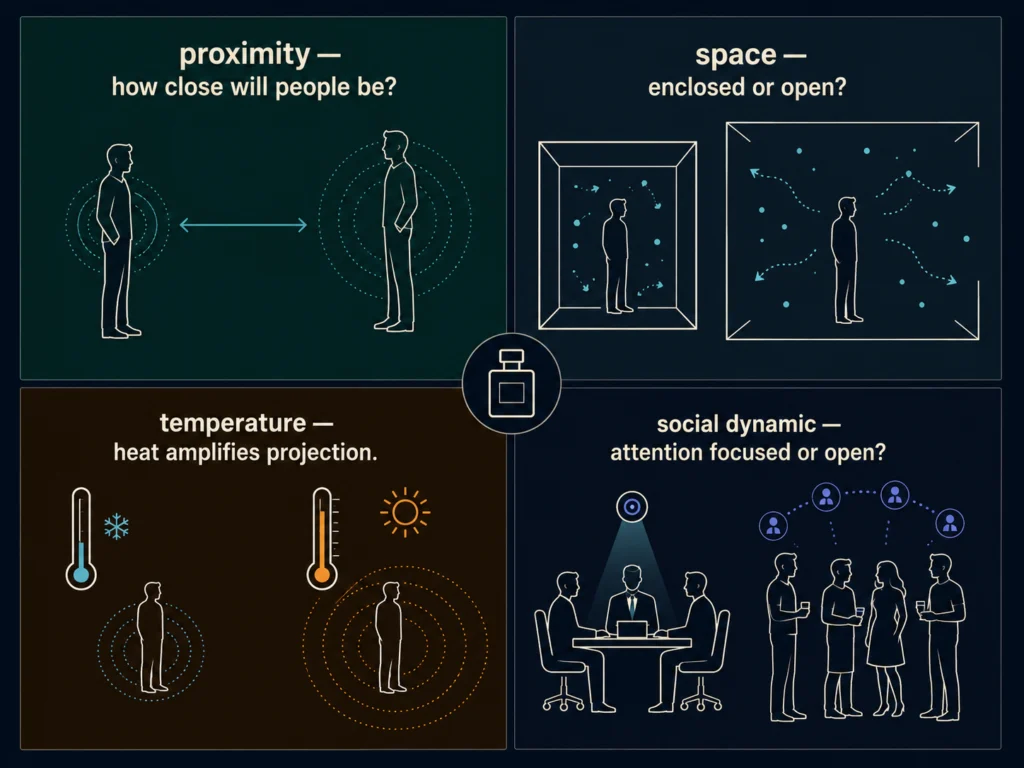
Proximity: How close will people be to you? Close proximity — a meeting table, a dinner table, a car — amplifies perceived projection dramatically. What reads as moderate outdoors reads as strong at arm’s length.
Space: Open or enclosed? Enclosed spaces trap aromatic molecules. The effective concentration of your fragrance increases as the space gets smaller and less ventilated.
Temperature: Warmer environments accelerate evaporation and increase projection radius. The same fragrance performs differently at 20°C vs. 35°C.
Social dynamic: What are people in this context doing with their attention? A professional context where people are trying to focus is different from a social context where sensory engagement is expected.
The foundational mechanisms behind how context shapes fragrance perception — including the crossmodal affective priming effect — are covered in [P00: The Psychology of Fragrance: How Scent Shapes the Way Men Think, Feel, and Are Perceived].
A Note on What This Guide Does and Doesn’t Tell You
This guide offers context-based reasoning, not universal rules. Individual cologne preferences, cultural norms, workplace culture, and personal chemistry all moderate what’s appropriate in any specific situation.
What the research does support firmly: excessive projection in enclosed spaces consistently produces negative reactions regardless of which fragrance is doing the projecting.
Context-inappropriate fragrance weight — heavy oriental at a daytime professional meeting, barely-there skin scent at an evening event — creates an impression mismatch. These are documented tendencies, not absolute laws.
Where the guide says “avoid,” read that as “this profile tends to produce problems in this context” — not “this profile is objectively wrong.”
Work and Professional Settings
The context: Enclosed or semi-enclosed office spaces, conference rooms, shared workspaces. Proximity varies from individual workstation (low) to packed conference room (high).
Temperature is typically controlled. The social dynamic is focused, professional, and not primarily about personal impression management.
The psychology: In professional contexts, fragrance serves a baseline function: signal cleanliness, hygiene, and presentability without demanding attention.
Research on scent and competence perception (Spence, 2021) shows that clean, fresh-smelling scents are most consistently associated with the competence and trustworthiness dimensions that matter in professional settings.1
The goal is presence without intrusion. A fragrance that makes a colleague pause at a shared printer because it’s overwhelming is a net negative — it takes attention that wasn’t invited and creates the impression that you’re unaware of your effect on others.
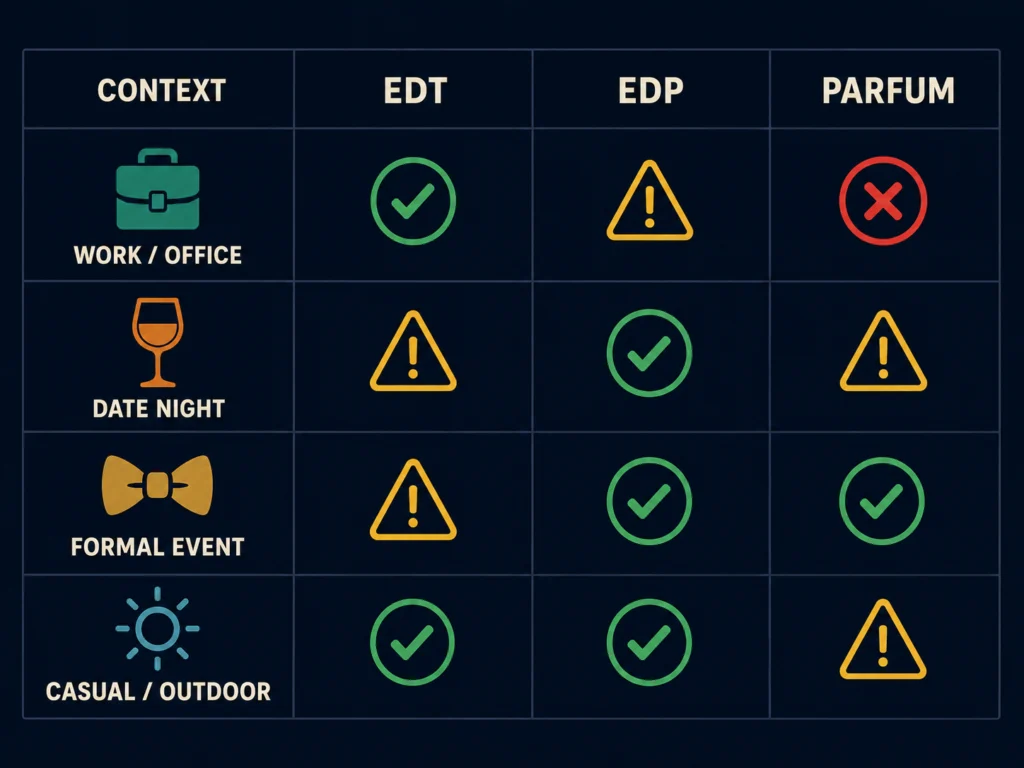
What works: Fresh, clean, and woody-fresh compositions with moderate projection. EDT concentration is preferable to EDP in most office contexts — lighter projection, closer to skin, less likely to persist in shared spaces.
Aromatic fougères, clean musks, and simple woody-citrus compositions all fit. They project competence without aggression.
What to limit: Heavy oriental and dense amber-resinous compositions project significantly and persist in enclosed air. Even well-formulated, high-quality orientals will overwhelm a small conference room.
The fragrance performing correctly is still the wrong tool for the job. Gourmand sweetness in professional contexts reads as oblivious to the environment rather than confident.
Concentration guidance: EDT or a lightly applied EDP of a fresh-woody composition. Two sprays maximum for enclosed office environments.
[CTA-1: Amazon affiliate CTA]
Two compositions that consistently perform in professional contexts without overstepping:
[PRODUCT LINKS — recommend: Bleu de Chanel EDT (fresh-woody, controlled projection) and Polo Ralph Lauren Blue EDT (clean aromatic, moderate sillage) — both available on Amazon]
For the specific case of a job interview — where projection control and enclosed-space dynamics are particularly consequential — see [A10: What Cologne to Wear to a Job Interview (And the Psychology Behind It)].
Date Nights and Intimate Social Settings

The context: Restaurants, bars, smaller social gatherings, evening events where physical proximity is expected and interpersonal connection is the goal.
Temperature varies. Space ranges from semi-enclosed (restaurant) to open (rooftop bar). The social dynamic explicitly involves personal impression.
The psychology: Musk and amber are the notes most directly relevant here.
Close-range projection — the quality of a fragrance that reveals itself to someone who leans in rather than announcing itself from across the room — is the mechanism most associated with intimacy and warmth.1
Fragrance that projects too far in a romantic context reads as trying too hard. Fragrance that is barely detectable misses the opportunity entirely. The target is calibrated presence at close range: noticeable when proximity increases, not before.
What works: Warm, amber-forward orientals with musk in the base. EDP concentration for an evening context where you want longevity into the late hours.
Woody-amber compositions that open cleanly and develop into a warm, intimate base over hours. These should sit close to skin with moderate sillage rather than projecting a meter into the room.
What to limit: Aquatic and fresh-only compositions tend to be top-note heavy — they project well in the first hour and fade before the evening develops.
For a 3-hour dinner, you want a fragrance that’s still present in the base notes at hour 2 and 3, not one that’s already gone.
Concentration guidance: EDP for evening. Apply 2–3 sprays — chest and neck are typically sufficient. Avoid over-application compensating for olfactory adaptation (if you can’t smell it anymore, that doesn’t mean others can’t).
The research on how scent shapes first impressions — including the specific mechanisms for close-range attraction signals — is covered in How Scent Shapes First Impressions in the First 30 Seconds.
[CTA-2: Amazon affiliate CTA]
Two EDP compositions built for exactly this context:
[PRODUCT LINKS — recommend: YSL Y EDP (bergamot/sage/amberwood — clean opening into warm base) and Dior Sauvage EDP (fresh-spicy opening into musk/ambroxan base — close-range presence) — both available on Amazon]
Formal Events
The context: Weddings, galas, corporate dinners, black tie. Typically larger spaces — hotel ballrooms, event venues — with varied proximity. Temperature is usually controlled.
The social dynamic involves multiple brief interactions with many people rather than sustained closeness with one.
The psychology: Formal contexts call for restraint and signal coherence. The impression goal is polished and considered, not distinctive or surprising.
Fragrance that projects well in a large space is more appropriate here than in an office, because the dispersal area is larger — but it should still read as composed rather than heavy.
Woody and resinous profiles read as grounded and reliable, which maps onto the social expectation of a formal event.
This isn’t peer-reviewed at the level of note-specific research — it’s the consistent consensus among perfumers and fragrance professionals that dry, composed profiles communicate differently than sweet or casual ones.
A fragrance that reads as eccentric or too casual in this context creates dissonance with everything else about the presentation.
What works: Classic aromatic fougères, woody-amber compositions, and well-structured orientals in EDP or Parfum concentration.
These profiles have genuine elegance without demanding attention. They project appropriately in larger spaces and develop into the evening as temperatures change.
What to limit: Very casual aquatic compositions read as underdressed in formal contexts — the olfactory equivalent of wearing trainers to a black-tie event.
Very heavy oud compositions can work for formal events but require precise application — too much in an enclosed pre-event gathering can create problems before the main space opens up.
Concentration guidance: EDP or Parfum for large formal spaces. The larger dispersal area supports higher-concentration formulations that would be inappropriate in smaller settings.
Casual Social Settings and Outdoors
The context: Weekend gatherings, outdoor events, casual dinners, daytime social occasions. Open or semi-open spaces, variable proximity, relaxed social dynamic.
The psychology: Casual contexts are the most forgiving. They allow for more distinctive choices — a niche fragrance you’d hesitate to wear to a client meeting, a gourmand composition that would be too casual for a formal dinner, something genuinely unusual.
The social dynamic doesn’t demand conformity to a professional or formal standard, which gives fragrance more room to express personality rather than just signal appropriateness.
Weather matters significantly here. Open-air summer gatherings call for lighter concentration and fresher compositions because heat amplifies projection. A fragrance that performs correctly at 20°C in light humidity can become overpowering at 32°C in direct sun.
For a full breakdown of how seasonal temperature changes affect which fragrance profiles perform best — and why the same fragrance that works in autumn can fail in summer — see [A09: Summer vs Winter Cologne — Why the Season Changes What Works].
What works: Fresh-woody and aromatic compositions for daytime. Oriental and amber for evening casual. EDT in warm weather; EDP in cooler seasons. More latitude for distinctive choices and personality expression.
What to limit: Very heavy, dense compositions in direct sunlight. Heat drives up projection radius dramatically and can turn a composition that’s elegant in the evening into an aggressively projecting presence at a midday outdoor gathering.
Concentration guidance: EDT for warm-weather outdoor events. EDP for evening casual in cooler temperatures.
The 2–3 Bottle Rotation That Covers Everything
Most men don’t need eight colognes. Two or three that cover distinct contextual registers without redundancy is enough.
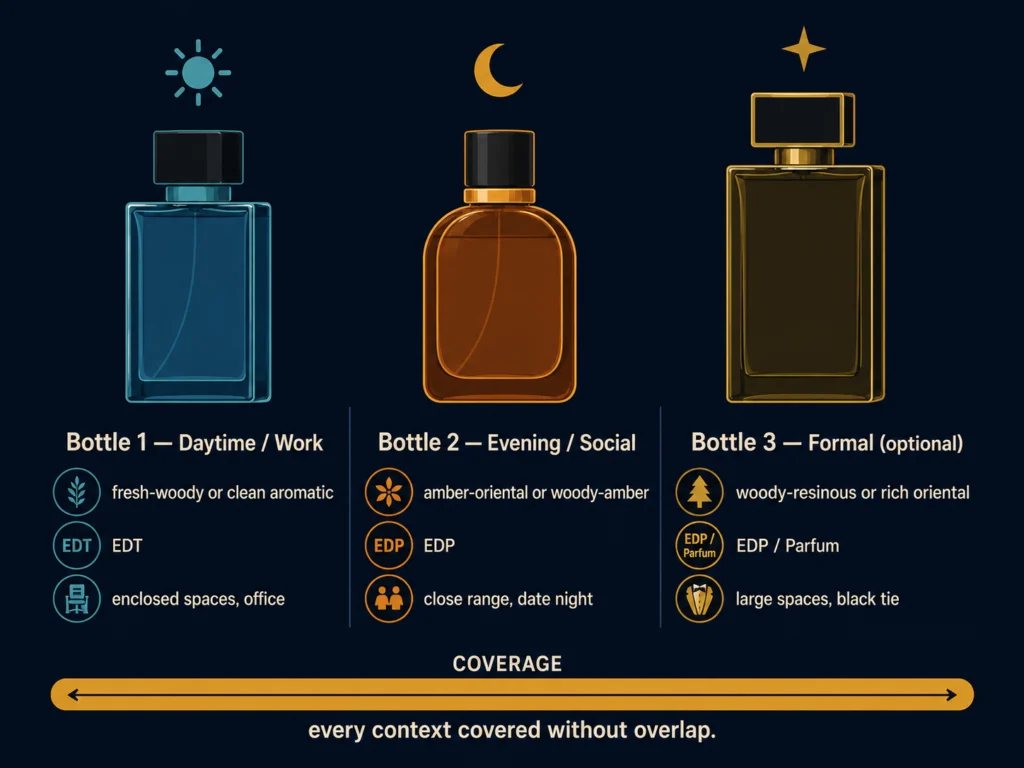
Bottle 1 — Daytime/professional: A fresh-woody or clean aromatic EDT that handles work, morning meetings, and daytime social events. Moderate projection, well-behaved in enclosed spaces, broadly appropriate.
Bottle 2 — Evening/social: A warm amber-oriental or woody-amber EDP for date nights, evening events, and social situations where personality expression matters more than professional restraint. Better at close range, more longevity into the evening.
Bottle 3 (optional) — Signature/formal: A richer, more distinctive composition in EDP or Parfum for formal events and special occasions. This can be something more distinctive than bottles 1 and 2 — the niche fragrance you’d hesitate to wear daily, or the classic composition that reads as particularly polished.
These three cover every situation in the guide above without overlap. The key is choosing bottles that are genuinely different from each other — different families, different projection profiles — rather than three variants of the same fresh-aquatic register.
For the personality signal perspective — what each fragrance family communicates to observers before you’ve spoken — see What Your Cologne Says About You Before You Say a Word.
For the mood regulation angle — how choosing a fragrance aligned with the emotional register of a situation affects your own internal state, not just how others perceive you — see [A11: Can Cologne Actually Improve Your Mood? What the Research Says].
FAQ
A clean, fresh-woody EDT with moderate projection. The goal is to signal cleanliness and competence without demanding attention. Fresh, aromatic, and light woody compositions handle professional environments without overwhelming shared or enclosed spaces. Keep application to 2 sprays maximum in office settings.
An EDP with warm base notes — musk, amber, sandalwood — that perform at close range rather than projecting across the room. The research on close-range attraction signals (musk and amber specifically) supports warm oriental and woody-amber compositions for evening social contexts. Apply to chest and neck, not wrists and neck simultaneously.
Yes. The crossmodal affective priming mechanism documented by Spence (2021) works negatively as well as positively — an overwhelming or contextually incongruent scent creates a negative perceptual frame that colors all other judgments. Excessive projection in an enclosed meeting room is the most common way this goes wrong in practice.
Fewer sprays than you think. 2 sprays for office and formal enclosed contexts. 2–3 sprays for evening and social contexts. The sensation of your own cologne disappearing (olfactory adaptation) doesn’t mean others can’t smell it — it means your receptors have adjusted to a constant stimulus. Adding more sprays to compensate is the most common cause of over-application.
The same fragrance performs differently in different temperatures — heat increases projection radius and accelerates evaporation. A composition appropriate for autumn will often project too aggressively in summer. Most men benefit from at least one lighter EDT for warm months and one richer EDP for cool months.
It depends on context. EDT offers lighter projection and 3–5 hours longevity — appropriate for office environments and daytime social contexts. EDP offers 5–8 hours longevity with richer base note development — better for evenings, cooler weather, and situations where you want the fragrance to last through a long day or evening without reapplication.
Conclusion
The question isn’t which cologne is best for a given occasion.
It’s what physical variables define that occasion — the size of the space, the proximity of other people, the temperature, the social dynamic — and which projection profile and fragrance weight are appropriate for those variables.
Crossmodal affective priming research confirms that a well-matched fragrance creates a positive perceptual frame that benefits everything about the interaction.
The same mechanism confirms that an incongruent or overwhelming fragrance creates a negative one. The choice of cologne for a specific context isn’t decoration — it’s a signal that either supports or undermines everything else about how you present.
A 2–3 bottle rotation covering daytime/professional, evening/social, and formal registers handles every situation most men encounter without requiring a different cologne for every sub-category.
[CTA-3: Amazon affiliate CTA]
If you’re building that rotation from scratch or filling a gap, a discovery set is the most efficient way to test multiple profiles on your actual skin across the fresh-woody, oriental, and amber registers before committing to full bottles:
[PRODUCT LINK — recommend: men’s multi-family fragrance discovery/sampler set, available on Amazon]
For the psychology of how EDT vs EDP concentration changes not just longevity but how your fragrance is socially perceived across the arc of a day — see [A23: EDT vs EDP vs Parfum — What the Difference Means for How Others Perceive You].

We research the psychology behind fragrance and grooming. Every article on this site is built on peer-reviewed research, tested on real skin, and written to explain the why behind what works.
Learn more on our About page.
Footnotes
- Spence, C. (2021). The scent of attraction and the smell of success: crossmodal influences on person perception. Cognitive Research: Principles and Implications, 6(1), 46. https://doi.org/10.1186/s41235-021-00311-3 ↩ ↩2 ↩3 ↩4
- Distel, H., Ayabe-Kanamura, S., Martínez-Gómez, M., Schicker, I., Kobayakawa, T., Saito, S., & Hudson, R. (1999). Perception of everyday odors — correlation between intensity, familiarity and strength of hedonic judgement. Chemical Senses, 24(2), 191–199. https://doi.org/10.1093/chemse/24.2.191 / Moskowitz, H.R., Dravnieks, A., & Klarman, L.A. (1976). Odor intensity and pleasantness for a diverse set of odorants. Perception & Psychophysics, 19(2), 122–128. https://doi.org/10.3758/BF03204218} ↩ ↩2