
- A job interview is one of the few situations where your fragrance can actively work against you, not just fail to help.
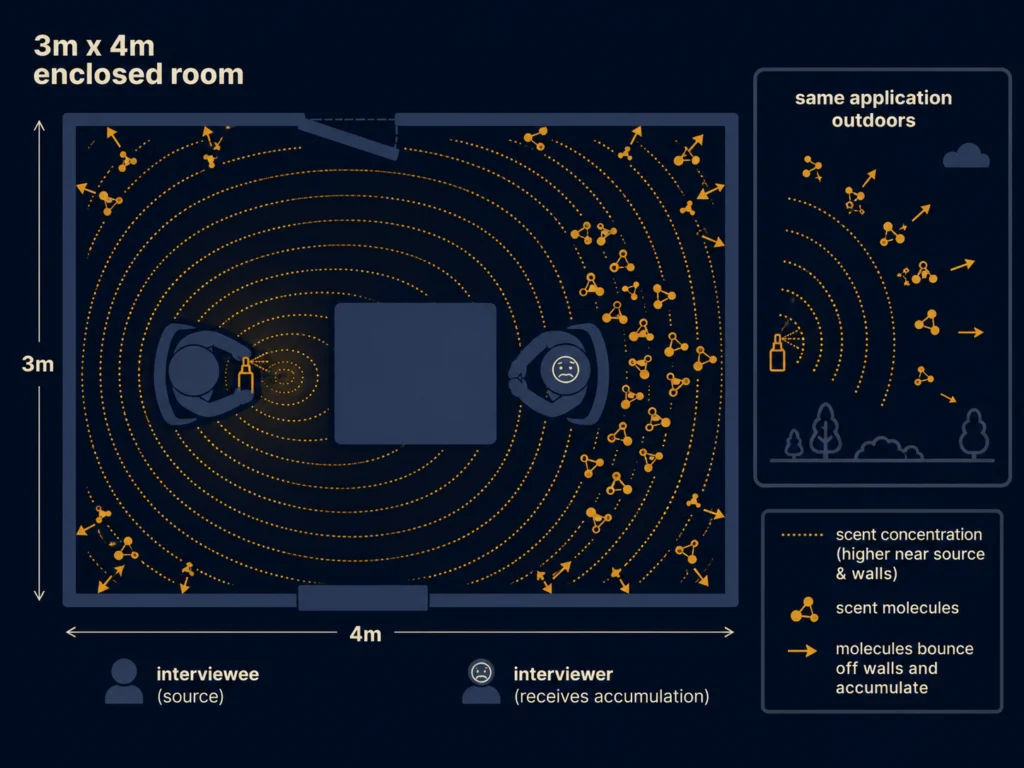
- Small enclosed rooms trap aromatic molecules. What reads as moderate projection in open air becomes high-concentration exposure at close quarters.
- Research by Spence (2021) at Oxford confirms that pleasant fragrance improves competence and trustworthiness ratings, but the crossmodal effect works negatively when scent overwhelms or reads as contextually inappropriate.
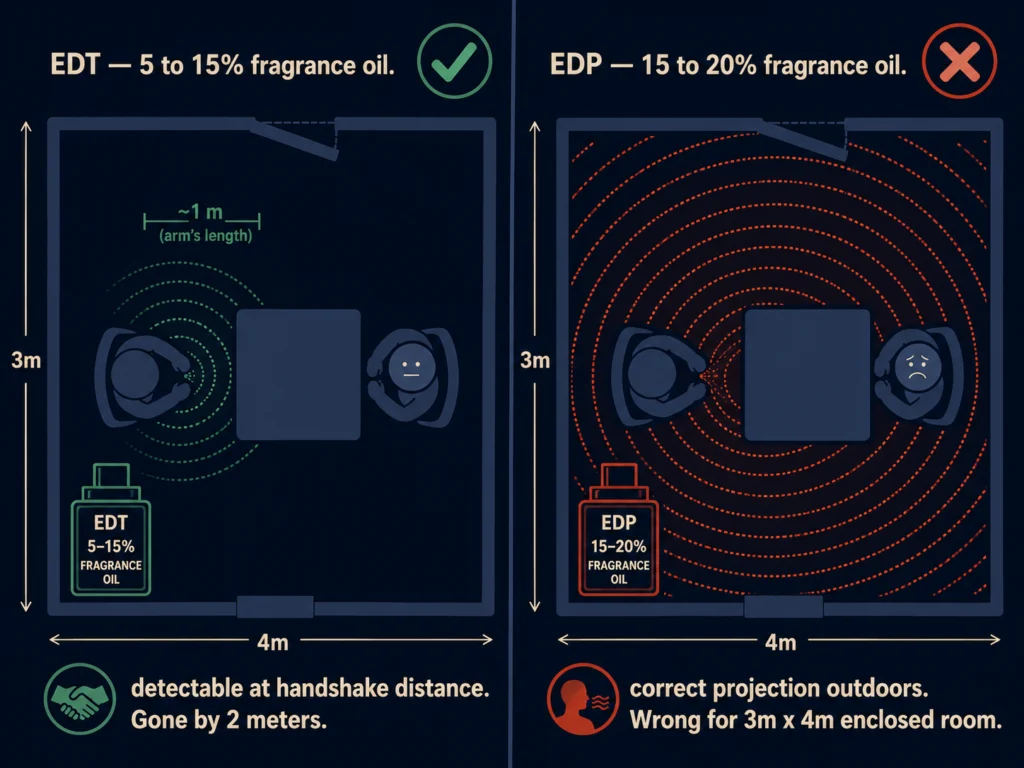
- The target is detectable at handshake distance, gone by two meters. That maps to 1 to 2 sprays of an EDT on covered skin.
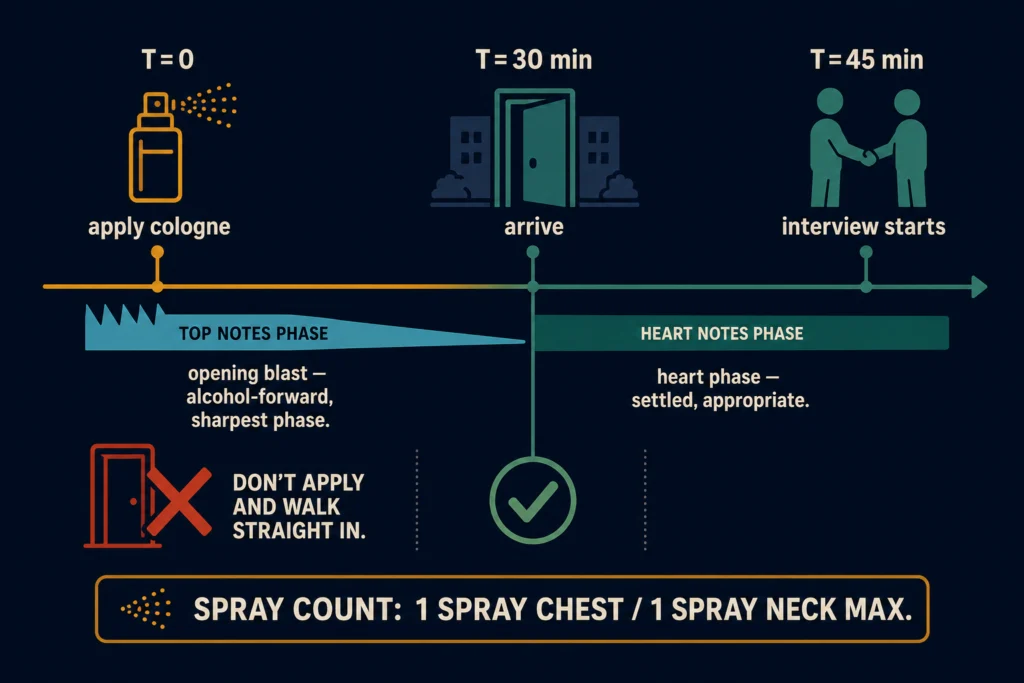
- Apply 30 minutes before the interview, not on the way out the door. Let the top notes settle before you walk in.
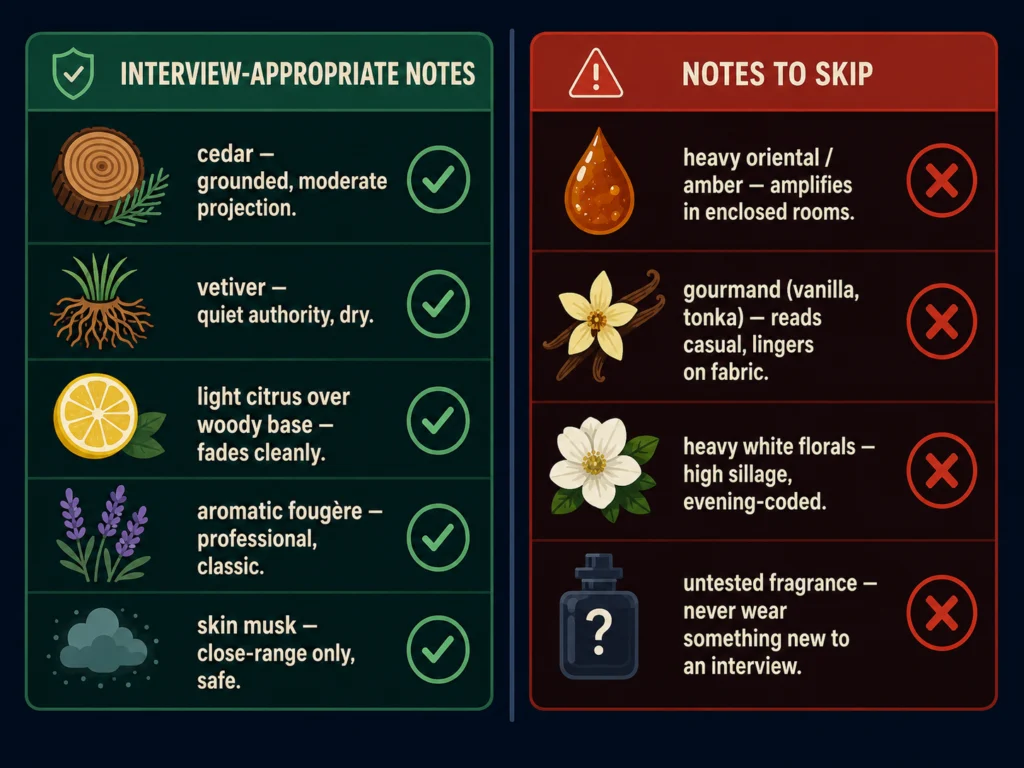
- Note profiles that work: clean woods (cedar, vetiver), fresh aromatic, light citrus over a woody base. Profiles to skip: heavy oriental, dense amber, anything gourmand.
- Two specific product recommendations are at the bottom.
Most advice on interview cologne lands in one of two places: “wear something subtle” (vague) or a list of product names with no explanation of why they work.
Neither is useful. This article explains the specific context you’re walking into, what scent perception research says happens there, and which choices follow from that.
The Room Changes the Rules
An interview usually happens in one of three places: a small private office, a conference room, or a glass-walled meeting room with limited ventilation. All three share the same properties that make fragrance a different calculation than in open air.
Enclosed spaces trap aromatic molecules. There is no airflow to disperse the scent, no room for projection to expand before it reaches someone.
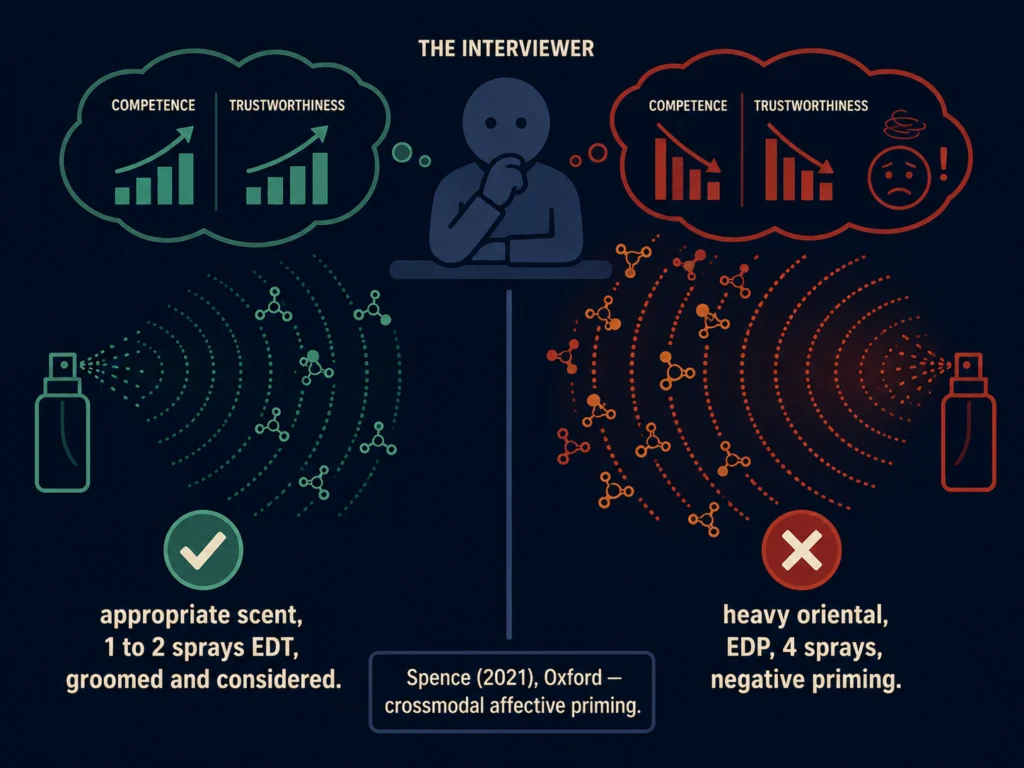
A fragrance that reads as moderate in an open environment reads as significantly stronger in a sealed room. A two-spray EDP that performs correctly outdoors on a spring afternoon can dominate a 3-meter-by-4-meter interview room within 10 minutes.
The interviewer across the table has no choice about what they’re inhaling. In a casual first meeting, someone can step back, change position, or leave. In an interview room, they sit there for 30 to 60 minutes, in a confined space, at 1 to 2 meters from you.
The crossmodal affective priming mechanism documented by Spence (2021) works in both directions: a pleasant, appropriate scent lifts your ratings on competence and trustworthiness, but an overwhelming or mismatched scent lowers them.1
Fragrance that is too strong, too sweet, or reads as evening-coded in a professional context produces a negative perceptual effect, not a neutral one.
The goal is to smell considered, not impressive.
For the full breakdown of how scent shapes first impressions through the limbic system, including the three judgment axes (attractiveness, approachability, competence) affected by fragrance, see How Scent Shapes First Impressions in the First 30 Seconds.
- The Room Changes the Rules
- What You’re Actually Trying to Communicate
- A Note on What This Article Can and Can’t Tell You
- The Concentration Question
- Note Profiles That Work in Interviews
- Note Profiles to Skip
- Two Specific Recommendations
- What to Do If Your Workplace Has a Scent-Free Policy
- FAQ
- Conclusion
- Footnotes
What You’re Actually Trying to Communicate
In any interview, you’re making a case that you’re competent, reliable, and someone worth working with. Fragrance should support that case without adding noise.
Research on scent and professional perception shows that clean, fresh-smelling compositions are most consistently associated with the competence and trustworthiness signals that matter in professional contexts.1
These aren’t vague impressions. The olfactory signals hit the amygdala before conscious processing begins, meaning the interviewer forms a scent-based judgment before they’ve consciously evaluated anything you’ve said.
The notes most associated with that signal: cedar, vetiver, clean musk, light citrus, and soft aromatic herbs like lavender. These smell groomed and settled. They don’t demand attention. They don’t suggest you got dressed for a nightclub.
Heavy oriental compositions, dense amber, warm gourmand (vanilla, caramel, tonka), and anything formulated for evening projection read as mismatched to a daytime professional context.
That mismatch creates cognitive dissonance. The interviewer may not identify it consciously, but the perception that “something is off” is a real outcome.
Context coherence is the point. The right fragrance for an interview is the one that never becomes a topic of thought during the interview.
For the research on what different fragrance families communicate about personality and professional status, including why woody profiles read as grounded and reliable, see What Your Cologne Says About You Before You Say a Word.
A Note on What This Article Can and Can’t Tell You
The research on scent and professional perception establishes reliable tendencies, not guarantees.
Individual interviewers have different scent sensitivities, different preferences, and different cultural associations with fragrance. Some people have fragrance allergies. Some workplaces have scent-free policies.
What the evidence supports firmly: excessive projection in enclosed spaces consistently produces negative reactions regardless of which fragrance is doing the projecting. A heavy oriental that smells excellent on a Saturday evening is the wrong formulation for an interview room.
What it can’t tell you: whether a specific fragrance at a specific application level will produce a specific response in a specific interviewer. The recommendations below are directionally well-grounded, not universal certainties.
The Concentration Question
EDT (Eau de Toilette) is the right concentration for most interviews.
EDT contains 5 to 15% fragrance oil, consistent across fragrance houses globally. On most skin types, it lasts 3 to 5 hours with moderate projection: detectable at close range, not projecting across the room.
For a 45-minute interview in a small room, that performance profile is correct. You get presence at handshake distance without filling the space.
EDP (Eau de Parfum) at 15 to 20% fragrance oil is usually too much for a small professional room, particularly for compositions with significant amber or musk in the base.
The exception is a lightly formulated EDP from a house known for restrained sillage. Some skin-scent EDPs project less than a standard EDT. Test your specific bottle before using it in an interview context.
Parfum and Extrait are effectively always wrong for this setting.
Application:
- 1 to 2 sprays maximum. One spray on the chest, one on the neck if you want more presence. Not wrists, neck, and chest simultaneously.
- Apply to covered skin where possible. Fabric diffuses the scent more gently than direct skin projection.
- Apply 30 minutes before the interview. The opening top notes of any fragrance are the sharpest, most alcohol-forward phase. By 30 minutes in, the heart has settled and the projection has stabilized. Walking into a room while your cologne is still in its opening phase is the most common cause of over-projection in professional settings.
For the full breakdown of what EDT vs EDP concentration differences mean for how a fragrance is perceived across the arc of a day, including projection timelines, see [EDT vs EDP vs Parfum — What the Difference Means for How Others Perceive You].
Note Profiles That Work in Interviews
Cedar and vetiver
Both are dry, woody base notes that read as grounded and composed. Vetiver in particular signals quiet authority without aggression. Cedar is slightly warmer and more accessible.
Compositions built around these notes project conservatively and develop in a way that stays appropriate throughout a morning or afternoon interview.
Clean citrus over a woody base
Bergamot, grapefruit, and neroli open clean and fade to a light woody base. The citrus top notes clear within 20 to 30 minutes, leaving you with a fresh, restrained presence rather than a sharp opening blast. This is exactly what you want after applying 30 minutes early.
Aromatic fougère
Lavender, coumarin, light wood: classic structures that smell like deliberate grooming. They read as professional, clean, and reliable. No polarizing elements. Nothing that suggests you made a fragrance statement rather than a practical choice.
Soft musk
Skin-scent musks project minimally, staying close to the body rather than filling the room. Used in compositions like Commodity Book or Bleu de Chanel EDT, they create a clean, pleasant presence at close range that is almost impossible to over-apply.
Note Profiles to Skip
Heavy oriental and amber
Oud, dense amber, incense, benzoin: these are formulated for projection in large spaces and cold air. In a small interview room at room temperature, they amplify significantly. An oud composition you wore correctly to a winter dinner will dominate a standard office interview.
Gourmand (vanilla, caramel, tonka, chocolate)
Gourmand sweetness reads as casual and socially oriented, appropriate for a date, not a professional evaluation. Dense vanilla and tonka in particular linger on fabric and persist long after the interview ends.
Heavy white florals
Tuberose, gardenia, heavy jasmine: these tend toward high sillage and are generally coded as personal or social rather than professional.
Anything you’ve never worn before
Don’t wear a new fragrance to a job interview. Untested means you don’t know how it develops on your skin over 2 to 3 hours, how much it projects in an enclosed space, or how it smells after the top notes have cleared. An interview is not the place to find out a cologne goes stale on your skin by hour two.
Two Specific Recommendations
These are fragrances that consistently perform in professional enclosed-space contexts: clean, grounded, moderate projection, appropriate as EDT formulations.
Bleu de Chanel EDT
Bergamot and citrus opening, ginger heart, cedar and sandalwood base with labdanum and white musk. The EDT version specifically is lighter than the EDP or Parfum, which makes it correct for interview contexts.
It projects moderately at arm’s length and fades gracefully. Broadly appropriate across industries and age groups. Available on Amazon in 50ml and 100ml.
Terre d’Hermès EDT
Orange and grapefruit opening over flint, vetiver, and cedar. Drier and more mineral than Bleu de Chanel. Reads as precise and considered without being showy. The vetiver base signals composure. EDT concentration is right for enclosed professional spaces. Available on Amazon.
[PRODUCT LINKS — Bleu de Chanel EDT and Terre d’Hermès EDT, both available on Amazon]
If you prefer something closer to the skin with even less projection risk:
Commodity Book Personal EDP
Sandalwood, cedarwood, black tea, vetiver, and skin musk. Formulated specifically as a low-projection “Personal” intensity, so the sillage stays within arm’s reach. One of the few EDPs appropriate for a small interview room because of its deliberate skin-scent formulation.
[PRODUCT LINK — Commodity Book Personal EDP, available on Amazon]
What to Do If Your Workplace Has a Scent-Free Policy
Many workplaces, particularly healthcare, education, and some legal environments, either ask employees to avoid fragrance or actively prohibit it.
If the role you’re interviewing for is in one of these environments, or if you genuinely don’t know the company’s policy, skip cologne entirely.
A good unscented deodorant handles the baseline hygiene signal. Showing up without fragrance is not a mistake.
Showing up with fragrance at a scent-free workplace signals that you either didn’t research the environment or decided your preference overrides the workplace’s norms. Neither impression helps in a first meeting.
If you’re unsure, check the company’s website or Glassdoor for any mention of workplace culture around fragrance. When in doubt, go without.
For the broader framework on matching fragrance to context across professional and social situations, including the psychology of why context mismatch produces negative impressions, see How to Match Your Cologne to the Occasion — A Psychology-Based Guide.
FAQ
Yes, with restraint. A clean, low-projection EDT worn at 1 to 2 sprays and applied 30 minutes before the interview supports the groomed, prepared impression you’re trying to make. The risks are over-application, wrong formulation for a small space, and choosing a fragrance that reads as evening or casual rather than professional. All three are avoidable with the choices covered above.
1 to 2 sprays of an EDT on covered skin (chest or neck, not both wrists, neck, and chest together). Apply 30 minutes before entering the building, not while walking from the car. The top note phase of any fragrance is the sharpest and most alcohol-forward. You want that phase done before you sit across from anyone.
EDT. The lower concentration (5 to 15% fragrance oil) produces lighter projection that doesn’t compound in enclosed spaces. EDP can work if the specific formulation has low sillage, but you need to have tested your specific bottle in an enclosed space first. Unknown EDP projection in an interview room is a real risk.
Heavy oriental bases (oud, dense amber, incense), gourmand sweetness (vanilla, caramel, tonka), and heavy white florals (tuberose, gardenia). These are all appropriate fragrances in the right context. A small professional room in the middle of a workday is not that context.
Your strong fragrance is for other contexts. An interview is not the setting to express fragrance personality. The goal is for the interviewer to remember your qualifications and answers, not your cologne. Wear something low-projection for the interview. Wear whatever you like the rest of the time.
No. Not wearing fragrance is a neutral choice. The only fragrance-related mistake in an interview is wearing one that creates a negative impression through over-projection, contextual mismatch, or triggering a sensitivity reaction in the interviewer.
Conclusion
The interview room is an enclosed space with no exit for the person evaluating you. That physical reality changes the fragrance calculation completely.
Pleasant fragrance, applied at the right concentration and level for the context, supports positive competence and trustworthiness ratings. This is documented in Spence’s crossmodal research at Oxford.
The same mechanism works negatively when the scent is overwhelming or reads as mismatched. The difference between those two outcomes is application volume, concentration choice, and timing.
EDT, 1 to 2 sprays, applied 30 minutes early, on a clean woody or fresh aromatic profile. Bleu de Chanel EDT and Terre d’Hermès EDT are the most reliable executions of it at accessible price points.
If you’re uncertain about the workplace culture, don’t wear cologne at all.
For the complete framework on how scent influences perception across all social contexts, not just professional ones, see [The Psychology of Fragrance: How Scent Shapes the Way Men Think, Feel, and Are Perceived].

We research the psychology behind fragrance and grooming. Every article on this site is built on peer-reviewed research, tested on real skin, and written to explain the why behind what works.
Learn more on our About page.
Footnotes
- Spence, C. (2021). The scent of attraction and the smell of success: crossmodal influences on person perception. Cognitive Research: Principles and Implications, 6(1), 46. Documents the bidirectional crossmodal affective priming effect on competence, trustworthiness, and attractiveness ratings. https://doi.org/10.1186/s41235-021-00311-3 ↩ ↩2 ↩3