

- Most men choose cologne by smelling the top notes in a store, on a paper strip, within the first five minutes. This evaluates the least representative part of any fragrance.
- The note pyramid matters: top notes evaporate in 20–45 minutes, heart notes develop from 30 minutes to 2 hours, and base notes — where your body chemistry has the most influence — emerge from 1–3 hours and persist.
- A peer-reviewed 2012 PLOS ONE study confirmed that fragrances interact with individual body chemistry to produce a mixture unique to each person — and that people who wore their preferred fragrance produced blends rated as more pleasant than randomly assigned ones.
- Start with fragrance families, not specific bottles. Narrowing from eight families to two or three that resonate with you filters 500+ available options down to a manageable field.
- The 30-minute rule and the 3-hour rule: evaluate on skin at both checkpoints before deciding anything.
- Consistency builds value over time. The Roberts et al. (2009) study showed the behavioral and social effects of fragrance compound with repeated use. A signature worn daily does something a rotating collection can’t.
Most men find their cologne one of two ways. Either someone gave them a bottle and they kept wearing it.
Or they walked into a store, sprayed a few things on paper strips, picked whatever smelled best in the first 30 seconds, and bought that.
Both approaches consistently produce the wrong result — not because the cologne is necessarily bad, but because neither method evaluates what actually matters: how the fragrance performs on your specific skin, over several hours, in the contexts where you’ll wear it.
Finding a signature scent is worth doing properly. The research on what consistent fragrance use actually does — for how you feel, how you perform, and how other people remember you — depends on it being the right scent for you.
At Mascudo, this guide is built on that research and on the mistakes we’ve seen men make repeatedly when choosing cologne, including ones we made ourselves early on.
- Why the Standard Approach Fails
- Step 1 — Start With Families, Not Bottles
- Step 2 — Test on Skin, Not Paper
- Step 3 — The 30-Minute Rule and the 3-Hour Rule
- Step 4 — Test in Context
- Step 5 — The Preference Effect: Why Liking It Matters More Than You Think
- Step 6 — Committing to a Signature
- Building From One Signature to a Small Rotation
- FAQ
- Conclusion
- Footnotes
Why the Standard Approach Fails
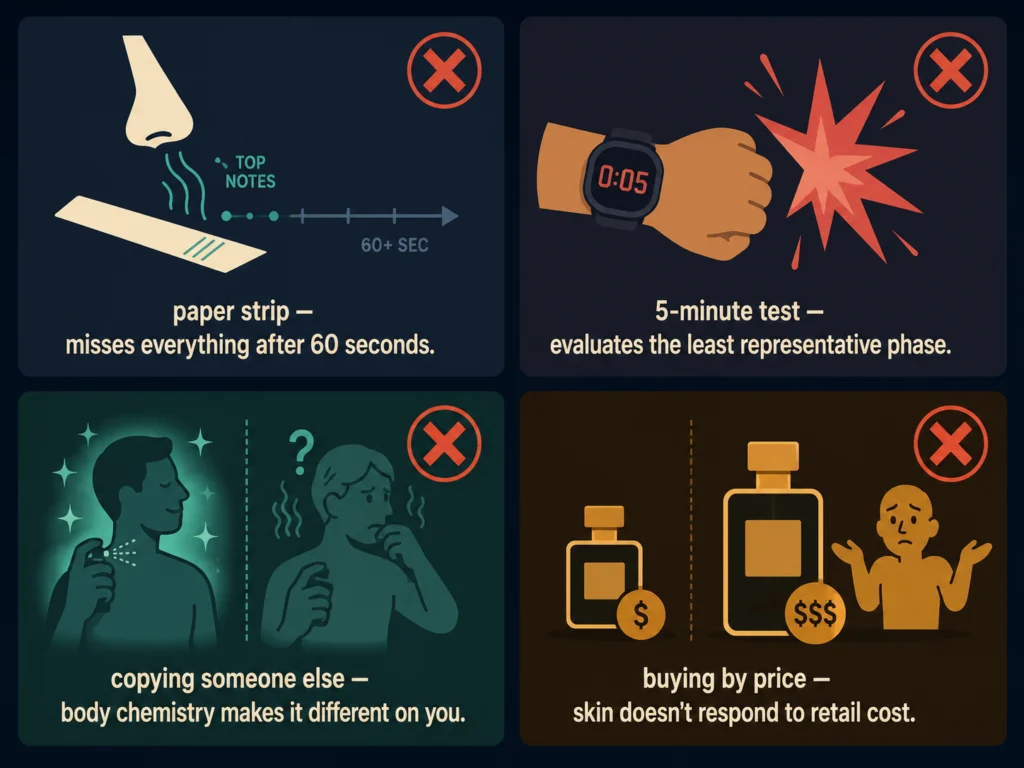
Paper strips tell you what a fragrance smells like for the first 60 seconds, in isolation from any skin chemistry, without any heat or sebum to interact with. They capture the top notes and nothing else.
First-five-minutes evaluation on skin captures the top note blast — the most volatile molecules evaporating all at once. This is typically the sharpest, most synthetic-smelling phase of any fragrance.
Many excellent compositions smell overwhelming or one-dimensional in the first five minutes and develop into something completely different by hour two.
Choosing by what smelled good on someone else ignores the most important variable: your body chemistry.
Lenochová et al. (2012) at Charles University Prague, the University of Stirling, and the University of Vienna confirmed in a peer-reviewed PLOS ONE study that fragrances interact with individual body odor to produce a perceptually distinct, person-specific blend.1
The cologne on your friend’s skin is a different olfactory result than the same cologne on yours.
Choosing by brand or price conflates marketing with performance.
A fragrance at four times the price won’t necessarily smell better on you than one at a quarter of the cost. Skin chemistry doesn’t respond to retail price.
None of these approaches is wrong in isolation — they can narrow the field. But none of them answers the only question that matters: how does this fragrance develop on my skin, over three hours, in my typical contexts?
The full science behind why the same cologne performs differently on different people — skin pH, sebum, body temperature, microbiome — is covered in Why Cologne Smells Different on You Than on Anyone Else.
Step 1 — Start With Families, Not Bottles
There are hundreds of men’s fragrances on the market at any given time. Evaluating them individually is inefficient and unnecessary.
The first step is to narrow from the full field to the two or three fragrance families that align with your personality, your typical contexts, and the signal you want to send.
Fragrance families are broad olfactory categories based on the dominant character of a composition.
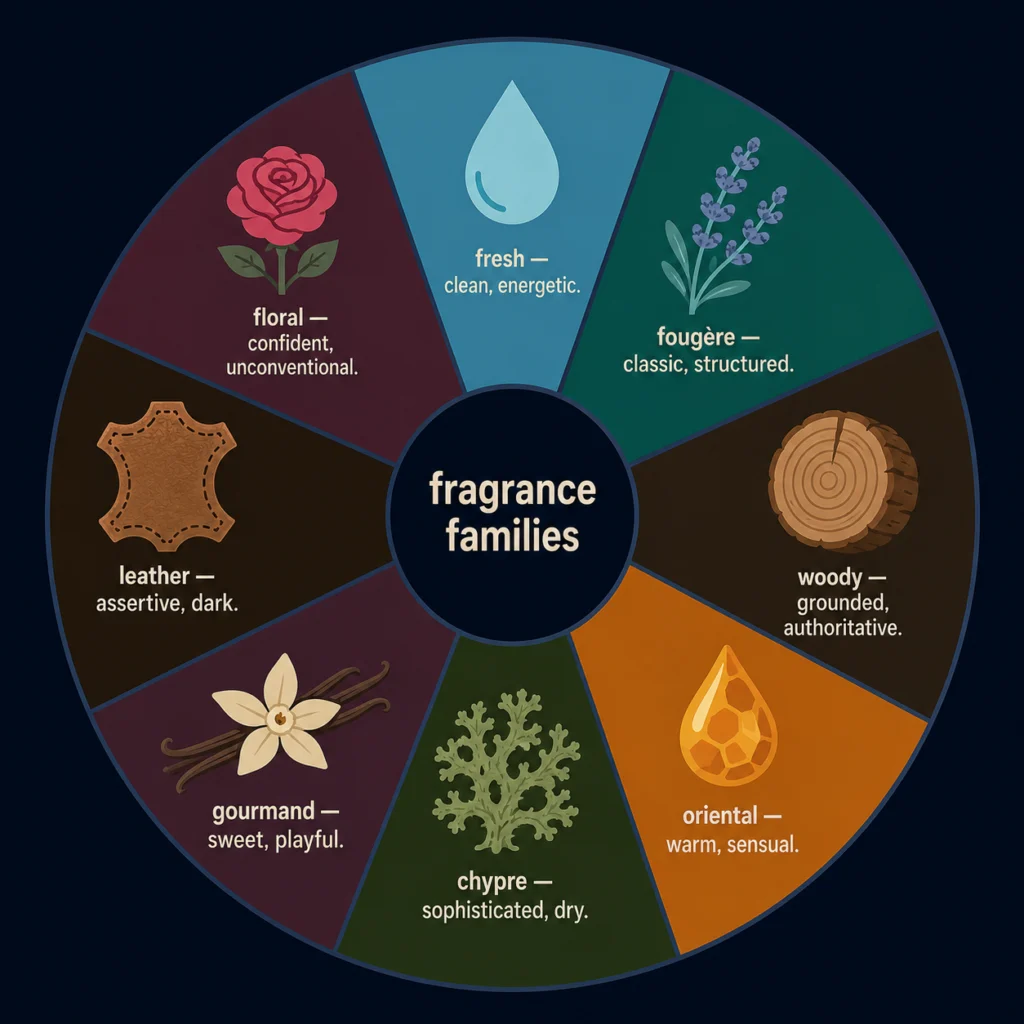
The classification system originally developed by perfumer and critic Michael Edwards — first published in 1984 as The Fragrance Manual and refined over subsequent decades — is now the standard reference framework used by fragrance houses, critics, and retailers.2
The eight main families relevant to men’s fragrance:
Fresh — Citrus, aquatic, green, and ozonic compositions. Light, clean, energetic. Strong top note phase, lighter base. Signal: approachable, clean, low-key. Contexts: daytime, professional, warm weather.
Aromatic/Fougère — Lavender, coumarin, oakmoss, herbs. A distinctly masculine family historically. Structured, clean with herbal depth. Signal: classic, reliable, comfortable. Contexts: professional, casual daily wear.
Woody — Cedar, sandalwood, vetiver, oud, guaiac wood. Complex base-note-dominant profiles. Signal: grounded, composed, authoritative. Contexts: professional, evening, all-season.
Oriental/Amber — Amber, resins, spices, vanilla, balsams. Rich, warm, dense. Significant sillage and longevity. Signal: warm, deliberate, sensual. Contexts: evening, cold weather, formal, social.
Chypre — Oakmoss, labdanum, bergamot, patchouli. Complex, dry, earthy, elegant. Signal: sophisticated, independent, distinguished. Contexts: formal, evening, cool weather.
Gourmand — Vanilla, caramel, chocolate, coffee, tonka. Sweet, foodlike. Signal: playful, warm, approachable — and polarizing. Contexts: casual, evening, cold weather.
Leather — Birch tar, leather accord, smoke, tobacco. Distinctive, assertive. Signal: rugged, dark, individualistic. Contexts: evening, cool weather, occasions where distinctiveness is the goal.
Floral — Typically considered a women’s category but increasingly worn by men, particularly rose, iris, and white floral compositions. Signal: surprising, confident, culturally aware. Contexts: social, evening, for men comfortable with an unconventional choice.
How to use this list: Read through the eight descriptions and identify which two or three resonate with who you are and where you typically spend your time.
If you work in a corporate environment and value restraint, fresh and woody are likely your territory.
If you lean toward evening social contexts and want presence, oriental and chypre are worth exploring.
If you’re new to fragrance and want the easiest starting points, fresh and fougère.
This narrows the field from hundreds of options to a specific subset — which is what you actually need before walking into a store or ordering samples.
For a deeper dive into each fragrance family — what the notes actually are, what psychological signals they send, and one product example per family — see [A22: The 8 Fragrance Families Decoded — What Each One Communicates Psychologically].
Step 2 — Test on Skin, Not Paper
Once you’ve identified your two or three target families, the next step is skin testing — and it requires actual skin, not paper.
The most efficient method is a fragrance discovery set.
These are multi-vial samplers of between 6 and 20 fragrances, typically 1–2ml per vial, sometimes from a single house and sometimes curated across multiple brands.
A single purchase gives you enough volume to do proper extended skin evaluation across several days — far more useful than 15 minutes at a department store counter.
Apply one fragrance per arm per session, maximum two per session.
Testing more than two simultaneously makes individual evaluation impossible — the compositions interfere with each other and with your ability to isolate what each is doing.
Rest your nose between evaluations by breathing through your sleeve (your own neutral body scent) or sniffing coffee beans, which interrupt olfactory adaptation without introducing a competing scent.
Spray on pulse points and leave it alone.
The most common evaluation mistake is rubbing the wrists together after applying. Friction generates heat and breaks down aromatic molecules faster than normal evaporation, distorting the drydown. Apply and leave it.
[CTA-1: Amazon affiliate CTA]
A discovery set is the single most efficient investment in finding the right cologne — far more useful than buying a full bottle based on 30 seconds in a store:
[PRODUCT LINK — recommend: a men’s multi-house fragrance discovery/sampler set covering woody, fresh, and oriental families, available on Amazon]
Step 3 — The 30-Minute Rule and the 3-Hour Rule
These are the two evaluation checkpoints that most men skip, and they explain most poor fragrance purchases.
At 30 minutes: The top notes have largely evaporated. You’re now smelling the heart of the fragrance — the florals, spices, aromatics, or woods that form the core of the composition — as they begin to interact with your skin.
This is the fragrance’s working phase: what it will smell like for most of the first two hours.
Ask yourself at 30 minutes: Do I want to smell this for the next several hours? Not “is it interesting” or “is it impressive” — those are top note reactions. Is this something I’d be comfortable wearing all day?
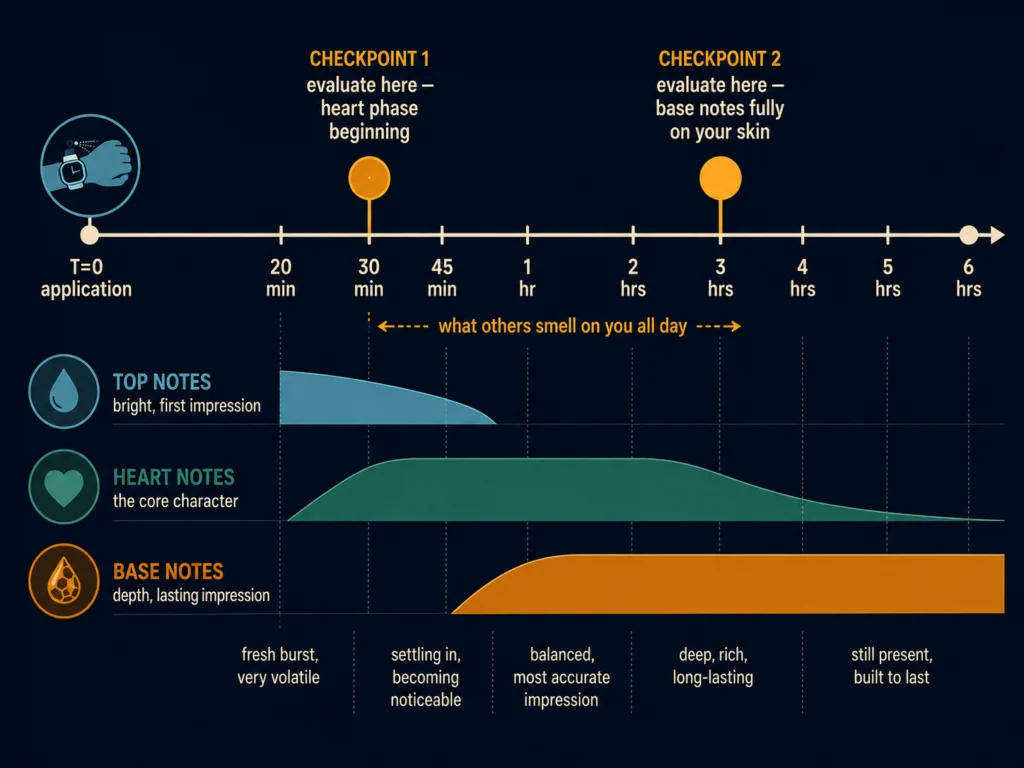
At 3 hours: You’re in the base notes. The heavier molecules — woods, musks, ambers, resins — have fully developed and are now bonded to your skin.
This is where your individual body chemistry exerts the most influence on the result.
Two men wearing the same fragrance can smell quite different by hour three, because of the interaction between their specific skin chemistry and the base note ingredients.
This is also what other people smell on you throughout the day — not the opening blast, but the base note drydown.
Evaluating a fragrance only in the first 30 minutes is like judging a meal by the smell from the kitchen before you’ve tasted it.
A fragrance that excites you at opening but becomes cloying, flat, or simply wrong by hour three is not the right fragrance for you, regardless of how the top notes performed.
If both checkpoints work — top notes you find engaging, drydown you want to keep wearing — you have a real candidate. If either checkpoint fails, move on.
Step 4 — Test in Context
Home evaluation — spraying in isolation — gives you valuable data but misses one variable: how the fragrance performs in the environments where you’ll actually wear it.
Temperature matters. The same base that reads as perfectly calibrated in your air-conditioned apartment can project aggressively in a warm office in July. Wear a test fragrance in your typical daily context before committing to a full bottle.
Social feedback matters, with a caveat. If you wear a fragrance sample on a day you’ll be around people you trust to give honest reactions, that feedback is genuinely useful.
Unsolicited positive reactions are the best validation you can get. But be cautious about negative reactions in the first 30 minutes, which may reflect top note intensity rather than the developed fragrance.
Context appropriateness matters too. A fragrance that performs beautifully on a Saturday afternoon may not be appropriate for your Monday morning context.
Evaluate your candidate fragrance against the specific contexts where you’ll wear it most frequently.
For the full breakdown of which fragrance profiles work in which contexts — and the psychology behind why — see How to Match Your Cologne to the Occasion — A Psychology-Based Guide.
Step 5 — The Preference Effect: Why Liking It Matters More Than You Think
The Roberts et al. (2009) study published in the International Journal of Cosmetic Science found that men who expressed a preference for their allocated fragrance showed stronger behavioral improvements than men who were neutral about it.3
The confidence feedback loop that produces observable changes in non-verbal behavior is amplified when the wearer genuinely likes the scent.
The Lenochová et al. (2012) study reinforced this from a different angle: when participants wore their own preferred fragrance, the resulting blend with their body chemistry was rated as more pleasant than the blend produced by a randomly assigned fragrance — even when both fragrances were rated equally pleasant in isolation.1
The implication is direct: the fragrance you genuinely prefer performs better on you than one you chose because it’s supposed to be excellent, or because it performed well on someone else, or because it appeared on a “best cologne” list.
Your own response to the scent isn’t a secondary consideration. It’s a primary variable in the outcome.
This is the argument against choosing cologne based purely on external validation — reviews, compliments on someone else’s bottle, fragrance forum recommendations.
These are useful for narrowing the field. They don’t tell you whether the fragrance is right for you.
Step 6 — Committing to a Signature
A signature scent is not the best fragrance in the world. It’s the fragrance that works consistently well on your skin, fits the contexts where you spend most of your time, and that you genuinely want to reach for every day.
Scent memory research makes the case for commitment over variety: odor-evoked memories are more emotionally vivid than memories triggered by any other sense, and a fragrance worn consistently across meaningful interactions builds a scent-identity association that a rotating collection cannot.4
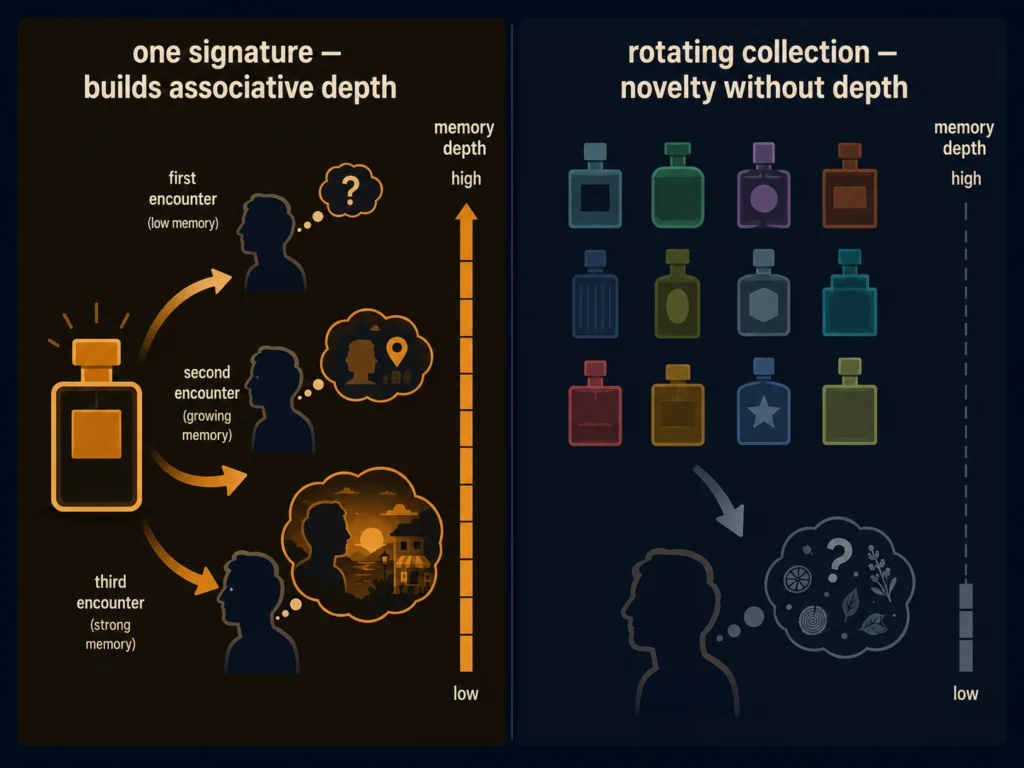
People carry a specific, emotionally rich version of you in memory — associated with a specific scent.
Wearing a different cologne every week produces novelty. It doesn’t build the associative depth that makes someone’s memory of you vivid and emotionally textured years later.
A practical test for whether you’ve found your signature: Would you buy a backup bottle before the current one runs out? If yes without hesitation, that’s the right fragrance. If you’re ambivalent about what you’d replace it with, you haven’t found it yet.
For the full neuroscience of how consistent fragrance use builds memory associations in the people around you — and why this matters more than having an impressive collection — The Science of Scent Memory: Why Your Cologne Can Define You in Someone’s Mind.
Building From One Signature to a Small Rotation
A single signature is the goal. But most men eventually find themselves with legitimate reasons for more than one bottle — different contexts that genuinely call for different profiles, seasonal variation, or a formal composition they use rarely.
The healthy rotation is two to three bottles, each clearly distinct from the others. Not two fresh aquatics with slightly different openings — two bottles that cover genuinely different registers, so each one serves a purpose the other can’t.
The practical structure that works for most men: one daytime/professional bottle, one evening/social bottle, and optionally one for formal or special occasions. These three cover most situations without redundancy.
The mistake is accumulating bottles — buying interesting fragrances without a clear sense of where each one fits. A collection of twelve bottles that all serve the same register isn’t twelve times as useful as one.
It’s one bottle with eleven alternatives that don’t add coverage.
For the specific technique of building a unique scent identity through layering — using compatible compositions together to create a result that belongs only to you — see [A12: How to Layer Cologne — The Psychology and the Technique].
For the personality-signal perspective on fragrance family selection — what each family communicates to observers before you’ve spoken — see What Your Cologne Says About You Before You Say a Word.
FAQ
Start with your personality and your most frequent contexts. Fresh and fougère families work across the widest range of situations and are the lowest-risk starting point. Woody families suit men who value groundedness and authority and tend to perform better on drier skin. Oriental and amber families suit evening and social contexts more than professional ones. Most men find their strongest affinity in one or two families after testing across the spectrum.
Test until you find one that passes both the 30-minute and 3-hour skin evaluations and that you’d choose to wear the following day. Some men find their signature in the first discovery set. Others test 20 or 30 samples across multiple families. There’s no correct number — the checkpoints are the standard, not the quantity tested.
Always sample first, especially for fragrances above $100. The failure mode is buying a 100ml bottle based on a good store experience or a positive review, only to find the drydown doesn’t work on your skin. A 1–2ml sample tested properly over an extended skin evaluation costs a fraction of the full bottle and gives you far better data.
The term “signature” implies one — a consistent, recognizable association that builds in the memories of people who interact with you regularly. In practice, most men end up with a 2–3 bottle rotation covering different contexts. The key is that each bottle serves a distinct contextual purpose, not that you have exactly one fragrance forever.
Not inherently. Price reflects ingredient quality, concentration, brand positioning, and bottle design — not necessarily how well a specific fragrance will perform on your skin or in your life. The Lenochová et al. (2012) research found that the quality of the fragrance-body chemistry blend determines how pleasant the result is, not the cost of the fragrance going into it.
Evaluate at 30 minutes and 3 hours on skin. If both checkpoints are positive, wear it in your typical daily context for one full day before making a final decision. If either checkpoint is negative — if the drydown at 3 hours doesn’t work on you — move on without further investment.
Conclusion
Finding a signature scent is a process, not a single decision. The process has six steps: identify your target fragrance families, test on skin rather than paper, evaluate at the 30-minute and 3-hour checkpoints, test in your actual contexts, confirm that you genuinely prefer it over alternatives, and commit to wearing it consistently.
The research on fragrance and personal chemistry establishes that the result — how your fragrance develops over hours on your specific skin — is different from how it performs on anyone else or on any paper strip. The only way to know is to test properly.
The research on fragrance and memory establishes why commitment matters once you’ve found the right one. A scent worn consistently across meaningful interactions builds an associative richness in the people around you that novelty and variety cannot produce.
The goal is one bottle you reach for without thinking, because it’s the right bottle for you. Everything in this guide is aimed at finding that.
[CTA-2: Amazon affiliate CTA]
Once you’ve identified your target family and want to test properly on skin — a curated discovery set covering the major fragrance families is the most efficient starting point:
[PRODUCT LINK — recommend: a men’s fragrance discovery set spanning woody, oriental, and fresh families, available on Amazon]

We research the psychology behind fragrance and grooming. Every article on this site is built on peer-reviewed research, tested on real skin, and written to explain the why behind what works.
Learn more on our About page.
Footnotes
- Lenochová, P., Vohnoutová, P., Roberts, S.C., Oberzaucher, E., Grammer, K., & Havlíček, J. (2012). Psychology of fragrance use: Perception of individual odor and perfume blends reveals a mechanism for idiosyncratic effects on fragrance choice. PLOS ONE, 7(3), e33810. https://doi.org/10.1371/journal.pone.0033810 ↩ ↩2 ↩3
- Edwards, M. (1984, revised annually). Fragrances of the World (originally published as The Fragrance Manual). Michael Edwards & Co. The fragrance wheel — first published in the 1992 edition — is the industry-standard classification framework referenced by Fragrantica, Basenotes, and major fragrance houses. https://www.fragrancesoftheworld.com ↩ ↩2
- Roberts, S.C., Little, A.C., Lyndon, A., Roberts, J., Havlicek, J., & Wright, R.L. (2009). Manipulation of body odour alters men’s self-confidence and judgements of their visual attractiveness by women. International Journal of Cosmetic Science, 31(1), 47–54. https://doi.org/10.1111/j.1468-2494.2008.00477.x ↩ ↩2
- Herz, R.S., Eliassen, J., Beland, S., & Souza, T. (2004). Neuroimaging evidence for the emotional potency of odor-evoked memory. Neuropsychologia, 42(3), 371–378. https://doi.org/10.1016/j.neuropsychologia.2003.08.009 ↩ ↩2