


- In a published study, researchers sprayed a room with fragrance before participants arrived, then asked them to rate strangers across 10 personality attributes — including charm, confidence, and sexual interest — from photographs alone. The scent changed the ratings, but only when the gender of the fragrance matched the gender of the face being rated. The participants didn’t know why.
- Scent signals personality before any other input. It operates below conscious awareness, which makes it harder to control and more influential than most men realize.
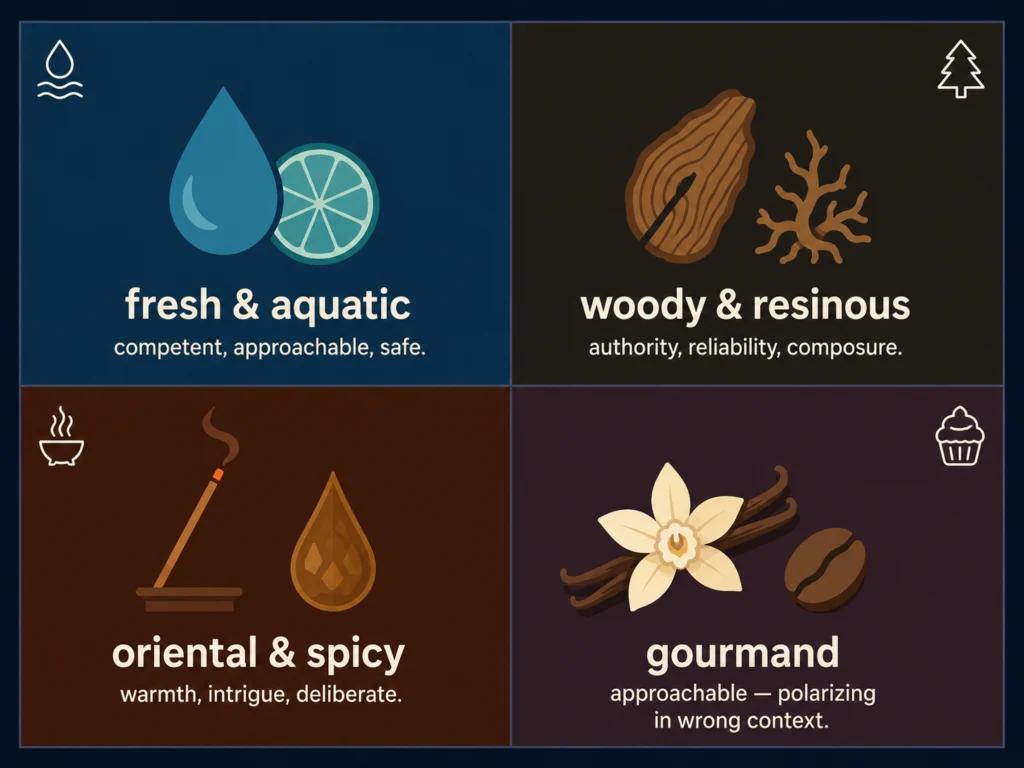
- Each fragrance family produces a consistent set of personality reads in observers: fresh/aquatic signals competence and approachability; woody signals authority and reliability; oriental signals warmth and intrigue; gourmand polarizes.
- Niche fragrance sends a different signal than designer — not about quality, but about in-group knowledge and deliberate identity.
- The practical application isn’t to manipulate people. It’s to make sure the signal you’re sending matches who you actually are.
You haven’t spoken yet. You’re across the room, or just walked in, or leaned past someone to reach something.
In that moment, before eye contact, before body language, before a word — you’ve already communicated something.
Scent travels faster than any of those other signals. It hits the brain through a direct anatomical route that bypasses conscious processing.
By the time someone has formed a thought about you, their olfactory system has already filed a report.
The research on what that report says is specific enough to be useful.
At Mascudo, we’ve tested a lot of fragrances across a lot of contexts — and the pattern holds: what you wear changes how a room receives you before you’ve done anything else.
- The Study That Started This Conversation
- A Note on What This Research Can and Can’t Tell Us
- Fresh and Aquatic: The Competence Signal
- Woody and Resinous: Authority and Reliability
- Oriental and Spicy: Warmth, Intrigue, Deliberateness
- Gourmand: The Signal That Polarizes
- Niche vs. Designer: A Different Signal Entirely
- Using This Deliberately Without Overthinking It
- FAQ
- Conclusion
- Footnotes
The Study That Started This Conversation
In 2010, Capparuccini, Berrie, and Mazzatenta published a study that has since been cited in Oxford’s landmark review of crossmodal person perception.1 The design was simple and the implications were not.
Researchers sprayed a room with one of two Givenchy fragrances — a men’s fragrance (Pi Neo) or a women’s fragrance (Angel or Demon) — before participants arrived.
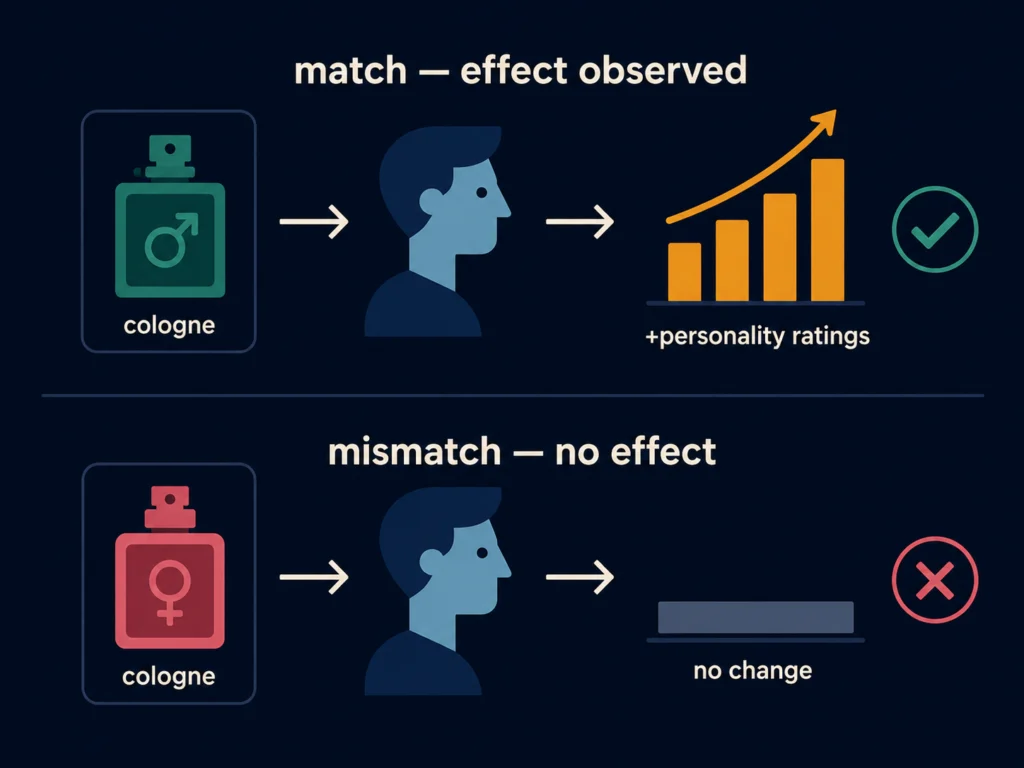
No mention of the scent was made. Participants then rated photographs of faces across 10 personality attributes using Likert scales: familiarity, confidence, liking, irritability, beauty, pleasantness, charm, intensity, sexual interest, and sexual attraction.
The fragrance changed the ratings — but with an important condition: the effect was significant only when the gender of the face in the photograph matched the gendered fragrance in the room.
A male fragrance amplified ratings of male faces; a female fragrance amplified ratings of female faces. Cross-gender pairings produced no significant effect.
This is the foundational finding: scent influences personality perception through crossmodal affective priming, and that priming is congruence-dependent.
When the scent matches the context — including the gender of the person wearing it — it creates a positive perceptual frame that colors every judgment made within it. When it doesn’t match, the effect disappears.
Apply that to personal fragrance, worn on the body rather than sprayed into a room. The mechanism is the same, at closer range, with greater intensity.
The crossmodal mechanism — how olfactory signals reach the brain before conscious thought — is covered in full in [P00: The Psychology of Fragrance: How Scent Shapes the Way Men Think, Feel, and Are Perceived].
A Note on What This Research Can and Can’t Tell Us
What it establishes clearly: Pleasant fragrance changes how people judge others across multiple personality dimensions, provided the scent is contextually congruent.
This is documented in peer-reviewed research across multiple labs and methodologies.
What it can’t tell us with precision: Exactly which fragrance note produces which specific personality read in a given observer, under controlled conditions, with statistical confidence.
That level of precision doesn’t exist in the published literature. Anyone claiming otherwise is overstating the science.
What the research does support — and what perfumers, psychologists, and fragrance professionals have documented consistently — is that fragrance families produce reliable clusters of associations in observers.
These associations are culturally informed, contextually variable, and not universal. But they’re consistent enough to be actionable.
The section below is built on that combination: verified research mechanisms and well-documented industry consensus on fragrance family associations.
Where the evidence is strong, we say so. Where it’s experiential or consensus-based, we say that too.
Fresh and Aquatic: The Competence Signal
Fresh fragrances — citrus, green, aquatic, and clean aromatic compositions — are the most common category in men’s fragrance. There’s a reason for that.
They consistently signal qualities that read as socially safe and professionally appropriate: cleanliness, approachability, energy, and competence.
Research on scent and perceived cleanliness consistently shows that fresh, clean-smelling scents are associated with higher ratings of health, hygiene, and social trustworthiness.2
In contexts where first impressions and professional credibility matter — job interviews, new client meetings, formal introductions — fresh fragrance is the low-risk, high-signal option.
The competence association comes partly from cultural conditioning (fresh = clean = cared-for = capable) and partly from the fact that fresh fragrances don’t demand attention. They suggest someone who has their baseline together without needing to announce it.
The limitation: Ubiquity. Fresh and aquatic fragrances are so common in men’s grooming that they’ve become baseline expectation rather than distinguishing signal.
A man wearing a generic fresh aquatic sends a neutral signal, not a positive one. It reads as “uses cologne” rather than “this is who he is.”
Fresh fragrance works best when the composition has genuine character — when there’s something in the drydown beyond the first-hour aquatic blast.
Citrus-forward openings that develop into a distinctive heart and base communicate something more than their more generic counterparts.
In short: fresh fragrance is the safest signal in men’s cologne, and that’s both its strength and its ceiling.
It works best where you need to be read as capable and non-threatening, which covers most professional and daytime contexts. The trade-off is that it’s rarely memorable.
For the research on how scent shapes first impressions in the first 30 seconds — including how fresh/clean notes interact with competence judgments — see How Scent Shapes First Impressions in the First 30 Seconds.
Woody and Resinous: Authority and Reliability
Woody fragrances — cedar, sandalwood, vetiver, patchouli, guaiac wood — sit at a different register than fresh. They are grounded, complex, and tend to be dry rather than sweet. They don’t disappear in 30 minutes. They persist.
The personality associations with woody fragrance families cluster around authority, stability, and reliability.
No peer-reviewed study has isolated this to woody notes specifically — the research on scent and dominance deals with body odor chemistry rather than fragrance families.
What does exist is consistent, long-standing consensus among perfumers and fragrance professionals: dry, grounded profiles read differently from sweet or light ones, and the difference maps onto how observers perceive the wearer’s social presence.
Woody notes project an impression of someone settled in themselves, not seeking approval, not trying to please everyone in the room.
Vetiver specifically — dry, earthy, slightly smoky — is the note most consistently associated with composed authority rather than aggression.
It’s not dominant in a confrontational sense. It’s more precise than that: it reads as someone who doesn’t need to raise their voice.
Cedar and sandalwood are warmer and more accessible than vetiver but carry similar groundedness signals.
They pair well with other note families — fresh top notes can sit on a cedar/sandalwood base and produce a fragrance that opens as approachable and develops into something more substantive.
Woody fragrance is the right choice when composure matters more than energy: professional settings where authority is an asset, evening wear, any context where you’d rather be read as settled than eager.
It’s not a first-meeting crowd-pleaser. It rewards people who get close enough and stay long enough to notice.
If you want to experience the woody register before committing to a bottle — Guerlain Vetiver EDT is the reference point for dry vetiver authority. Terre d’Hermès EDT bridges woody-mineral into something more complex. Both are available on Amazon:
[PRODUCT LINKS — Guerlain Vetiver EDT / Terre d’Hermès EDT on Amazon]
[Affiliate link — full disclosure at /affiliate-disclosure]
Oriental and Spicy: Warmth, Intrigue, Deliberateness
Oriental fragrances — amber, incense, resins, spices, warm vanilla, oud — are the most polarizing category in men’s fragrance.
They are also, when worn correctly, the most distinctive.
The personality reads associated with oriental fragrance cluster around warmth, confidence, and deliberateness.
A man wearing a well-constructed oriental — something like Guerlain’s Habit Rouge, or a well-formulated oud composition, or a classic amber oriental like YSL Opium Pour Homme — signals that he is comfortable taking up olfactory space.
He made a choice. He isn’t deferring to generic consensus.
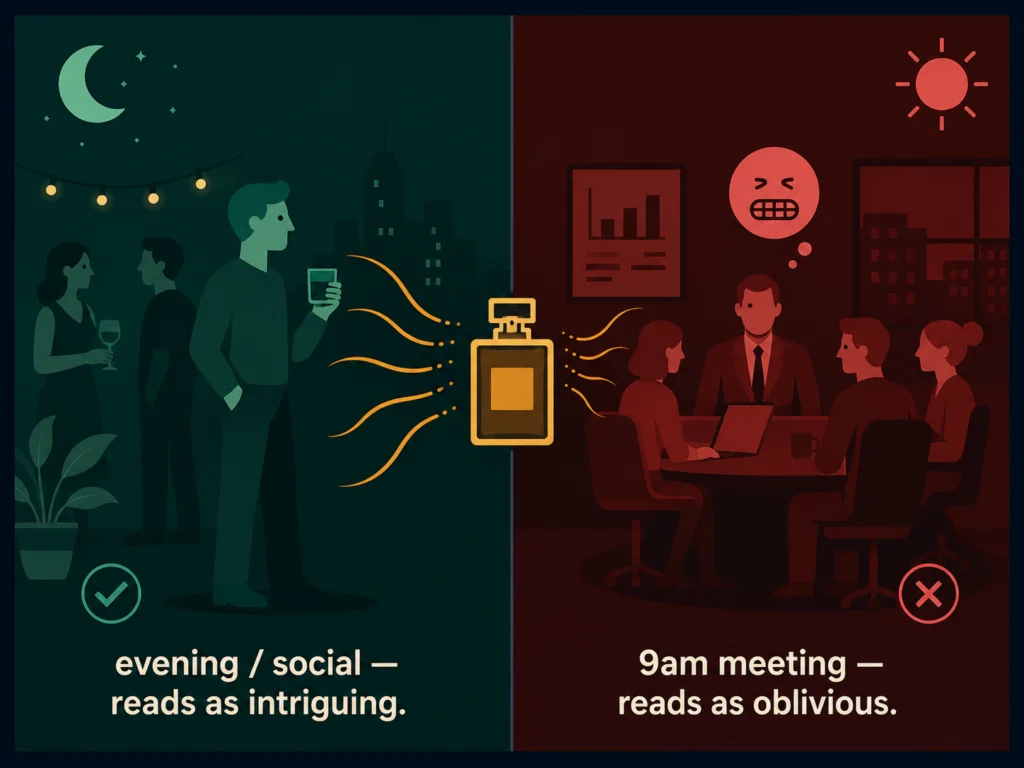
That signal is high-variance. In the right context, it reads as interesting, sensual, and self-possessed. In the wrong context — an overpowering cloud in a small office, a heavy oud at a casual daytime gathering — it reads as inconsiderate or oblivious to social norms.
Heavy oriental fragrances with significant projection can push into dominance coding, which has its own effects in certain contexts but actively undermines approachability in others.
The difference between “intriguing” and “overwhelming” is mostly about projection control and context matching.
Oriental fragrance is high-variance by design. Wear it in the right context — evening, cold weather, somewhere with space to breathe — and it reads as self-possessed and interesting.
Wear it at a 9am team meeting and it reads as oblivious. The cold weather note is practical, not aesthetic: lower ambient temperature slows evaporation and keeps projection in check.
For the specific research on how dominance signals in fragrance play differently in different contexts — and how to choose between authority and approachability depending on what a situation calls for — see [A14: Dominance vs Approachability: Choosing the Psychological Register of Your Scent].
Gourmand: The Signal That Polarizes
Gourmand fragrances — heavy vanilla, caramel, chocolate, tonka, dessert-type sweetness — are a specific personality signal worth addressing separately, because they’re poorly understood.
The personality association with gourmand fragrance is comfort and approachability, but at the cost of authority.
Gourmand notes read as warm and inviting in an immediate, unpretentious way. They’re broadly pleasant. They rarely intimidate.
The polarization comes from context. Gourmand fragrance on a man in a casual social setting, worn with restraint, can read as confident enough to ignore convention and interesting in its unexpectedness.
The same fragrance in a professional context, at full projection, reads as juvenile or unaware. The gap between those two reads is wide.
There’s also a quality gradient that matters more in gourmand than in other families. Cheaply made gourmands smell like synthetic candy.
Well-formulated gourmands (Thierry Mugler’s A*Men, for example, or the better vanilla-forward orientals from Serge Lutens) use sweetness as part of a complex composition where other notes — coffee, tobacco, patchouli, woods — provide counterweight.
The difference in personality signal between these two categories is significant.
Gourmand is the most context-sensitive family in this list. A well-formulated one worn with restraint in a casual evening setting can be genuinely interesting.
At full projection in a professional context, it’s a problem. If you wear gourmand: fewer sprays than you think, and never before noon.
Niche vs. Designer: A Different Signal Entirely
One dimension of fragrance personality signaling that the basic family categories don’t capture is the niche versus designer distinction.
Wearing a widely available designer fragrance (Bleu de Chanel, Dior Sauvage, Giorgio Armani Acqua di Giò) sends a different social signal than wearing a niche fragrance most people won’t recognize. Neither is better. They communicate different things.
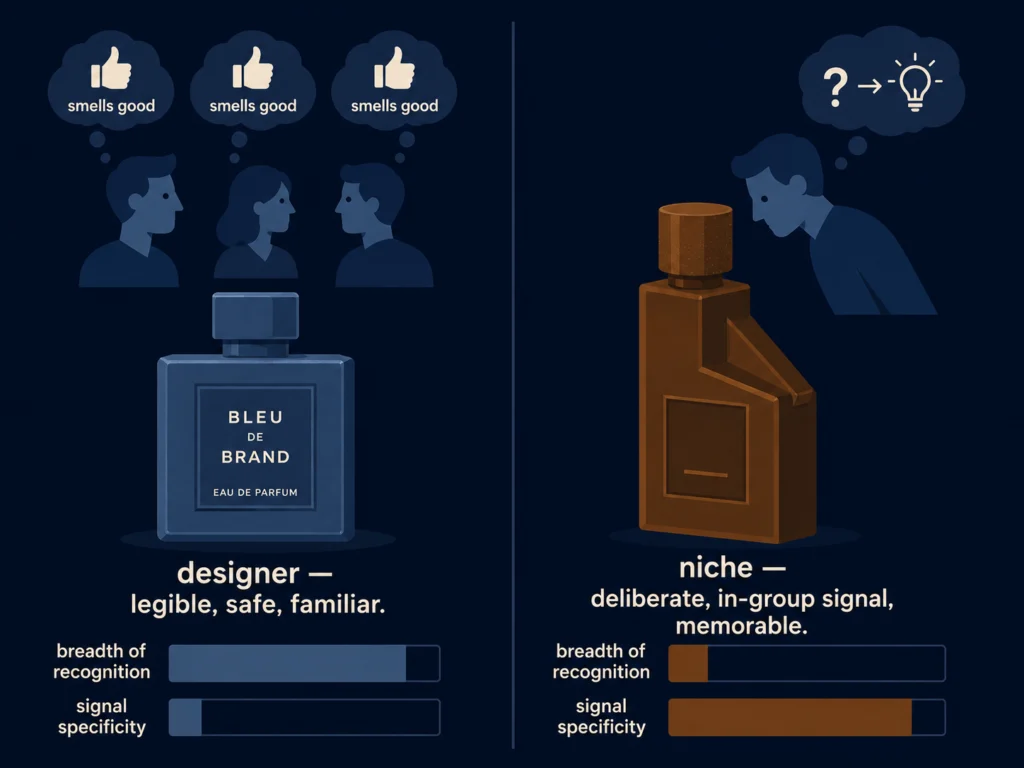
Designer fragrance signals: familiar, accessible, connected to mainstream culture, safe.
The fragrance equivalent of wearing a well-known clothing brand. It’s known, legible, and meets baseline expectations without making a strong statement about individual taste.
Niche fragrance signals: deliberate choice, in-group knowledge, willingness to invest in personal expression beyond brand recognition.
Circana data from 2024–2025 shows that prestige and luxury fragrance is growing faster than mass-market alternatives — and Gen Z is driving a significant share of that growth, with fragrance spending among teenage boys rising 44% in 2024 alone.
The appeal is built on identity and self-expression, not brand recognition in the traditional sense.3
This doesn’t mean niche is “better.” It means it sends a different signal.
The person who notices your Le Labo or Amouage knows something about fragrance. The interaction that follows is different from one where they simply recognize that you smell good.
For the signal to work, the fragrance still has to smell good on you. Wearing an obscure niche fragrance that’s wrong for your body chemistry or the context sends no useful signal — it just smells wrong.
For the broader context on why men’s relationship with fragrance has shifted — and why deliberate fragrance choices carry more signal weight now than they did a decade ago — see [A16: Masculinity and Scent: Why Men Avoided Fragrance (And Why That’s Changing)].
Using This Deliberately Without Overthinking It
The research doesn’t suggest you should reverse-engineer a cologne choice from a personality matrix.
That approach produces misalignment — wearing a fragrance because it “signals authority” when you don’t feel like yourself wearing it is exactly the wrong move.
The confidence effect documented in the Roberts et al. study depends on you genuinely liking what you’re wearing.
What the research does support is using this information to audit your current choices:
Does the signal match the context? A heavy oriental at a casual 9am meeting and a generic aquatic at a formal evening event are both mismatches. Not catastrophic, but not deliberate either.
Does the signal match who you are? If you’re someone with a dry, precise sense of humor who values composure, a loud gourmand is a strange choice.
If you’re warm, sociable, and direct, a cold austere vetiver soliflore might be technically excellent but communicationally off.
Is the signal legible? Wearing something genuinely interesting that develops well on your skin and produces a distinctive trail is worth pursuing.
Wearing something obscure that smells wrong on you just to send an in-group signal is not.
If you’re in the process of finding a fragrance that actually reflects who you are — rather than what the cologne counter defaulted you into — testing across families is the most reliable method. A curated sampler set gives you real skin tests across multiple profiles:
[PRODUCT LINK — recommend: a men’s fragrance discovery set spanning woody, oriental, and fresh families, available on Amazon]
[Affiliate link — full disclosure at /affiliate-disclosure]
FAQ
Yes — but through a specific mechanism. Research shows that ambient scent alters personality judgments of people in photographs, even when participants aren’t aware of the scent. Critically, the effect only holds when the gender of the fragrance matches the gender of the person being judged. The mechanism is crossmodal affective priming: a congruent, pleasant scent creates a positive perceptual frame that colors all judgments made within it. Capparuccini et al. (2010), reviewed by Spence (2021) at Oxford, documented this across 10 personality attributes.
Niche and oriental fragrances tend to produce the strongest and most specific personality reads — because they require a deliberate choice. Generic fresh aquatics produce weaker reads precisely because they’re the default. The fragrance that says the most about you is one that you wear consistently, that develops well on your body chemistry, and that you chose deliberately rather than by default.
No. Widely available designer fragrances produce a readable, socially safe signal. The cost is distinctiveness, not quality. If your goal is to avoid a strong reaction in any direction, a well-constructed designer fragrance is a reasonable choice. If your goal is to be remembered, or to signal something specific about your taste and identity, common territory is harder to work with.
The research on scent and confidence (Roberts et al., 2009) shows that men who preferred their fragrance showed stronger behavioral improvements than those who were neutral about it. A fragrance that fits who you are produces a more reliable confidence effect than one you wear because it “should” signal something. Start with what you genuinely like, then consider what it communicates.
No specific note maps cleanly to “intelligence” in the research. What does map to perceived thoughtfulness and care is a fragrance that develops well — meaning it has genuine complexity that evolves from top to base notes over several hours, rather than a flat synthetic smell that doesn’t change. Observers may not consciously identify this, but a fragrance that rewards attention tends to be perceived more favorably than one that doesn’t.
Conclusion
Scent is a personality signal that operates before conscious processing begins. Not a metaphor — it’s the anatomical reality of how the olfactory system connects to the brain.
By the time someone has formed a thought about you, your fragrance has already contributed to the frame through which that thought was formed.
The Capparuccini study showed that ambient fragrance changes personality ratings — but only when the scent is contextually congruent.
Personal fragrance, worn on the body at close range by the gender it was designed for, operates through the same mechanism at greater intensity.
The practical implication is that your cologne is making a statement regardless of whether you intend it to. Fresh fragrance signals competence and approachability.
Woody signals groundedness and authority. Oriental signals warmth and deliberateness. Gourmand polarizes. Niche signals in-group knowledge and individuality.
None of these signals is universally superior. The question is whether the one you’re currently sending is the one you’d choose to send if you thought about it.
If this article has you rethinking which fragrance family you actually want to be in — the most systematic way to find out is to test across families before committing to a bottle. We cover the full process in [A08: How to Find Your Signature Scent as a Man].

We research the psychology behind fragrance and grooming. Every article on this site is built on peer-reviewed research, tested on real skin, and written to explain the why behind what works.
Learn more on our About page.
Footnotes
- Spence, C. (2021). The scent of attraction and the smell of success: crossmodal influences on person perception. Cognitive Research: Principles and Implications, 6(1), 46. Includes review of Capparuccini, Berrie & Mazzatenta (2010) ambient fragrance/personality study. https://doi.org/10.1186/s41235-021-00311-3 ↩ ↩2
- Semin, G.R., & Gün Semin, C.S. (2019). Olfactory signals carry social meaning. In Social Odors in Mammals. Also: Lenochová, P., et al. (2012). Psychology of fragrance use: Perception of individual odor and perfume blends reveals a mechanism for idiosyncratic effects on fragrance choice. PLOS ONE, 7(12), e51779. https://doi.org/10.1371/journal.pone.0051779 ↩ ↩2
- Business of Fashion. (2025, January). How to Keep the Gen-Z Fragrance Boom Going. Analysis of Circana data on prestige fragrance market growth 2024–2025. https://www.businessoffashion.com/articles/beauty/how-to-keep-the-gen-z-fragrance-boom-going/ ↩ ↩2