

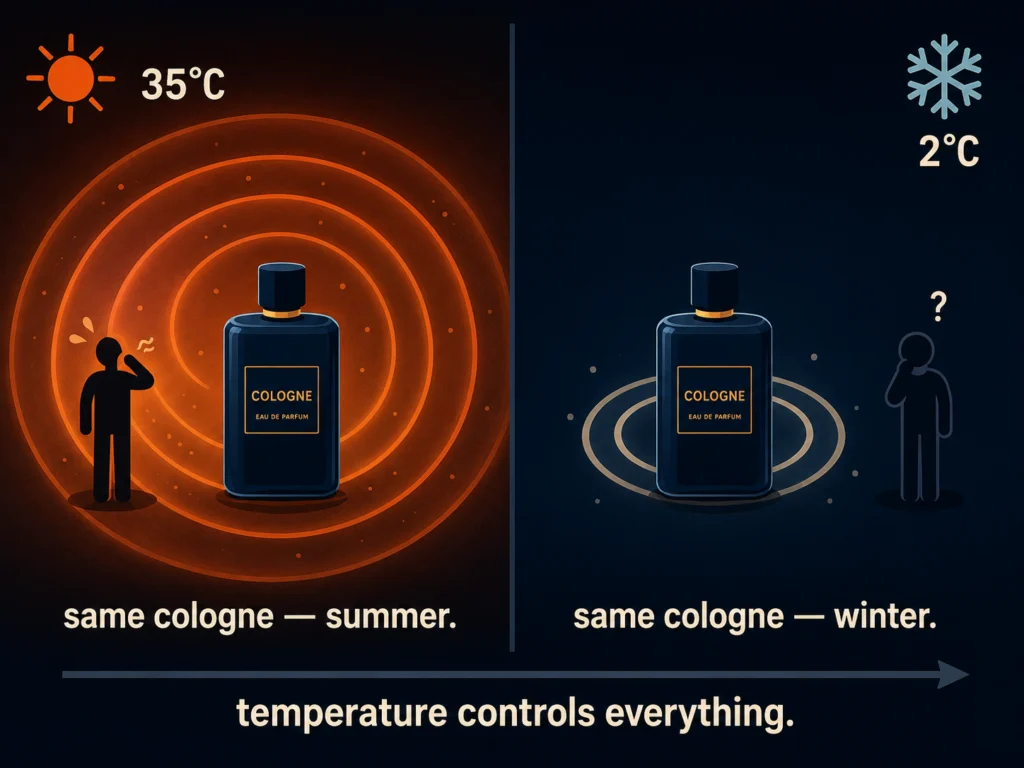
- Temperature controls how fast fragrance molecules evaporate from your skin. Higher temperature means faster evaporation, stronger projection, and shorter longevity.
- In summer, heat pushes top notes off your skin in 20 minutes instead of 45. A cologne that was subtle in January can fill a room in July.
- In winter, cold air slows evaporation, compresses projection, and keeps scent closer to your body. A fragrance that lasted 4 hours in summer can persist for 8 in December.
- Summer: reach for fresh, citrus, aquatic, and light woody compositions in EDT concentration. Apply fewer sprays.
- Winter: oriental, amber, resinous, and dense woody compositions in EDP or Parfum concentration. Apply to exposed skin and clothing for added projection.
- Spring and autumn call for something in between: a woody aromatic or soft spicy composition handles 15–22°C conditions without the extremes of either season.
Put on your winter cologne on a 35°C July afternoon and you’ll understand immediately. Within an hour, what was a well-calibrated amber-oriental in February becomes a cloud that announces you three rooms early.
The fragrance hasn’t changed. The temperature has. And temperature controls everything about how cologne performs.
This is basic physical chemistry, not a matter of style or preference. Understanding the mechanism tells you exactly why certain fragrances work in certain seasons, and gives you a framework to make better decisions about what’s in your collection.
Seasonal performance is one of the most common things men get wrong, and it’s almost always a physics problem, not a fragrance problem.
The Chemistry: What Temperature Does to Fragrance Molecules
Fragrance is a liquid that evaporates. The aromatic molecules in a cologne only reach your nose after they leave your skin and travel through the air as vapor. Temperature controls how fast that happens.
At higher temperatures, molecules move with more kinetic energy. They hit the boundary between skin and air faster and escape more readily.
The physical chemistry here is well-established: vapor pressure rises with temperature, so fragrance molecules leave your skin faster as the air gets warmer.
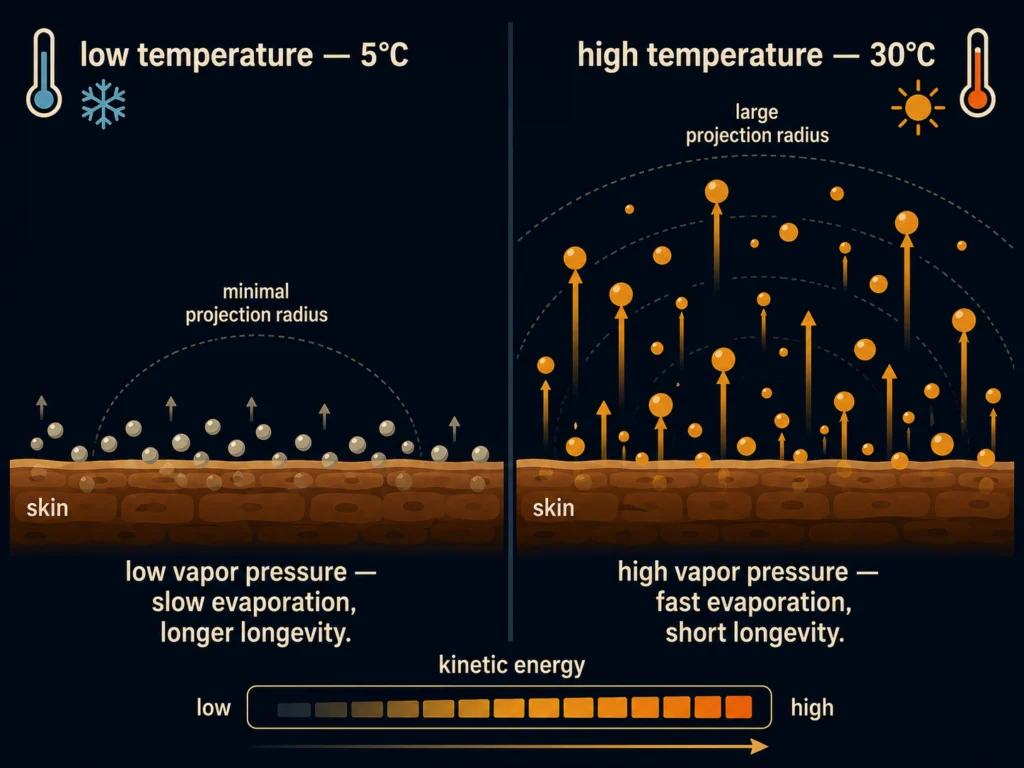
Limonene, the primary molecule in citrus top notes, can see its vapor pressure drop by more than 50% at 5°C compared to 30°C. The Clausius-Clapeyron equation, a standard physical chemistry principle, describes this relationship precisely.1
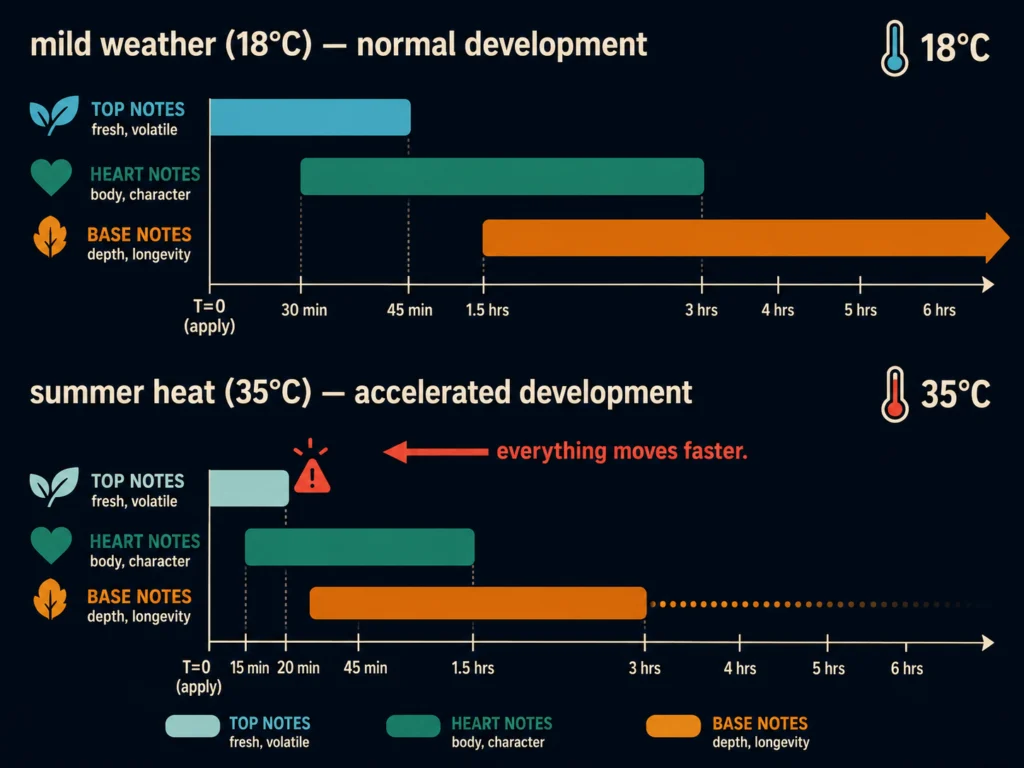
A cologne that lasted 6 to 8 hours on a mild spring day can realistically cut to 3 to 4 hours in midsummer heat.
The acceleration doesn’t affect all notes equally. Top notes, built from small, highly volatile molecules like citrus aldehydes, terpenes, and light aromatics, evaporate fastest under any conditions.
In summer heat, they can be gone in 20 minutes instead of the usual 45. This rushes you directly into the heart of the fragrance before you’ve even left the house. By midday, you may already be in the base notes.
Cold air does the opposite. Below 10°C, fragrance molecules lose kinetic energy. Vapor pressure drops. Evaporation slows across all note tiers, which means the fragrance lasts longer on the skin.
A 4-hour EDT in summer can stretch to 8 hours in winter.2 The tradeoff: projection drops too. Cold, dense air compresses sillage, keeping scent closer to your body. You smell the fragrance longer, but it doesn’t travel as far.
These are the two seasonal realities your cologne choices need to account for.
For the foundational overview of how olfaction and chemistry interact with perception and social signaling, see [The Psychology of Fragrance: How Scent Shapes the Way Men Think, Feel, and Are Perceived].
A Note on What This Article Does and Doesn’t Cover
The chemistry of temperature and fragrance evaporation is well-established. The specific performance of any individual cologne varies by formulation, concentration, and your own skin chemistry. The recommendations below are directionally reliable, not guaranteed.
What holds for almost everyone: heavy, dense oriental compositions amplify aggressively in heat. Light, citrus-forward compositions can fade within 2 hours in very cold, dry air.
The adjustments described below address these tendencies. Individual results depend on your skin type, local climate, and the specific formulations you’re wearing.
Summer: The Heat Problem
In summer, your skin is warm, often humid, and sweating. Every one of these conditions works against heavy fragrance.
Warm skin drives aggressive evaporation. The pulse points you rely on for projection, your neck, wrists, and chest, are even warmer in summer.
Heat-driven evaporation makes moderate-projection fragrances project hard. A composition calibrated for controlled sillage in cool weather can become oppressive in direct sunlight at 35°C.
Humidity amplifies projection, up to a point. At high humidity (above 70%), moisture on the skin surface helps fragrance molecules diffuse into the surrounding air. Oriental and amber-heavy compositions can project 30 to 40% beyond their intended range in these conditions.3
At very high humidity above 90%, common in monsoon conditions or tropical coastal days, the dynamic reverses. Skin saturation prevents molecules from releasing into the air properly, and projection collapses.
The fragrance sits on your skin without diffusing. If you live in a tropical climate and notice your cologne performing inconsistently in the wet season, this is the likely cause. In those conditions, lighter fresh compositions in EDT often outperform the heavy orientals.
Sweat changes the chemical environment. Sweat alters the skin’s pH and provides a medium through which fragrance molecules interact differently with your individual microbiome.
In summer, you’re producing significantly more of this variable. Base notes in particular can shift in ways that don’t happen in cooler conditions.
What to wear in summer
Fresh, citrus, and aquatic compositions are built from volatile molecules that evaporate cleanly. Lemon, bergamot, grapefruit, neroli, and aquatic-marine notes lift off quickly and read as clean rather than cloying.
The same volatility that makes them short-lived in winter is an asset in heat, because they don’t accumulate on the skin the way ambers and dense woods do.
Light woody bases, cedar and white musk in particular, add enough depth to keep a summer fragrance present without the projection problems of heavier oriental bases.
EDT concentration is the right call for most summer contexts. The lower aromatic compound concentration (5 to 15%) means the fragrance doesn’t build as aggressively on warm skin.
Application in summer:
- 1 to 2 sprays maximum. Heat amplifies everything. You need less than in winter.
- Spray on the chest or neck. Avoid the wrists in very hot weather if you’re prone to over-projection.
- If the fragrance fades at midday, reapply 1 spray rather than over-applying at the start of the day.
Two summer EDT picks that hold up in heat without becoming overwhelming:
[PRODUCT LINKS — recommend: Bleu de Chanel EDT (citrus-woody, controlled in heat) and Acqua di Giò EDT by Giorgio Armani (aquatic-marine, genuinely made for warm weather) — both available on Amazon]
Winter: The Cold Problem
Cold weather inverts the summer dynamics. Projection drops. Longevity increases. Scent stays close to your body.
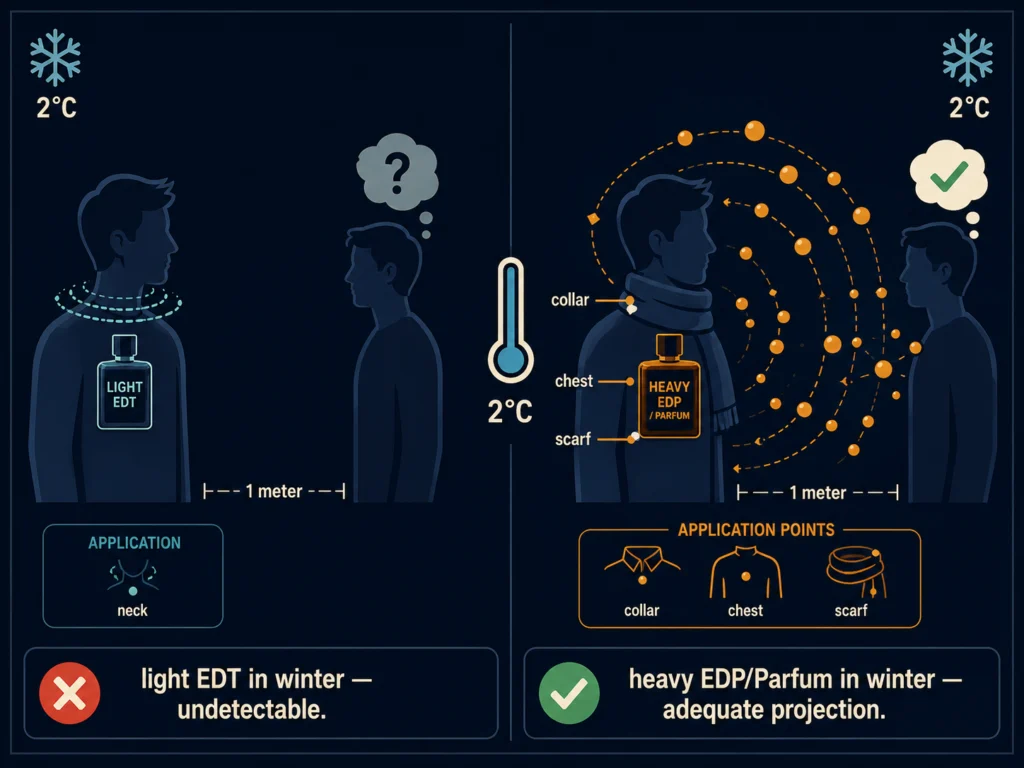
A fresh EDT that performs correctly in mild spring weather can feel like almost nothing at 2°C. The molecules don’t have enough kinetic energy to lift off your skin and travel through cold, dense air. You might barely smell it yourself, and the person across from you won’t detect it at all.
The winter problem is under-delivery, not over-projection.
What to wear in winter
Heavy base-note compositions, amber, oud, resins, incense, benzoin, sandalwood, and warm spices (cinnamon, cardamom, clove), are designed for exactly these conditions.
Their high-molecular-weight aromatic compounds have low volatility to begin with. Cold air barely slows them further. They project adequately even when lighter compositions have gone silent.
They also develop slowly, which is an advantage in winter: the extended longevity of cold air means a complex oriental can evolve on your skin across 8 or 10 hours.
EDP and Parfum concentrations (15 to 30%+ aromatic compounds) compensate for the projection loss that cold air causes.
Application in winter:
- 2 to 3 sprays in cold weather. The additional volume compensates for the projection loss without creating the cloying effect it would cause in summer.
- Apply to exposed skin and clothing. Fabric holds fragrance longer than skin in cold, dry air. Inner collar, scarf, and chest are all valid application points. Test for staining on clothing before committing.
- Apply to moisturized skin. Dry winter skin absorbs fragrance molecules faster, reducing how long they sit on the surface and project.
Two winter EDP compositions that deliver the projection and longevity cold air demands:
[PRODUCT LINKS — recommend: YSL Y EDP (amberwood base, performs in cold) and Dior Sauvage EDP (musk-ambroxan base, reliable cold-weather longevity) — both available on Amazon]
Spring and Autumn: The Transitional Problem
Spring and autumn are the hardest seasons to dress for in fragrance terms, because the temperature range is wide and unpredictable.
A 16°C spring morning can climb to 26°C by afternoon. The oriental you applied at 7am for the cooler morning air is working against you by 2pm. An aquatic EDT you wore on a mild autumn afternoon sits flat when the temperature drops to 8°C in the evening.
The practical solution is a fragrance that sits between the two seasonal extremes: a woody aromatic or soft spicy composition with moderate concentration.
These perform adequately across a 15 to 25°C range without the over-projection risks of heavy orientals in warm conditions or the under-delivery of light fresh compositions in cool conditions.
Note profiles that handle transitional weather well:
- Woody-aromatic: cedarwood, lavender, light vetiver, clean musk
- Spicy-fresh: cardamom or pink pepper over a clean woody base
- Chypre: oakmoss, bergamot, patchouli, labdanum. Historically the most season-adaptable family.
Context matters as much as temperature when choosing what to wear. For the full breakdown of how occasion and environment interact with fragrance choices, see How to Match Your Cologne to the Occasion — A Psychology-Based Guide.
The Concentration Question
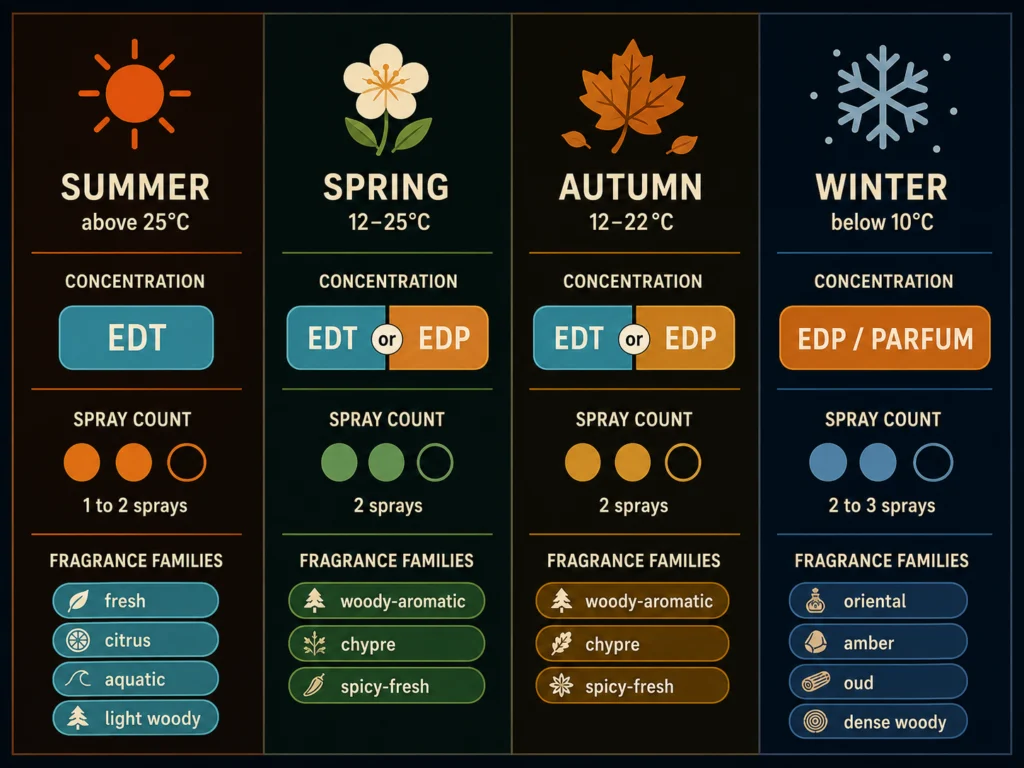
Season and concentration are decisions that go together. Wearing an EDP in summer produces the same problem as wearing a heavy coat in July: the formulation wasn’t designed for those conditions, and it will perform accordingly.
The rough seasonal mapping:
| Season | Recommended concentration | Sprays |
|---|---|---|
| Summer (>25°C) | EDT | 1 to 2 |
| Spring/Autumn (12–25°C) | EDT or EDP | 2 |
| Winter (<10°C) | EDP or Parfum | 2 to 3 |
These are starting points, not rules. Your skin chemistry, the specific formulation, and the day’s humidity all shift the right answer. A lightly formulated EDP from a house known for restrained sillage can work fine in mild summer weather.
A particularly dense EDT can overwhelm in heat. The temperature-concentration relationship is the primary guide, but how the fragrance actually behaves on your skin is the final authority.
For the full breakdown of what EDT vs EDP vs Parfum concentration differences mean for how your fragrance is perceived across the arc of a day, see [EDT vs EDP vs Parfum — What the Difference Means for How Others Perceive You].
Building a Seasonal Rotation
You don’t need a different cologne for every month. Two to three bottles covering distinct seasonal registers is enough.
One summer bottle: A fresh-citrus or aquatic EDT. Something genuinely light that works at 1 to 2 sprays in direct heat. This bottle handles May through September in most climates.
One winter bottle: A woody-oriental or amber-resinous EDP. Dense enough to project in cold air, complex enough to develop across the extended winter longevity. This bottle handles November through February.
One transitional bottle (optional): A woody-aromatic or chypre composition in EDT or light EDP. This covers the spring and autumn range without pushing your summer or winter bottle outside its optimal conditions.
If budget is a constraint and you’re choosing between two bottles, choose summer and winter. The transitional seasons are forgiving enough that either bottle can work with adjusted application.
If you haven’t yet identified which fragrance families fit your skin chemistry and usual contexts, the process for finding that is covered systematically in How to Find Your Signature Scent as a Man.
FAQ
Yes, directly. Fragrance molecules evaporate faster in heat, which accelerates the scent cycle and increases projection. The Clausius-Clapeyron equation in physical chemistry describes this precisely: vapor pressure rises with temperature, meaning molecules leave your skin faster. A cologne that performs correctly in mild spring conditions can become overwhelming in midsummer and nearly undetectable in winter cold.
You can, but adjust your application accordingly. In summer, use 1 to 2 sprays of a fragrance you’d normally apply 3 times in winter. If you only own one cologne and it’s a dense oriental, test it in summer before wearing it to work. The same projection that worked in January may not be appropriate in July. Most men who wear a single fragrance year-round are either under-applying in winter or over-applying in summer.
Two reasons. First, temperature changes the evaporation rate, which shifts the ratio of top-to-heart-to-base notes you smell at any given point after application. In summer, you rush through the top notes and into the heart faster. Second, your skin chemistry changes seasonally. Sweat, humidity, and sebum levels shift the environment in which the fragrance molecules interact with your body chemistry.
EDT for summer in almost all cases. The lower concentration (5 to 15% aromatic compounds) produces lighter projection that doesn’t amplify into overwhelming territory on warm skin. If you prefer EDP, apply one fewer spray than you normally would and test the result before going somewhere the projection matters.
Woody-aromatic and chypre compositions handle the widest temperature range without the over-projection risks of orientals or the under-delivery of pure citruses. Fragrances built around a clean woody base with moderate sillage, cedar, soft vetiver, restrained musk, tend to be the most season-neutral.
Start with 1 spray. Evaluate after 30 minutes. If you want slightly more presence, add a second spray on the next application. Most people who over-apply in summer are compensating for olfactory adaptation, not responding to a genuine under-projection problem.
Conclusion
The reason your winter cologne fails in summer, and your summer cologne disappears in winter, comes down to one physical variable: temperature controls evaporation rate, and evaporation rate controls everything about how a fragrance performs.
Vapor pressure rises with temperature. That’s why summer requires lighter compositions at lower concentrations with fewer sprays.
In cold air below 10°C, molecules lose kinetic energy, projection drops, and longevity increases. That’s why winter rewards heavier, denser compositions at EDP or Parfum concentration.
A two-bottle rotation, one EDT-based summer fragrance and one EDP or Parfum-based winter fragrance, covers the meaningful seasonal range for most men without redundancy.
The transitional seasons are forgiving enough to use either bottle with adjusted application rather than requiring a third purchase.
The chemistry is predictable once you understand it. Your fragrance choices should follow from it.
Seasonal temperature is one of five variables that change how a cologne performs on you specifically. The full picture on skin pH, sebum, microbiome, and diet is in Why Cologne Smells Different on You Than on Anyone Else.
Footnotes
- Première Peau. (2025, October). Winter Perfume: Why Cold Air Demands Weight. Industry source; not peer-reviewed. The underlying physics (Clausius-Clapeyron vapor pressure relationships) is standard physical chemistry. The longevity figures reflect industry consensus consistent across multiple fragrance publications. https://premierepeau.com/blogs/news/winter-perfume-cold-weather / For the underlying physical chemistry: Atkins, P., & de Paula, J. Physical Chemistry (multiple editions). Oxford University Press. Standard reference for Clausius-Clapeyron and vapor pressure relationships. ↩ ↩2
- Première Peau. (2025, October). Winter Perfume: Why Cold Air Demands Weight. Industry source; not peer-reviewed. The underlying physics (Clausius-Clapeyron vapor pressure relationships) is standard physical chemistry. The “4 hours in summer, 8 hours in winter” figures reflect industry consensus consistent across multiple fragrance publications. https://premierepeau.com/blogs/news/winter-perfume-cold-weather ↩ ↩2 ↩3
- Fragrenza. (2023, April). The Impact of Weather on Your Perfume: How Temperature and Humidity Affect Fragrances. Industry source; not peer-reviewed. The 30–40% amplification figure at humidity above 70% reflects industry consensus. Note: at very high humidity above 90%, projection can collapse rather than amplify, a distinction relevant in tropical climates. https://www.fragrenza.com/blogs/fragrances/the-impact-of-weather-on-your-perfume-how-temperature-and-humidity-affect-fragrances ↩ ↩2