

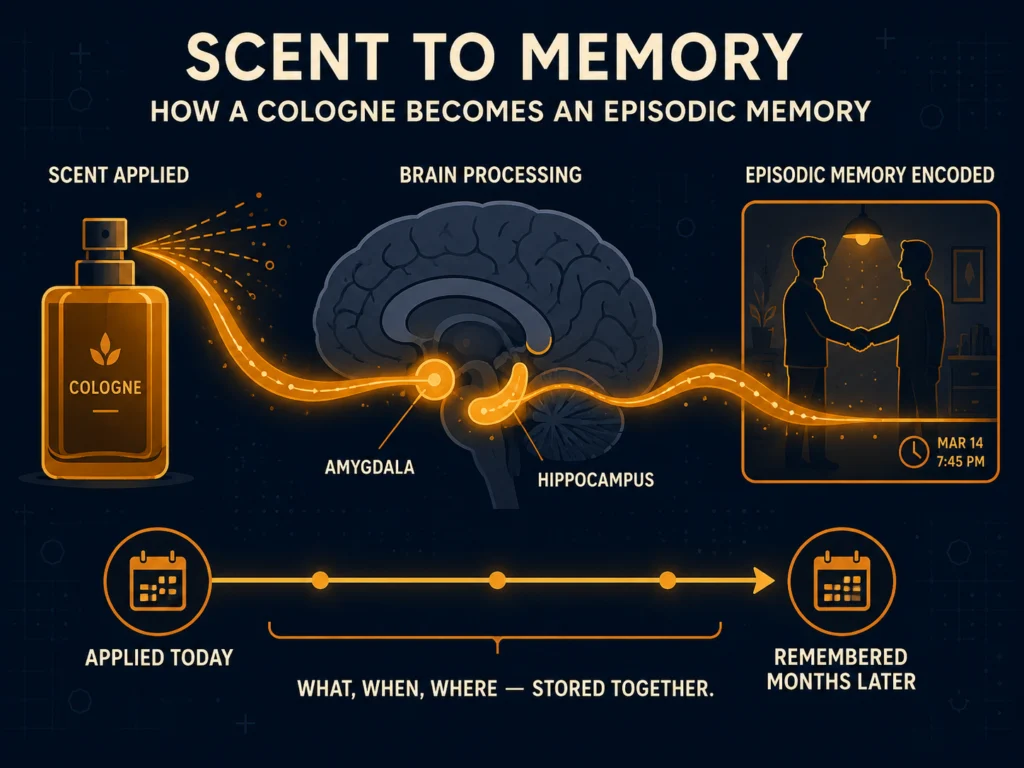
- Odor-evoked memories are more emotional and more vivid than memories triggered by vision, hearing, or touch — documented by fMRI neuroimaging showing greater amygdala activation during scent-cued recall than visual-cued recall (Herz et al., 2004).
- The anterior olfactory nucleus (AON) stores “what-when-where” episodic scent memories — encoding not just the smell but the full context of where you were and when (Aqrabawi & Kim, 2018, Nature Communications).
- Daily cologne use measurably improves mood across six POMS dimensions — tension, depression, anger, vigor, fatigue, and confusion — based on a 12-day study in 60 men aged 40–55 (Schiffman et al., 1995).
- A scent associated with a personal memory triggers more brain activity than seeing a photograph of the same moment (Herz et al., 2004).
- The practical implication: a consistently worn cologne doesn’t just make you smell good — it encodes you into the memories of people around you with unusual emotional depth and durability.
- Consistency beats novelty. Switching fragrances frequently undermines the memory association that builds with repetition.
Most men think about cologne in terms of the immediate effect — whether it smells good right now, whether someone notices it today. That frame is too short.
The more consequential effect of wearing a consistent fragrance operates over weeks and months, in the memories of the people around you. It’s not about any single interaction.
It’s about what you leave behind when the interaction ends — and how reliably you can be recalled, emotionally and specifically, by the people who matter.
The neuroscience behind this is specific and well-documented. At Mascudo, it’s also the argument we find most convincing for why cologne choice matters beyond any single moment — and why consistency matters more than variety.
- Why Scent Memory Is Different From Every Other Kind
- The Neuroimaging Evidence
- What the Anterior Olfactory Nucleus Adds
- The POMS Study: What Daily Cologne Use Does to Your Own Mood
- The Memory Mechanism and Personal Identity
- Why Consistency Beats Novelty
- A Note on What This Research Can and Can’t Tell Us
- FAQ
- Conclusion
- Footnotes
Why Scent Memory Is Different From Every Other Kind
Memory researchers have documented a consistent finding since the 1990s: memories triggered by smell are qualitatively different from memories triggered by any other sense.
They’re older. They reach further back in time than visual or auditory cues.
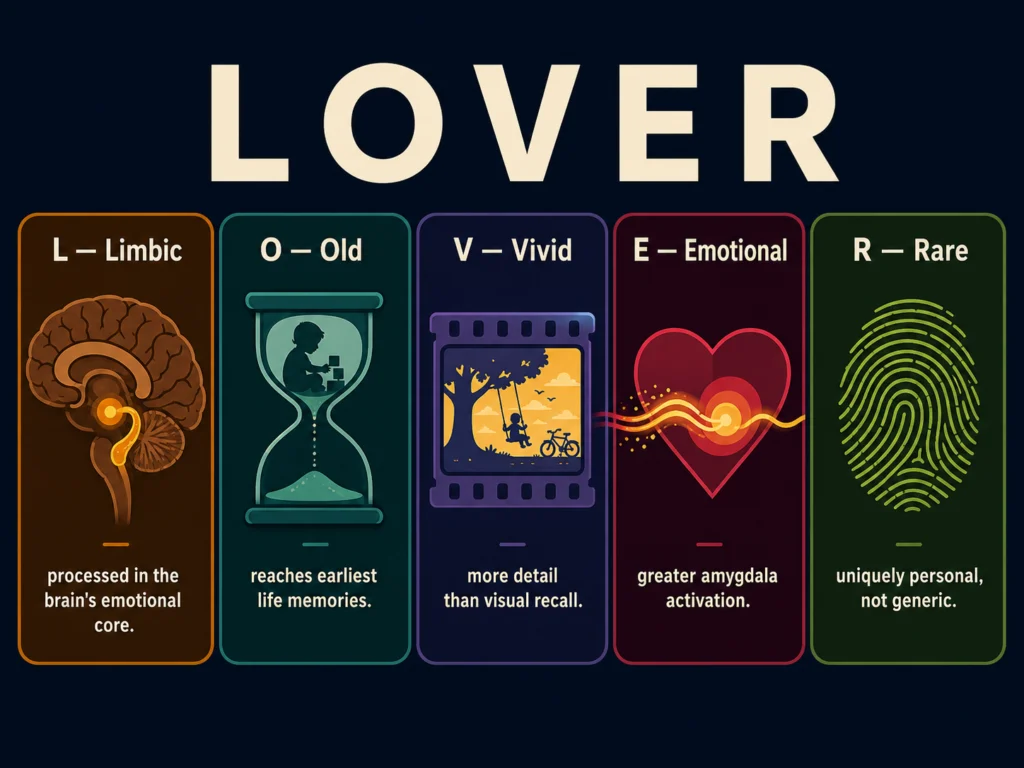
Willander and Larsson (2006) found that autobiographical memories triggered by odors tended to be from earlier periods of life than memories triggered by visual cues — a finding replicated across multiple studies.
Most olfactory autobiographical memories originate from the first decade of life, a period that visual memory typically can’t access with comparable clarity.
They’re more emotional. Herz and Cupchik (1995) found that odor-evoked memories were more emotional than verbally-cued memories on multiple measures.1
That finding has been replicated across labs, methodologies, and populations consistently enough that researchers now treat emotional intensity as a defining characteristic of olfactory memory, not an occasional feature of it.
They’re more vivid. Chu and Downes (2002) documented that autobiographical memories triggered by olfactory cues were described as more detailed and more vivid than memories evoked by the same object presented visually or verbally.
The feeling of being “brought back in time” — of re-experiencing rather than just recalling — is stronger for scent-cued memories than for any other sensory modality.
The acronym used in one systematic review captures the research consensus precisely: olfactory autobiographical memories are LOVER — Limbic, Old, Vivid, Emotional, and Rare.1
The Neuroimaging Evidence
The behavioral findings above are compelling. The neuroimaging evidence makes the mechanism concrete.
In 2004, Dr. Rachel Herz and colleagues at Brown University conducted one of the first fMRI studies of olfactory autobiographical memory.2
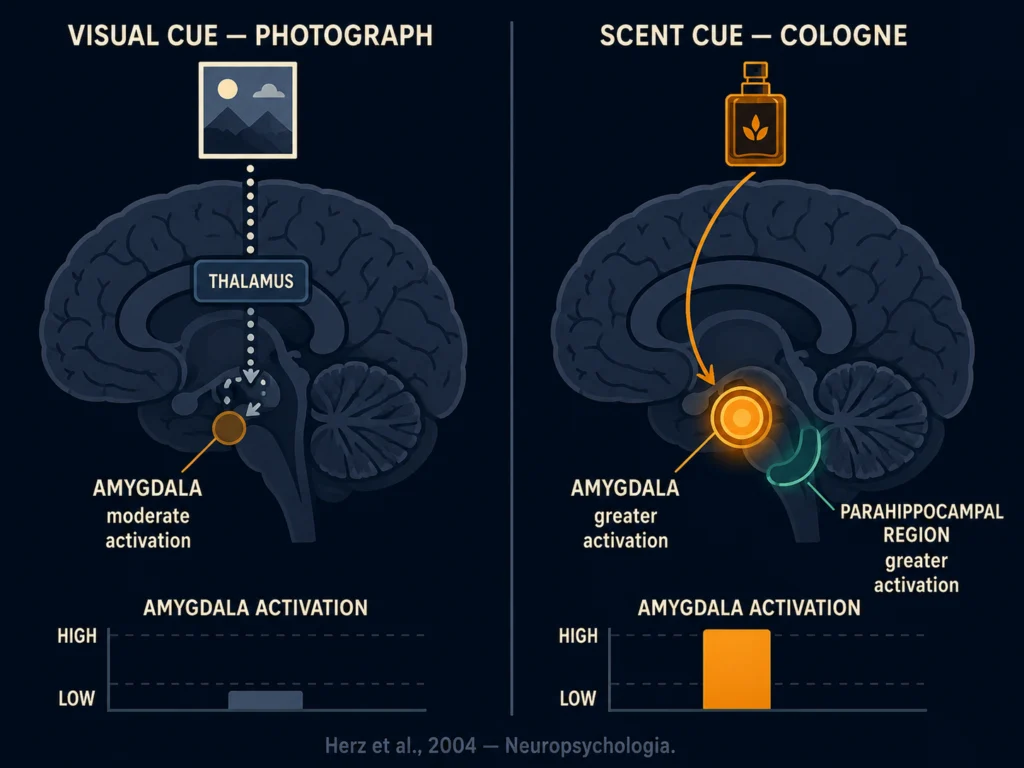
Five participants identified positive personal memories associated with both a specific perfume and a visual cue of the same memory.
During scanning, they were exposed to the associated perfume, a visually presented photograph representing the same memory, and a control scent with no prior association.
The findings were direct: the familiar perfume triggered greater brain activity than both the visual cue and the control scent.
Specifically, it produced measurably greater activation in the amygdala — the brain structure most involved in emotional processing and emotional memory consolidation — and in the parahippocampal gyrus, a region involved in encoding contextual memory.
The amygdala finding is the critical one. It confirms that the subjective experience of odor-evoked memories being more emotional isn’t a reporting bias.
It corresponds to a measurable difference in how the brain processes and stores the memory. Scent-triggered recall activates the emotional core of the brain more powerfully than visual-triggered recall of the same event.
Herz’s phrasing in a subsequent interview captures the implication clearly: a scent you associate with a person can bring back memories “that might otherwise never be recalled.” The visual cue of the same moment doesn’t accomplish this. The scent does.
This memory mechanism is directly connected to the first-impression effect covered in How Scent Shapes First Impressions in the First 30 Seconds. The scent present at a first meeting doesn’t just influence the meeting — it’s encoded into how that person will recall you afterward.
What the Anterior Olfactory Nucleus Adds
A 2018 study published in Nature Communications by Aqrabawi and Kim at the University of Toronto identified a specific neurological mechanism for why scent memories carry so much contextual richness.3
The anterior olfactory nucleus (AON) — a region in the olfactory cortex that was previously poorly understood — receives both odor information from the olfactory bulb and spatiotemporal information from the hippocampus.
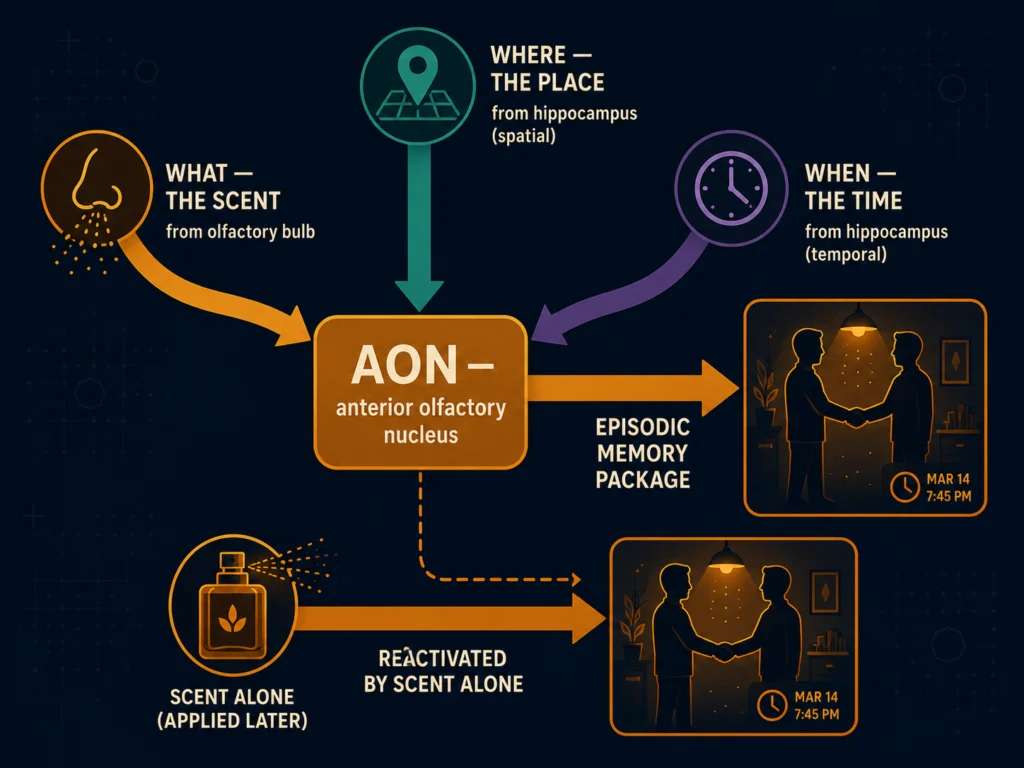
The hippocampus, the brain’s primary structure for episodic memory, sends projections to the AON that encode not just what an odor is, but when and where it was encountered.
“When these elements combine, a what-when-where memory is formed,” said Aqrabawi.
The example offered in the University of Toronto press release is exact: this is why you can remember the smell of a lover’s perfume when you think about your first kiss — the scent, the time, and the place are stored together as a unified episodic package.
The researchers selectively inhibited hippocampal projections to the AON and found that spatial and temporal odor memory were independently impaired — confirming that the hippocampal-AON pathway is directly responsible for the context-rich encoding of scent memories.
For fragrance, the practical implication is this: when someone encounters your cologne in a context that matters to them — a first meeting, an important conversation, a shared experience — the AON encodes the full episodic package.
The smell, the when, the where, and the emotional state are filed together. Every subsequent encounter with that scent has the potential to reactivate the entire package.
A follow-up study from the same lab (Aqrabawi & Kim, 2020, Nature Communications) confirmed that these contextually-relevant odor memories are stored as specific neural engrams in the AON — patterns of neural activity that are “necessary and sufficient for the behavioral expression of odour memory.”3
The POMS Study: What Daily Cologne Use Does to Your Own Mood
Beyond how other people remember you, there’s a documented effect on your own daily emotional baseline worth covering.
A peer-reviewed study published in Brain Research Bulletin (Schiffman et al., 1995) examined the effect of daily cologne use on mood in 60 men aged 40–55 over a 12-day period.4
Mood was measured twice daily using the Profile of Mood States (POMS) questionnaire — a validated psychological instrument covering six mood dimensions: tension, depression, anger, vigor, fatigue, and confusion.
The study used a three-phase design: a two-day baseline period with no fragrance, five days of fragrance use, and five days of placebo (an identical-appearing product with no active fragrance).
The results across all six POMS dimensions favored the fragrance condition over baseline:
- Tension scores were significantly lower during fragrance use
- Depression scores were lower
- Anger scores were lower
- Vigor scores were higher
- Fatigue scores were lower
- Confusion scores were lower
The Total Mood Disturbance score — a composite across all six dimensions — was significantly better during fragrance use than during both the baseline and placebo conditions.
This is a direct, measurable effect on daily emotional state from something as simple as wearing a cologne you like every morning.
The effect compounds with the memory mechanism: wearing a scent you find pleasant builds a neural association between that scent and a positive emotional state, which reinforces the positive state every time you apply it.
The mood regulation effects of scent, including the POMS study findings, are covered in more depth in [A11: Can Cologne Actually Improve Your Mood? What the Research Says].
The Memory Mechanism and Personal Identity
There’s a dimension to scent memory that goes beyond psychology-of-impression and into something more fundamental: identity.
Because scent memories are stored as episodic packages — what, when, where, and the emotional state of the moment — a consistently worn fragrance becomes associated not just with the smell but with everything about you that was present during the moments it was encoded.
Your manner of speaking. Your body language. The quality of your attention in conversation. The emotional tone of your interactions.
When someone encounters your scent again, all of that reassembles. Not as a vague positive feeling, but as a specific, emotionally textured memory of you as a person.
This is the mechanism behind what fragrance communities often describe as a cologne becoming “iconic” for a specific person — where a single whiff of a particular fragrance instantly calls someone specific to mind, even years after the last interaction.
It isn’t magic. It’s the AON doing its job: encoding the what-when-where package and making it available for reactivation by the sensory trigger that initiated the encoding.
The implication is direct: every time someone encounters your scent in a positive context, the encoding strengthens. Repetition builds depth.
A fragrance worn consistently across a significant relationship — personal or professional — accumulates a richness of association that novelty can’t produce.
[CTA-1: Amazon affiliate CTA]
The memory effect favors consistency over novelty — which means the first step is finding a fragrance worth wearing consistently. A discovery set is the most efficient way to test multiple profiles on your skin before committing to a bottle you’ll actually reach for every day:
[PRODUCT LINK — recommend: men’s fragrance discovery/sampler set, available on Amazon]
Why Consistency Beats Novelty
This is the most practical conclusion from the memory research, and the one most at odds with how fragrance is typically marketed.
Fragrance marketing emphasizes variety — seasonal rotations, occasion-specific bottles, limited editions. New is presented as better.
The neuroscience of scent memory argues for the opposite approach in contexts where being remembered matters.
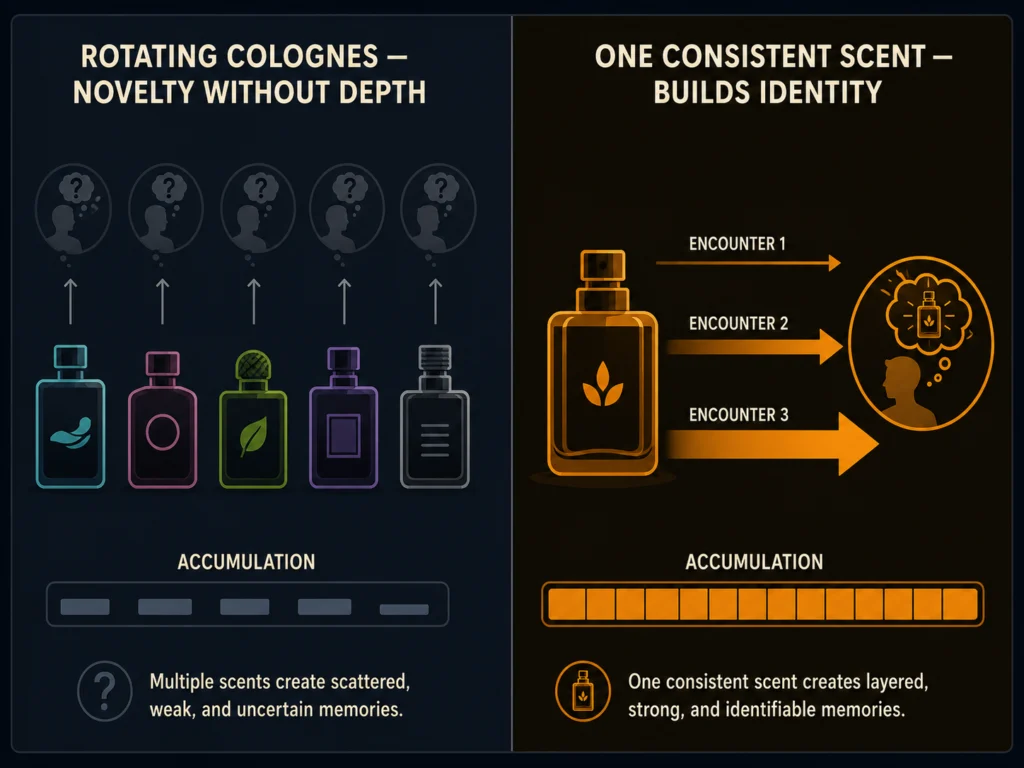
A single distinctive fragrance worn consistently across months of interactions with the same people builds a scent-identity association that is emotionally rich (amygdala activation during recall), contextually specific (AON what-when-where encoding), and increasingly durable with repetition.
Switching fragrances frequently produces novelty — which has its own merits in certain contexts — but doesn’t build the associative depth that makes a scent recall you specifically rather than just “a pleasant fragrance.”
Herz’s research notes one important caveat: the memory association requires the scent to be associated with meaningful interactions, not just frequent exposure in neutral contexts.
A fragrance you wear every day while sitting alone at a desk accumulates less associative richness than one you wear consistently in interactions with people who matter. Context quality affects memory encoding quality.
For the full discussion of how daily fragrance habits build scent identity over time — including the psychology of routine and what it means to wear the same cologne consistently — see [A18: The Psychology of Wearing Cologne Every Day].
A Note on What This Research Can and Can’t Tell Us
The studies cited in this article are real, peer-reviewed, and accurately represented. A few important limitations are worth stating clearly.
The Herz et al. (2004) fMRI study involved five participants — a very small sample by modern standards.
The findings have held up across subsequent behavioral studies, but the neuroimaging evidence specifically warrants replication at larger scale.
Treat the neuroimaging findings as directionally credible, not as definitive proof of magnitude.
The POMS study (Schiffman et al., 1995) is from the mid-1990s and its sample was limited to men aged 40–55 in two specific ethnic groups.
The mood-elevation finding has face validity and is consistent with broader research on pleasant odors and mood, but it hasn’t been replicated with modern methodology at greater scale.
The Aqrabawi and Kim research (2018, 2020) was conducted in mice. The anatomical and mechanistic findings are highly relevant to human olfactory memory — the neuroanatomy is shared — but direct human replication of the AON engram findings is still an active research area.
Where the evidence is strong: that odor-evoked memories are more emotional and vivid than other-sense memories. This has been replicated across multiple labs and methodologies over 30 years.
Where the evidence is more preliminary: the precise magnitude of these effects and the degree to which they apply uniformly across individuals and cultural contexts.
FAQ
Because the olfactory pathway bypasses the thalamus and projects directly to the amygdala and hippocampus — the brain structures most involved in emotional response and episodic memory. Every other sense passes through the thalamic relay before reaching these structures. Olfactory signals don’t. This anatomical shortcut gives scent a privileged route to emotional and contextual memory encoding that no other sense has.
Yes, and this is one of the most replicated findings in olfactory psychology. Herz and Cupchik (1995) established it behaviorally. Herz et al. (2004) confirmed it at the neural level using fMRI, showing greater amygdala activation during scent-cued recall than visual-cued recall of the same event. Subsequent studies across multiple labs have replicated the behavioral finding consistently.
The scent memory research supports this, with one important qualification. Consistent use of a specific fragrance builds a scent-identity association in people who interact with you regularly. But the quality of the memory encoded depends on the quality of the interaction during encoding — not just the frequency of scent exposure. A distinctive fragrance worn consistently in meaningful interactions encodes more richly than the same fragrance worn daily in low-engagement contexts.
A peer-reviewed study (Schiffman et al., 1995) using the POMS questionnaire found that daily cologne use over five days significantly improved mood across all six measured dimensions — tension, depression, anger, vigor, fatigue, and confusion — compared to baseline and placebo conditions. The effect was consistent across the study’s 60 participants. The research is from the mid-1990s and hasn’t been replicated at larger scale with modern methodology, but it’s consistent with broader findings on pleasant odors and positive affect.
Yes, in contexts where being distinctively remembered matters. The scent-identity association that builds with consistent use — and that produces the AON what-when-where encoding documented by Aqrabawi and Kim — requires repetition of the same scent across multiple meaningful interactions. Frequent switching produces novelty but not associative depth.
The research doesn’t establish a specific timeline. What it does establish is that emotionally significant encounters are more richly encoded than neutral ones, and that repetition strengthens existing associations. A single highly significant first meeting can initiate a strong encoding. Repeated interactions in positive contexts strengthen it over time.
Conclusion
The research on scent memory leads to a conclusion that most fragrance marketing actively works against: the value of a cologne isn’t primarily about what’s new or interesting or impressive in isolation.
It’s about what it becomes associated with over time, in the minds of the people you interact with consistently.
Herz’s neuroimaging work confirmed that a familiar scent triggers more amygdala activation — more emotional depth in recall — than a photograph of the same moment.
Aqrabawi and Kim’s work identified the precise neural mechanism: the anterior olfactory nucleus encodes scent memories as complete what-when-where episodic packages, making them reactivatable in full by the sensory trigger alone.
The POMS study showed that daily cologne use improves your own mood across six dimensions.
The memory research shows that the people you interact with will carry a version of you in their memories that is more emotionally vivid and contextually rich than what a photograph could convey.
Consistency does what novelty can’t. A fragrance worn repeatedly across meaningful interactions doesn’t just make you smell good in the moment.
It encodes you as someone specific, emotionally textured, and recallable in full.
[CTA-2: Amazon affiliate CTA]
If the research has you thinking about finding one fragrance to wear consistently rather than rotating through a collection — the systematic approach is to test across fragrance families first, then commit. A curated sampler set covering woody, oriental, and fresh families gives you real skin-test data before you decide:
[PRODUCT LINK — recommend: men’s multi-family fragrance discovery set, available on Amazon]
The systematic process for finding the fragrance worth wearing consistently — including how to evaluate across families, the 30-minute and 3-hour skin test protocol, and how to build from a signature to a small rotation — is covered in [A08: How to Find Your Signature Scent as a Man].
For the deep-dive on how fragrance forms lasting memories and how to use that knowledge deliberately — including the full mechanistic detail on odor-associative learning — see [A24: How Fragrance Forms Lasting Memories — And How to Use That to Your Advantage].

We research the psychology behind fragrance and grooming. Every article on this site is built on peer-reviewed research, tested on real skin, and written to explain the why behind what works.
Learn more on our About page.
Footnotes
- Willander, J., & Larsson, M. (2006). Smell your way back to childhood: Autobiographical odor memory. Psychonomic Bulletin & Review, 13(2), 240–244. https://doi.org/10.3758/BF03193837 / Herz, R.S., & Cupchik, G.C. (1995). The emotional distinctiveness of odor-evoked memories. Chemical Senses, 20(5), 517–528. / Larsson, M., & Willander, J. (2009). Autobiographical odor memory. Annals of the New York Academy of Sciences, 1170, 318–323. Consolidated in the LOVER framework: https://www.frontiersin.org/journals/psychology/articles/10.3389/fpsyg.2014.00312/full ↩ ↩2 ↩3
- Herz, R.S., Eliassen, J., Beland, S., & Souza, T. (2004). Neuroimaging evidence for the emotional potency of odor-evoked memory. Neuropsychologia, 42(3), 371–378. https://doi.org/10.1016/j.neuropsychologia.2003.08.009 ↩ ↩2
- Aqrabawi, A.J., & Kim, J.C. (2018). Hippocampal projections to the anterior olfactory nucleus differentially convey spatiotemporal information during episodic odour memory. Nature Communications, 9(1), 2735. https://doi.org/10.1038/s41467-018-05131-6{rel=”nofollow”} / Aqrabawi, A.J., & Kim, J.C. (2020). Olfactory memory representations are stored in the anterior olfactory nucleus. Nature Communications, 11(1), 1246. https://doi.org/10.1038/s41467-020-15032-2 ↩ ↩2 ↩3
- Schiffman, S.S., Suggs, M.S., & Sattely-Miller, E.A. (1995). Effect of pleasant odors on mood of males at midlife: Comparison of African-American and European-American men. Brain Research Bulletin, 36(1), 31–37. https://doi.org/10.1016/0361-9230(94)00134-m PMID: 7882047. ↩ ↩2