

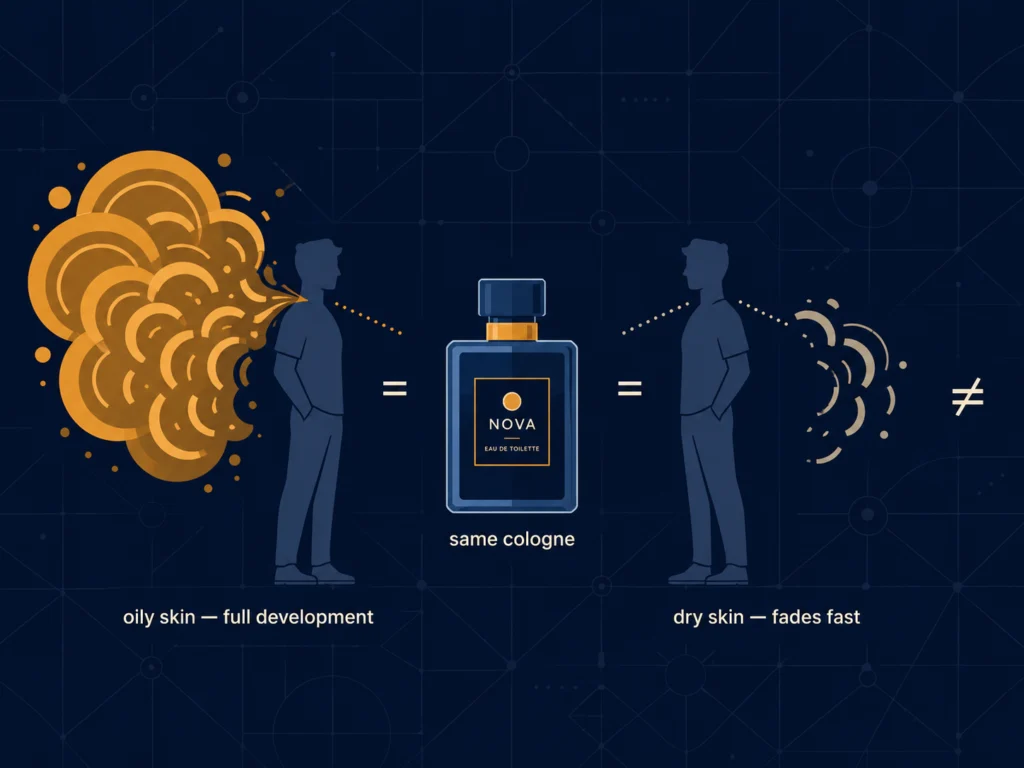
- Cologne doesn’t perform the same way on every person. The same fragrance can smell significantly different on two people wearing identical amounts, because fragrance molecules interact with your individual skin chemistry — not just sit on top of it.
- Five factors drive this: skin pH, sebum (natural oil) levels, body temperature, your skin’s microbial ecosystem, and diet.
- A peer-reviewed PLOS ONE study (Lenochová et al., 2012) confirmed that fragrances interact with body odor to create an individually-specific mixture — not a simple masking effect.
- Skin pH sits between 4.5 and 5.5 in most people. Variations within that range meaningfully affect how top notes break down and how quickly base notes emerge.
- Oily skin holds fragrance longer. Drier skin loses top notes faster and benefits from heavier concentrations (EDP over EDT) and a moisturizer base.
- The only reliable way to know how a cologne performs on you is to test it on your skin and evaluate it at 30 minutes and 3 hours — not from a paper strip or within the first five minutes.
A cologne that smells excellent on your friend can fall completely flat on your skin.
The same fragrance, the same amount, worn the same way — and the result is different enough that you’d think it was a different product.
It’s not perception. It’s chemistry.
Fragrance molecules don’t simply float above your skin — they interact with it. Your skin pH, your sebum levels, your body temperature, the bacteria living on your skin surface, what you ate last night — all of these alter what a fragrance becomes in the hours after you apply it.
Understanding how this works changes how you shop for cologne and how you evaluate whether one is right for you.
At Mascudo, it’s one of the most common reasons we hear for why someone gave up on a fragrance that should have worked — they tested it wrong.
- What the Research Establishes
- A Note on What This Article Claims and What It Doesn’t
- Factor 1 — Skin pH: The Acid Mantle
- Factor 2 — Sebum: Your Skin’s Natural Fragrance Base
- Factor 3 — Body Temperature: Projection and Evaporation Rate
- Factor 4 — The Skin Microbiome: The Most Individual Factor of All
- Factor 5 — Diet: The Variable Most Men Don’t Consider
- Why Paper Strips at the Counter Fail You
- Fragrance Families That Perform Most Consistently
- FAQ
- Conclusion
- Footnotes
What the Research Establishes
The foundational peer-reviewed study on this mechanism is Lenochová et al. (2012), published in PLOS ONE.1
Researchers from Charles University Prague, the University of Stirling, and the University of Vienna conducted three experiments examining how fragrance interacts with individual body odor.

The key finding: fragrances don’t simply mask body odor. They interact with it to create an individually-specific odor mixture.
The blend that results — fragrance plus your particular body chemistry — is perceptually different from either component alone.
Participants in the study rated the pleasantness, attractiveness, and intensity of perfumed body odor samples, and the results were “modulated by significant interactions with individual odor donors.”
The same perfume produced measurably different outcomes on different people.
A third experiment in the same study found that when a person wore their own preferred fragrance — rather than one randomly assigned — the resulting blend was rated as more pleasant, even when the two fragrances were rated as equally pleasant in isolation.
This suggests people intuitively gravitate toward fragrances that interact well with their own chemistry.
The practical implication is direct: testing a cologne on paper, or on someone else’s skin, gives you incomplete information about how it will perform on yours.
For the broader science on how olfaction interacts with chemistry, identity, and social perception, see [P00: The Psychology of Fragrance: How Scent Shapes the Way Men Think, Feel, and Are Perceived].
A Note on What This Article Claims and What It Doesn’t
Skin chemistry effects on fragrance are real and documented.
But some claims in the fragrance community overstate the precision of what we know.
What the evidence clearly supports: Skin pH, sebum levels, body temperature, the skin microbiome, and diet all measurably affect fragrance performance. These are not myths.
What the evidence does not support with precise measurement: Exactly how much a specific cologne will change on your specific skin under specific conditions. The interactions are complex, variable, and not reducible to a simple formula.
Where the sections below describe specific effects, those descriptions reflect documented mechanisms, not guaranteed outcomes. Individual variation is real, which is why testing on your own skin remains the only reliable method.
Factor 1 — Skin pH: The Acid Mantle
Healthy skin maintains an acid mantle — a thin film on the surface with a pH between 4.5 and 5.5.2
This slight acidity serves a protective function: it limits bacterial overgrowth and maintains the skin barrier. It also interacts directly with fragrance molecules.
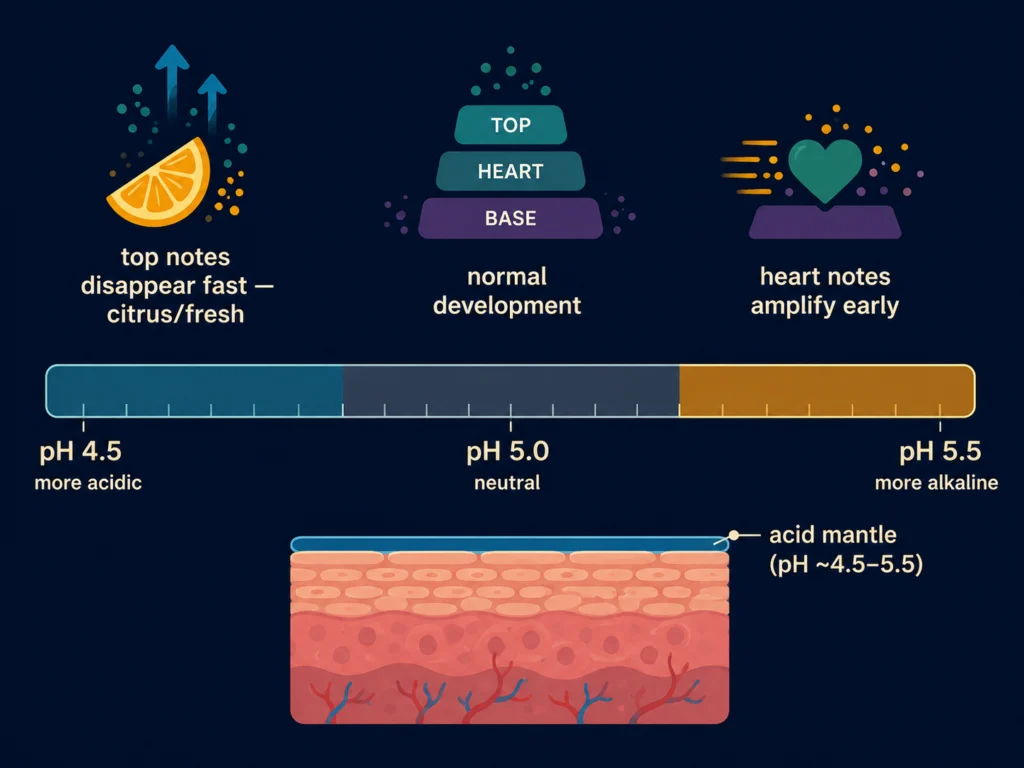
Many fragrance ingredients — particularly esters, which carry floral, fruity, and fresh notes — are sensitive to pH. In highly acidic conditions, ester molecules break down more rapidly, accelerating the loss of top notes.
This is why some people find that fresh and citrus-forward fragrances disappear quickly on their skin: their slightly more acidic surface chemistry is consuming the volatile top note molecules faster than average.
At the other end, skin that skews more alkaline within the normal range can cause certain notes to intensify unpredictably — sometimes amplifying heart notes before the top notes have finished developing, or causing base notes to read heavier than intended.
Diet, hormonal profile, stress levels, and genetics all influence where your skin falls within the normal pH range.
This isn’t something you can reliably shift with products, though maintaining skin hydration supports more stable pH.
What this means for choosing cologne: If you consistently find that fresh and citrus-forward fragrances disappear within an hour, a pH interaction with top note esters is the likely cause.
Woody, amber, and oriental base-note-heavy fragrances are more pH-stable and perform more consistently across skin types.
Factor 2 — Sebum: Your Skin’s Natural Fragrance Base
Sebum is the natural oil your skin produces, secreted by sebaceous glands throughout the body.
It serves as a lubricant and barrier — and it functions as an anchor for fragrance molecules.
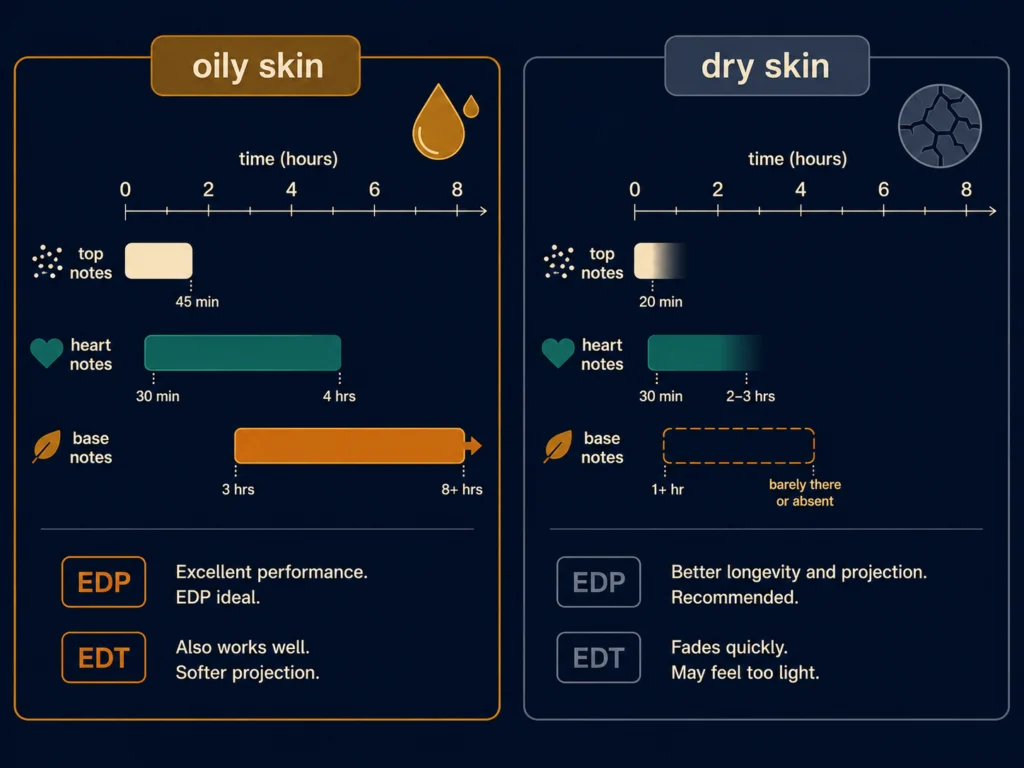
Oily skin holds fragrance significantly longer than dry skin because fragrance molecules have more lipid material to bond to. The oils slow evaporation, extending how long a scent projects and lasts.
People with naturally oily skin typically find that colognes perform better on them — longer longevity, more consistent projection, more pronounced base note development.
Dry skin has the opposite problem. Without sufficient sebum, fragrance molecules evaporate more quickly.
Top notes disappear fast. Base notes may never fully develop, or may appear prematurely because there’s no anchor to slow the top-to-base transition.
What this means for choosing cologne: If you have dry skin, two adjustments help. First, apply an unscented moisturizer before cologne — the additional moisture and lipid layer gives fragrance molecules something to bond to.
Second, consider EDP formulations over EDT. The higher concentration of aromatic compounds compensates for the accelerated evaporation rate on drier skin.
If you have dry skin and consistently find colognes fade within a couple of hours, testing an EDP rather than an EDT version of the same fragrance is the most practical first step. Fragrance sampler sets let you test both concentrations of multiple fragrances on your actual skin before committing to a full bottle:
[PRODUCT LINK — recommend: men’s fragrance discovery/sampler set featuring EDP-forward compositions, available on Amazon]
[Affiliate link — full disclosure at /affiliate-disclosure]
Factor 3 — Body Temperature: Projection and Evaporation Rate
Fragrance works by evaporating from your skin into the air. The rate of evaporation is directly controlled by heat.
Warmer skin temperature means faster evaporation — stronger initial projection but shorter overall longevity.
Cooler skin temperature slows evaporation — lighter projection but a longer, more gradual development.
Skin temperature typically ranges from 33°C to 37°C (91°F to 98.6°F), and varies by body site, activity level, environmental temperature, and individual physiology.3
The pulse points — wrists, neck, inner elbows, behind the ears — are warmer than surrounding areas because blood vessels run close to the surface, which is why cologne applied at pulse points projects more than cologne applied to cooler areas.
Men with naturally warmer body temperatures tend to find that fragrances project more aggressively, fade faster, and that heavy oriental compositions can become overwhelming in warm conditions.
Men with cooler baseline temperatures may find that fragrances don’t project enough and that they need to apply more or choose denser formulations to get adequate presence.
Environmental temperature compounds this. The same cologne that’s perfectly calibrated in February can become suffocating in July.
Heat dramatically accelerates the entire fragrance cycle — top notes blast off quickly, middle notes develop fast, base notes arrive early.
This is why fragrance professionals recommend lighter formulations in summer heat and denser, richer base-heavy fragrances in cold weather.
What this means for choosing cologne: If you run warm, prefer EDT over EDP for year-round wear and reduce application in hot weather.
If you run cool or find fragrances barely project on you, reach for higher-concentration EDP formulations and apply slightly more.
Neither situation is a flaw — it’s just information about which formulations will perform best on your skin.
Factor 4 — The Skin Microbiome: The Most Individual Factor of All
Your skin hosts a complex community of bacteria, fungi, and other microorganisms — particularly in areas with active sebaceous and sweat glands.
The composition of this community is unique to you, shaped by genetics, age, geography, diet, and hygiene habits.
These microorganisms metabolize the aromatic compounds in fragrance as they interact with your sweat and sebum.
The specific bacterial community on your skin contributes to your personal odor signature — which is stable enough that individuals can recognize their own body odor among many others, and that family members can identify relatives by scent alone.4
When a fragrance is applied over this bacterial environment, the result is a blend of fragrance molecule, skin chemistry, and microbial activity.
This is the real mechanism behind why two people wearing the same cologne smell different within an hour or two of application.
It’s not just the pH, or the sebum, or the temperature — it’s the entire biological environment interacting with the fragrance molecules simultaneously.
A 2023 review in Physiology & Behavior documented the range of intrinsic factors that shape axillary (underarm) odor, including sex, age, ethnicity, emotional state, personality, and diet — alongside extrinsic factors like climate and hygiene habits.
All of these variables feed back into the microbiome composition, which in turn affects how fragrance develops on the skin.4
What this means for choosing cologne: You can’t directly manipulate your microbiome to change fragrance performance. What you can do is recognize that this variability is normal and expected.
The colleague whose cologne you love may simply have a skin chemistry that interacts particularly well with that formulation. The only way to know if the same will happen on your skin is to test it there.
Factor 5 — Diet: The Variable Most Men Don’t Consider
What you eat affects your body odor, and body odor is part of the base that fragrance builds on.
Sulphur-rich foods — garlic, onions, certain spices — contain compounds that are partially excreted through the skin via sweat.
These compounds can interact with fragrance molecules at the base note stage, altering how the drydown reads.
It’s a real effect, though it varies significantly between individuals depending on metabolism and how those sulphur compounds are processed.
High-sugar diets can shift skin pH slightly toward acidity and affect sebum composition, reducing the stability of fragrance molecules on the skin surface.
Conversely, well-hydrated skin with a balanced diet tends to maintain a more consistent pH that supports fragrance performance.
Spicy foods temporarily raise body temperature and increase perspiration, both of which amplify fragrance projection in ways that can work against intention — particularly with heavier formulations.
What this means for choosing cologne: If you notice your cologne performing differently on different days without a clear reason, diet and hydration are worth examining before assuming the fragrance is inconsistent.
On days with heavy garlic or onion intake, base note interactions can make a familiar fragrance read differently in the drydown.
Why Paper Strips at the Counter Fail You
A fragrance paper strip — the blotter at a cologne counter — tells you one thing: what the top notes smell like in isolation, without any skin interaction.
Paper has no pH. No sebum. No body temperature. No microbiome. No interaction with your natural odor.
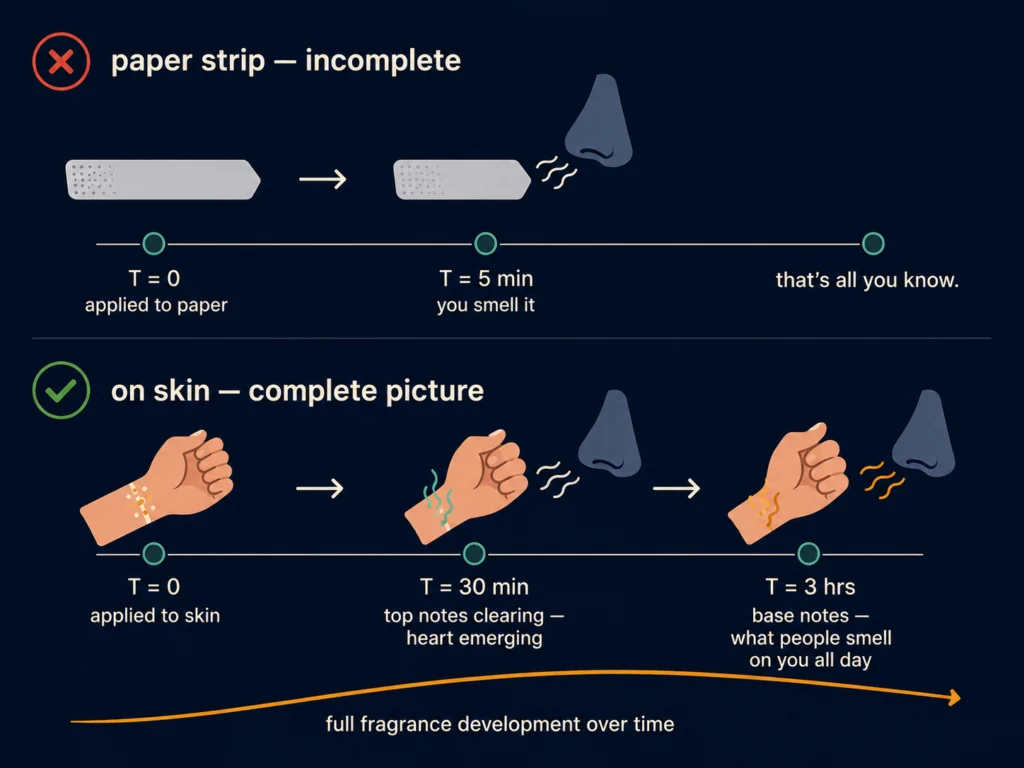
Paper strips are useful for quickly identifying whether the top notes of a fragrance are the direction you want to explore.
They tell you almost nothing about how the fragrance will develop on your skin over the course of several hours.
The professional approach to evaluating a fragrance involves two time checkpoints.
At 30 minutes, the top notes have largely evaporated and you’re beginning to smell the heart of the fragrance as it interacts with your skin.
At 3 hours, you’re in the base notes — the part of the fragrance that will define how people experience you after the initial application has settled.
This is the phase most men never evaluate before purchasing, and it’s the phase where the most significant individual variation occurs.
The 30-minute and 3-hour evaluation rules are part of the systematic approach to finding a fragrance that works with your chemistry rather than against it. We cover the full process in [A08: How to Find Your Signature Scent as a Man].
Fragrance Families That Perform Most Consistently
Not all fragrance families are equally affected by skin chemistry variation.
Some note profiles are more stable across different pH levels, sebum levels, and temperatures than others.
Most stable: Woody, amber, and oriental base notes — cedar, sandalwood, vetiver, amber, oud, musk, and resinous accords — use heavy aromatic molecules that evaporate slowly and bond strongly to skin lipids.
These perform more consistently across skin types than lighter families. If you’ve struggled to find a cologne that lasts, woody and oriental compositions are the most reliable starting point.
Most variable: Citrus and light aquatic top notes are highly volatile. They evaporate quickly on everyone, but the rate is particularly accelerated on warmer or more acidic skin.
These notes are beautiful in the first 30 minutes but can disappear entirely on some skin types before the heart notes even develop.
Synthetics as a stabilizer: Some synthetic aromatic molecules — particularly certain musks and woody synthetics like Iso E Super and Ambroxan — have strong skin-binding properties that make them less affected by individual chemistry variation.
Fragrances built around these molecules tend to be more consistent performers across different people, which is partly why they’re so common in designer fragrances.
If skin chemistry variability has made cologne selection frustrating for you — buying something that smelled great on someone else or in the store, then finding it doesn’t perform on your skin — a curated discovery set is the most efficient way to test multiple formulations on your actual skin without the full cost of each bottle:
[PRODUCT LINK — recommend: men’s fragrance discovery set featuring woody/amber-forward compositions, available on Amazon]
[Affiliate link — full disclosure at /affiliate-disclosure]
FAQ
Because fragrance molecules interact with your skin chemistry — not just sit on top of it. Your skin pH, natural oil levels, body temperature, and the bacteria living on your skin all alter how the fragrance develops over time. A peer-reviewed 2012 PLOS ONE study confirmed that fragrance blends with body odor to create an individually-specific mixture that is perceptually distinct from either the fragrance or the body odor alone.
Yes, but within a range. Normal skin pH sits between 4.5 and 5.5. Variations within that range affect how quickly top note ester molecules break down, how certain heart notes develop, and how heavy base notes read. The effect is most noticeable with fresh and citrus fragrances, which are more pH-sensitive than woody or oriental families.
Yes. Sebum (natural skin oil) anchors fragrance molecules and slows their evaporation. Dry skin has less sebum available, so fragrance molecules evaporate more quickly — top notes disappear faster, and base notes may not develop as fully. Applying an unscented moisturizer before cologne and choosing EDP over EDT are the most practical compensations.
Partially. Sulphur-rich foods (garlic, onions, certain spices) produce compounds that are excreted through sweat and can interact with fragrance molecules in the base note stage, altering the drydown. High-sugar diets can shift skin pH and sebum composition. These effects are real but vary significantly between individuals.
Evaluate at two points: 30 minutes in (when the top notes have cleared and the heart is developing on your skin) and 3 hours in (when you’re in the base notes, which is how the fragrance will smell to people who encounter you throughout the day). Never make a purchase decision from a paper strip or from the first five minutes after application.
No cologne works identically on all skin types. But woody, amber, and oriental base-note-heavy compositions are the most consistent performers across different skin chemistries, because their heavier aromatic molecules bond more strongly to skin and are less sensitive to pH variation than citrus or aquatic top notes.
Conclusion
The same cologne smells different on different people because fragrance is a reaction, not just a scent.
It interacts with your skin pH, your sebum, your body temperature, the bacteria on your skin surface, and what you’ve eaten — and the combination of all those variables produces a result that is specific to you.
The Lenochová et al. (2012) research confirmed this isn’t a perception effect or a myth: fragrance genuinely interacts with body odor to create an individually-specific odor mixture that is perceptually distinct from either component alone.
People who choose fragrance that interacts well with their own chemistry end up with results that are rated as more pleasant than randomly selected fragrances — even equally well-rated ones.
The practical takeaway is simple: stop evaluating cologne on paper. Test it on skin. Wait 30 minutes, then come back at three hours.
That second evaluation — the drydown — is where your individual chemistry shows up most clearly, and where the decision about whether a fragrance is right for you should actually be made.
Your body chemistry doesn’t just affect how fragrance smells on you — it affects how you’re remembered. For the science on how a consistent, well-matched scent builds lasting memory associations in the people around you, see [A06: The Science of Scent Memory: Why Your Cologne Can Define You in Someone’s Mind].

We research the psychology behind fragrance and grooming. Every article on this site is built on peer-reviewed research, tested on real skin, and written to explain the why behind what works.
Learn more on our About page.
Footnotes
- Lenochová, P., Vohnoutová, P., Roberts, S.C., Oberzaucher, E., Grammer, K., & Havlíček, J. (2012). Psychology of fragrance use: Perception of individual odor and perfume blends reveals a mechanism for idiosyncratic effects on fragrance choice. PLOS ONE, 7(3), e33810. https://doi.org/10.1371/journal.pone.0033810 ↩ ↩2
- Schmid-Wendtner, M.H., & Korting, H.C. (2006). The pH of the skin surface and its impact on the barrier function. Skin Pharmacology and Physiology, 19(6), 296–302. https://doi.org/10.1159/000094670 ↩ ↩2
- Lee, C.M., Jin, S.P., Doh, E.J., Lee, D.H., & Chung, J.H. (2019). Regional variation of human skin surface temperature. Annals of Dermatology, 31(3), 349–352. https://doi.org/10.5021/ad.2019.31.3.349 ↩ ↩2
- Di Cicco, F., Evans, R.L., James, A.G., Weddell, I., Chopra, A., & Smeets, M.A.M. (2023). Intrinsic and extrinsic factors affecting axillary odor variation: A comprehensive review. Physiology & Behavior, 270, 114307. https://doi.org/10.1016/j.physbeh.2023.114307 ↩ ↩2 ↩3