

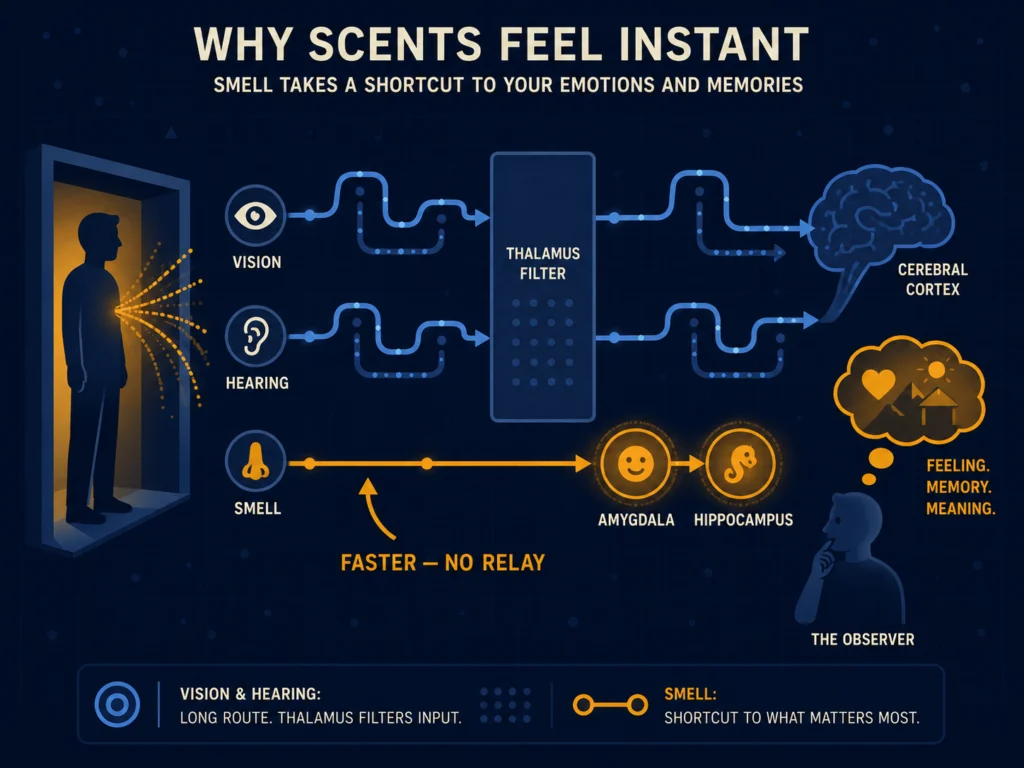
- Olfaction is the only sense that bypasses the thalamus and projects directly to the amygdala and hippocampus — the brain structures responsible for emotional response and memory. Judgment from scent arrives before conscious thought.
- Spence (2021) at Oxford’s Crossmodal Research Laboratory reviewed decades of research confirming that pleasant fragrance measurably increases ratings of attractiveness, competence, and social trustworthiness — independent of any other cue.
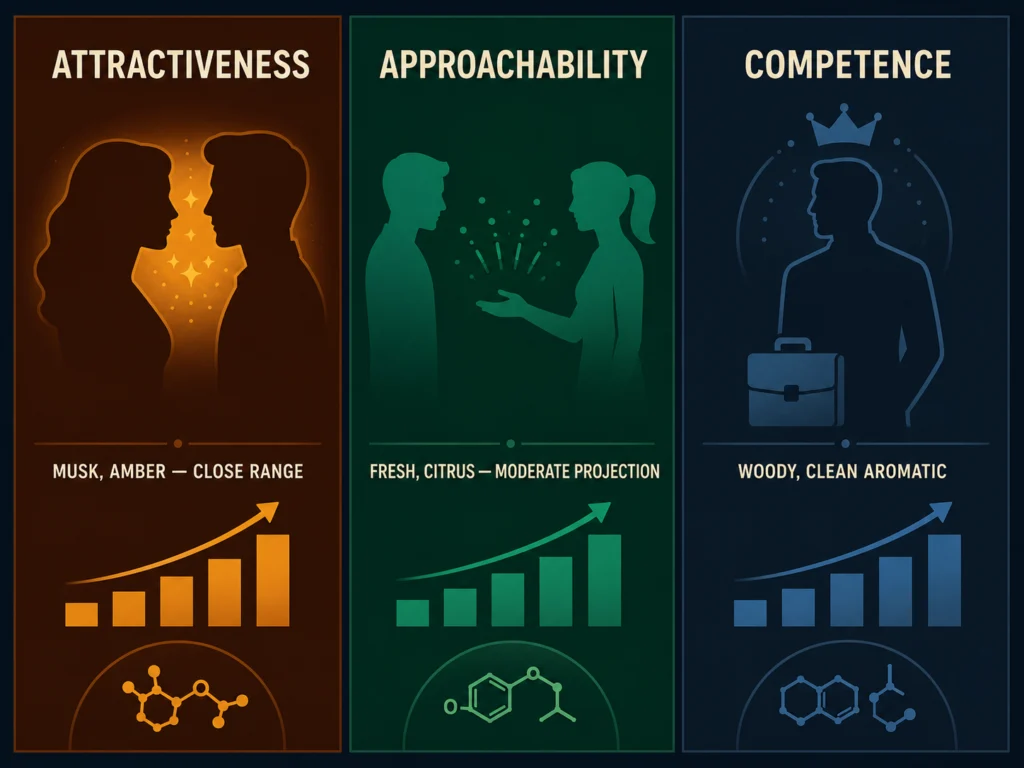
- Three distinct judgment axes are influenced by scent in the first meeting: attractiveness, approachability, and competence. Different fragrance profiles influence each one differently.
- Odor-evoked memories are more vivid and more emotional than memories triggered by any other sense (Herz et al., 2004). The scent you wear consistently is the version of you that people carry in memory.
- Context mismatch — wearing the wrong projection level or wrong fragrance family for a situation — actively degrades the impression. It’s not neutral.
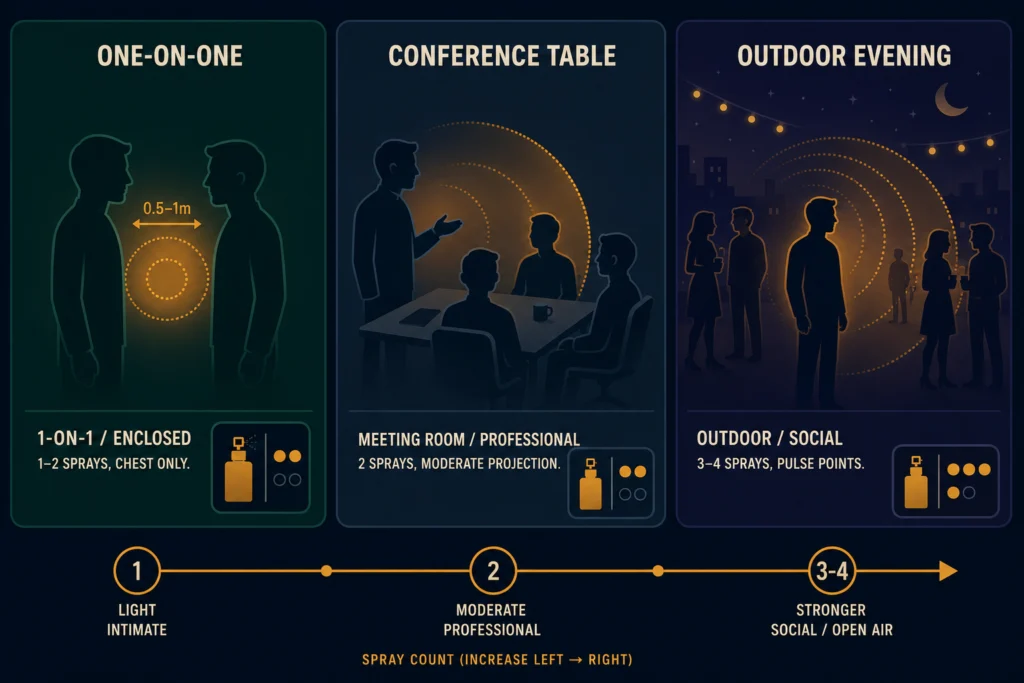
- The practical rule: match projection intensity to proximity, and match fragrance weight to environmental context.
Most men think about cologne as something other people might notice. The truth runs closer than that.
Before anyone decides they noticed your cologne, their brain has already processed it — and that processing happened before they consciously recognized your face, your handshake, or your voice.
This isn’t a loose claim about smell being powerful. It’s a specific anatomical fact about how the olfactory system connects to the brain, and it has direct implications for what your fragrance is doing in the first 30 seconds of any interaction.
At Mascudo, it’s the piece of the puzzle most men we talk to have never considered — and it changes how you think about every cologne choice you make.
- The Neuroscience: Why Smell Reaches the Brain Before Anything Else
- What This Does to First Impressions Specifically
- The Three Judgment Axes
- The Memory Effect: Why Your Scent Sticks When Your Face Fades
- When Scent Misalignment Actively Hurts Your Impression
- What This Doesn’t Mean
- The Practical Rules
- FAQ
- Conclusion
- Footnotes
The Neuroscience: Why Smell Reaches the Brain Before Anything Else
Every sensory system except olfaction routes signals through the thalamus before they reach cortical areas for conscious processing.
Vision, hearing, touch, taste — all of them pass through the thalamic relay station, which acts as a filter and distributor.
Olfactory signals don’t.1 When you detect a scent, signals travel from olfactory receptor neurons through the olfactory bulb and project directly to the amygdala, hippocampus, and piriform cortex — the brain structures responsible for emotional response, memory encoding, and affective evaluation.
There is no mandatory thalamic relay. The olfactory pathway has only two synapses between the nose and the amygdala — a shorter route than any other sensory modality.
The consequence is that emotional and associative processing of a scent is already underway before conscious identification occurs.
A 2026 paper in the journal Life described this arrangement as providing “a powerful functional explanation for the rapid, non-conscious evaluation of stimuli” — the olfactory system’s unique neuroanatomy makes scent the fastest route to the brain’s emotional core.1
In practical terms: by the time someone has consciously registered that you’re wearing cologne, their limbic system has already filed a judgment.
That judgment will color everything that follows — their assessment of your face, their interpretation of your body language, their willingness to engage. The conscious mind catches up to a conclusion the olfactory brain already reached.
What This Does to First Impressions Specifically
The mechanism above — olfactory signals reaching the amygdala before conscious processing — is what makes scent particularly influential in first impressions rather than in extended interactions.
In a first meeting, there’s no established prior. No history, no personality read, no track record.
The observer is assembling a judgment from available inputs: what you look like, how you carry yourself, what you say, and what you smell like. Each input contributes to the frame through which the others are interpreted.
Spence’s (2021) comprehensive review at Oxford’s Crossmodal Research Laboratory documented that pleasant fragrance consistently and measurably increases ratings across three distinct judgment dimensions: attractiveness, health/cleanliness, and social desirability.2
These aren’t the same judgment. A scent can increase perceived attractiveness without increasing perceived competence.
It can increase approachability while decreasing perceived authority. Understanding which judgment dimension you want to influence in a given context changes which fragrance strategy makes sense.
A note on what this research can and can’t tell us: Spence’s review documents the crossmodal affective priming mechanism reliably — pleasant scent biases social perception positively.
What it can’t tell us with precision is which specific note within which specific fragrance will produce which specific judgment shift in a specific observer.
Cultural background, personal scent history, and individual preferences all moderate the effect. The principles below are grounded in the research but should be applied with that variability in mind.
For the foundational overview of how all of these mechanisms connect — olfaction, the limbic system, confidence, memory, and social perception — see [P00: The Psychology of Fragrance: How Scent Shapes the Way Men Think, Feel, and Are Perceived].
The Three Judgment Axes
Attractiveness
The attractiveness effect is the most documented in the research.
Spence (2021) reviewed multiple studies showing that ambient pleasant scent increases attractiveness ratings of faces in photographs — without the observers being in the presence of the person whose face they were judging.2
The scent creates a positive perceptual frame; everything evaluated within that frame benefits.
A 2024 study published in Behavioural Brain Research extended this using EEG, showing that pleasant fragrance produced measurable changes in neural responses to face stimuli, specifically in components associated with social and emotional evaluation.3
The fragrance was affecting how the brain processed visual social information.
For men, the attractiveness effect from pleasant fragrance is documented but operates differently than when applied to women’s fragrance — partly because of cultural norms around masculine scent use, and partly because the most reliable attractiveness signals from men’s fragrance tend to operate at close range (musk, amber) rather than at a distance.
Approachability
Approachability is about whether someone seems safe, warm, and open to interaction. It’s a distinct dimension from attractiveness — someone can be judged as attractive and simultaneously as unapproachable.
Fresh, clean, and citrus-forward fragrances consistently signal approachability.
The association is partly cultural (clean = hygienic = trustworthy) and partly based on the low-intensity, non-aggressive projection profile of fresh compositions.
A scent that doesn’t announce itself aggressively reads as considerate rather than dominating, and consideration is a component of approachability.
This is also why fresh fragrances are the default recommendation for professional first meetings: they maximize approachability and competence signals simultaneously, at the cost of distinctiveness.
Competence
Competence is the third judgment axis, and it’s the one most relevant in professional contexts.
Research on scent and cleanliness perception shows that clean-smelling scents are consistently associated with higher ratings of competence, reliability, and social trustworthiness.2
There’s a direct association between not smelling offensive and being judged as capable — which is why any well-applied pleasant fragrance already serves this function.
Beyond the baseline, grounded and composed fragrance profiles — woody, resinous, dry — are more associated with perceived authority and competence than sweet or diffuse compositions.
Heavy orientals and dense gourmands can undercut competence perception in professional contexts, while clean woody compositions support it.
For the detailed breakdown of which fragrance families signal which personality attributes — including the research basis for the competence and authority associations — see What Your Cologne Says About You Before You Say a Word.
The Memory Effect: Why Your Scent Sticks When Your Face Fades
First impressions don’t just shape the immediate interaction. They shape the version of you that other people carry in memory afterward.
Here’s where the olfactory pathway’s anatomy produces its most significant long-term effect. Because olfactory signals project directly to the hippocampus — the brain’s primary memory encoding structure — scent is encoded into memory differently than other sensory information.
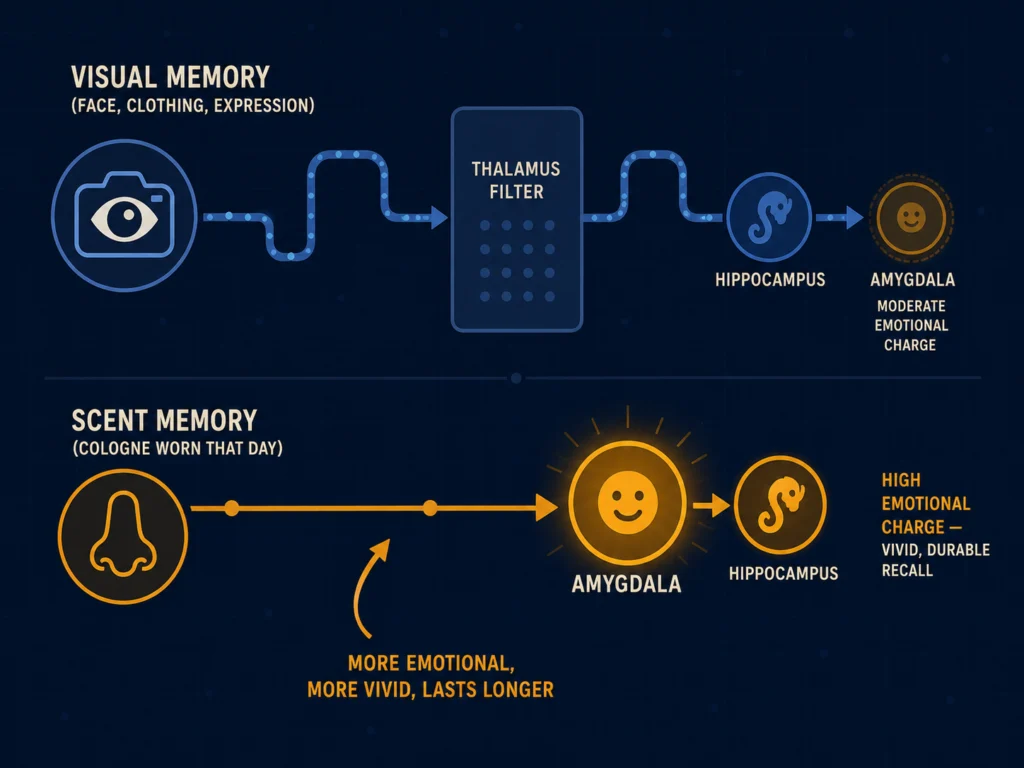
Odor-evoked memories are more emotional, more vivid, and reach further back in time than memories triggered by visual or auditory cues.4
Dr. Rachel Herz at Brown University conducted neuroimaging research showing that the subjective experience of emotional potency in odor-evoked memory is correlated with specific amygdala activation during recall — activation that was measurably greater than for the same memories triggered by visual cues of the same object.4
What this means for first impressions: the scent you were wearing when you met someone is encoded alongside everything else from that moment — the room, the conversation, the emotional valence of the interaction.
When that person encounters your scent again, the entire memory reassembles, including its emotional charge.
Consistency matters more than most men realize. A cologne worn once at a significant event encodes into that person’s memory.
A cologne worn every time you meet the same person becomes the scent associated with you — a trigger for the accumulated memory of all those interactions. The longer the pattern holds, the stronger the association.
The confidence effect documented in Roberts et al. (2009) — where wearing a fragrance changed men’s non-verbal behavior in ways observers could detect — compounds the memory effect. Other people aren’t just smelling you; they’re encoding your behavioral state alongside your scent. See How Cologne Affects Your Confidence — The Science Behind It.
When Scent Misalignment Actively Hurts Your Impression
The research establishes that pleasant fragrance improves first impression judgments.
The corollary — less frequently discussed — is that fragrance that reads as unpleasant or contextually inappropriate doesn’t produce a neutral effect. It produces a negative one.

This is because the crossmodal affective priming mechanism works in both directions.
An unpleasant or overwhelming scent creates a negative perceptual frame. Every other judgment made within that frame is colored by it.
Two specific misalignment patterns produce the most consistent negative effects:
Excessive projection in enclosed spaces
The same fragrance that reads as confident and distinctive outdoors or in a large room becomes physically overwhelming in a small office, an elevator, or a closed car.
In enclosed spaces, projection radius collapses — what was moderate projection now fills the entire space at close contact range.
The research on hedonic odor perception is clear that concentration matters: the same aromatic compound can be perceived as pleasant at low concentration and unpleasant at high concentration.
Projection is effectively a concentration control. Too much, and the pleasant fragrance crosses into overwhelming territory.
A single encounter where your fragrance makes someone physically uncomfortable in an enclosed space encodes as a negative memory. It can undo the benefit of every previous pleasant interaction.
Wrong fragrance weight for the context
Heavy oriental fragrances — dense amber, oud, thick resinous compositions — are evening and cold-weather formulations that carry significant sillage by design.
Applied in a daytime professional meeting in an air-conditioned office, they exceed what the context calls for. This doesn’t read as confident; it reads as oblivious to social norms, which is one of the most reliable predictors of poor social judgment.
Conversely, wearing a barely-there skin scent to an outdoor evening event where you want to be engaging and present results in no olfactory signal at all — not a negative one, but a missed opportunity.
The full breakdown of how to match fragrance to context — with the psychological reasoning behind each pairing — is in [A07: How to Match Your Cologne to the Occasion — A Psychology-Based Guide].
What This Doesn’t Mean
A brief note on scope: this article establishes that scent influences first impressions through documented neurological and social mechanisms.
That’s not the same as saying cologne is the decisive factor in any given first impression, or that the right fragrance will override other inputs.
Research on person perception consistently shows that multiple cues are processed simultaneously and interact with each other.
A pleasant fragrance operating inside a first meeting where your preparation, knowledge, and body language are all strong amplifies those signals. It doesn’t replace them.
The fragrance effect is real and documented. Its size relative to other factors depends on context, cultural background, and the specific observer.
The most useful framing is additive: cologne isn’t the main event, but it’s one input that is reliably within your control and that operates through mechanisms most people never think about.
For the specific application of these principles to professional contexts — particularly job interviews, where enclosed space dynamics and concentration choices become particularly consequential — see [A10: What Cologne to Wear to a Job Interview (And the Psychology Behind It)].
The Practical Rules
What follows from this research is a small number of principles that apply across contexts:
Match projection intensity to proximity.
The closer people will be to you in a given situation, the less projection you need. A business meeting at a conference table calls for a different application than an outdoor gathering.
Pulse points on the chest project more diffusely than pulse points on the wrists — a useful distinction when you want presence without aggression.
Apply 20–30 minutes before the interaction matters.
Top notes — the first thing you and others smell — evaporate within 20–45 minutes. What you want people to encounter in a first meeting is the heart of the fragrance as it has settled on your skin, not the sharp opening blast of top notes.
Applying at home before leaving, rather than in the parking lot before walking in, produces a better olfactory presentation.
Choose concentration for the context.
An EDP in a small professional meeting typically overdelivers. An EDT at an outdoor evening event may underdeliver.
Concentration is a projection control — make that choice with the context in mind, not just the fragrance preference.
Wear the same scent consistently in repeated interactions.
The memory encoding effect favors consistency over novelty in professional and social contexts where relationship-building matters.
A recognizable scent that people associate specifically with you is more valuable over time than a different interesting fragrance at every meeting.
For professional first impressions — meetings, interviews, client introductions — a clean woody-fresh composition with moderate projection gives you maximum flexibility across contexts. Two that consistently deliver the right balance:
[PRODUCT LINKS — recommend: Terre d’Hermès EDT (woody-mineral, moderate projection) and Bleu de Chanel EDT (fresh-woody, clean projection) — both available on Amazon]
FAQ
Yes, through a documented mechanism. Spence (2021) at Oxford reviewed multiple peer-reviewed studies confirming that pleasant fragrance measurably increases ratings of attractiveness, cleanliness, and social desirability. The effect operates through crossmodal affective priming: a pleasant scent creates a positive perceptual frame that biases judgments of everything perceived within it.
The olfactory pathway bypasses the thalamus and projects directly to the amygdala in two synapses — a faster route than any other sensory modality. Emotional evaluation of a scent begins before conscious identification occurs. The “impression” effect is essentially immediate upon olfactory detection.
No — because “first impression” varies too much by context. Professional first impressions favor clean, moderate-projection compositions (fresh woody, clean aromatic) that signal competence and approachability. Social first impressions in the evening can support warmer, more distinctive note profiles. The context defines the target, and the fragrance should match the context.
Yes. The crossmodal affective priming effect works in both directions. An unpleasant or overwhelming scent creates a negative perceptual frame that colors all other judgments. Excessive projection in enclosed spaces and heavy fragrance weight in daytime professional contexts are the two most common sources of active negative impression from fragrance.
Research by Herz et al. (2004) using neuroimaging confirmed that odor-evoked memories produce greater amygdala activation than memories triggered by visual cues — making them more emotional and more vivid. The scent present during a significant interaction is encoded into memory alongside the emotional valence of that interaction. A consistently worn fragrance in repeated interactions becomes a scent-identity association that strengthens over time.
Fewer than you’re inclined to use. Two sprays on the chest or neck — not both wrists, neck, and chest simultaneously — is sufficient for most professional first-meeting contexts. The goal is presence at greeting distance (arm’s length to half a meter), not projection across a room.
Conclusion
Scent shapes first impressions through mechanisms that operate before conscious thought begins.
The olfactory system’s direct projection to the amygdala — bypassing the thalamic relay that filters every other sense — means that emotional evaluation of your fragrance is already underway when the person across from you is still registering your face.
The research documents this across three judgment axes: attractiveness, approachability, and competence. Pleasant fragrance improves ratings on all three.
Context mismatch — excessive projection in enclosed spaces, wrong fragrance weight for the situation — creates negative priming that works against all three.
The memory encoding research by Herz et al. makes the longer-term stakes clear: the scent from a first meeting doesn’t fade when the meeting ends.
It’s stored alongside the emotional content of the entire interaction and can be reactivated years later by the same scent. A consistently worn, well-matched fragrance is the version of you that other people carry forward.
If you’re still working out which fragrance fits your regular contexts — both professional and social — a discovery set covering multiple fragrance families is the most efficient way to test on your own skin before committing:
[PRODUCT LINK — recommend: men’s multi-family fragrance discovery/sampler set, available on Amazon]
For the specific note profiles most linked to attractiveness and close-range social perception — and how they work differently from the broader first-impression mechanism covered in this article — see The Fragrance Notes Most Linked to Attraction — What Research Shows.

We research the psychology behind fragrance and grooming. Every article on this site is built on peer-reviewed research, tested on real skin, and written to explain the why behind what works.
Learn more on our About page.
Footnotes
- Walla, P. (2026). The Olfactory Origins of Affective Processing: A Neurobiological Synthesis Through the Walla Emotion Model. Life, 16(1), 86. Documents the two-synapse direct olfactory-amygdala pathway and thalamic bypass. https://doi.org/10.3390/life16010086 ↩ ↩2 ↩3
- Spence, C. (2021). The scent of attraction and the smell of success: crossmodal influences on person perception. Cognitive Research: Principles and Implications, 6(1), 46. https://doi.org/10.1186/s41235-021-00311-3 ↩ ↩2 ↩3 ↩4
- Davies-Owen, J., Roberts, H., Scott, M., Thomas, A., Sen, S., Sethna, S., Roberts, C., Giesbrecht, T., & Fallon, N.B. (2024). Beauty is in the nose of the beholder: Fragrance modulates attractiveness, confidence and femininity ratings and neural responses to faces of self and others. Behavioural Brain Research, 465, 114932. https://doi.org/10.1016/j.bbr.2024.114932 ↩ ↩2
- Herz, R.S., Eliassen, J.C., Beland, S.L., & Souza, T. (2004). Neuroimaging evidence for the emotional potency of odor-evoked memory. Neuropsychologia, 42(3), 371–378. https://doi.org/10.1016/j.neuropsychologia.2003.08.009 ↩ ↩2 ↩3