


- The research on scent and attraction is real, but it operates through crossmodal perception, not pheromones.
- Spence (2021) at Oxford’s Crossmodal Research Laboratory reviewed decades of studies confirming that pleasant fragrance measurably increases how attractive a person is judged to be by others.
- Androstadienone, a compound found in male sweat, has shown context-dependent effects on women’s mood and their ratings of men’s attractiveness in speed-dating studies — but it is not an ingredient you can buy in a cologne bottle.
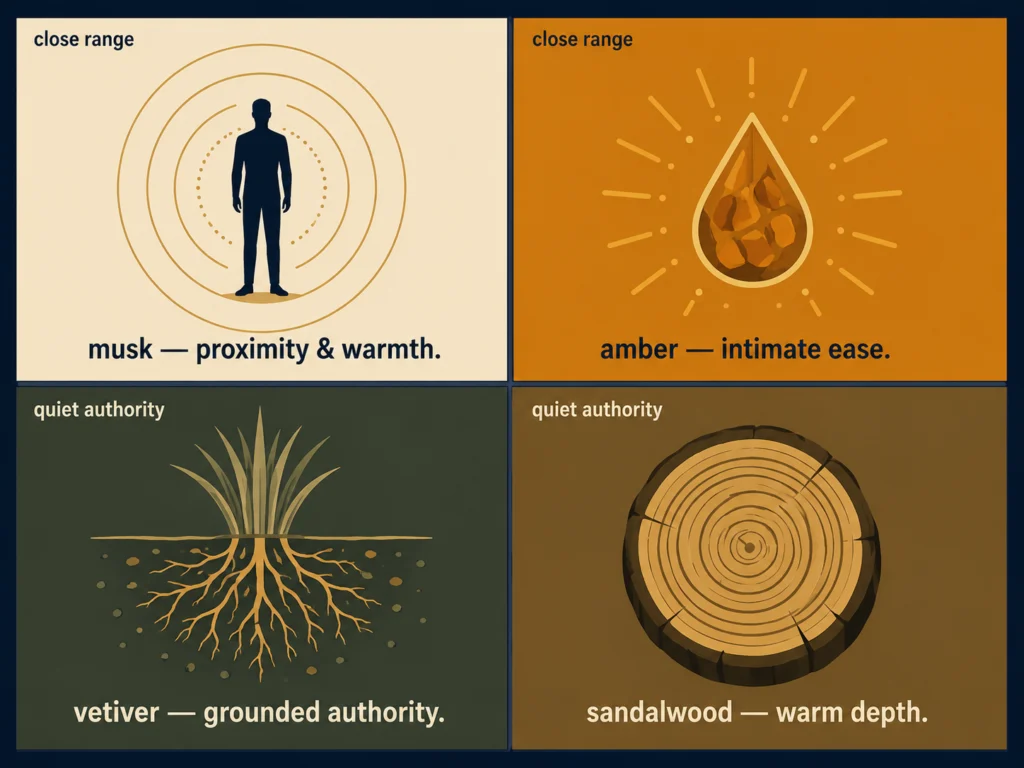
- Musk and amber work at close range. They create warmth and intimacy that registers as approachability and ease.
- Vetiver and sandalwood work at a different register — grounded, composed, authoritative — and support the confidence signals.
- Notes to avoid in attraction contexts: heavy synthetic aquatics as primary notes, and overloaded gourmand sweetness.
Before anything else: a clarification on what this article is and isn’t.
It isn’t a guide to cologne that will “make you irresistible.” That promise has never existed in peer-reviewed research and is used primarily to sell products at a markup. I
f you’ve seen ads for pheromone colognes with marketing built around guaranteed attraction effects, those claims go well beyond what the science actually supports — and we’ll address that directly.
What does exist is a substantial body of research on how scent influences social perception, mood, and attraction judgments.
At Mascudo, we’ve gone through a lot of that research — and a lot of cologne — trying to separate what’s actually documented from what’s industry talking points.
The findings are specific, useful, and largely ignored by mainstream grooming content.
- What “Attraction” Actually Means in Scent Research
- The Crossmodal Research Basis
- On Pheromones: What the Science Actually Says
- Musk: The Proximity Note
- Amber: Warmth and Intimate Presence
- Vetiver: Grounded Confidence
- Sandalwood: Warm Depth With Broader Appeal
- What to Avoid in Attraction Contexts
- FAQ
- Conclusion
- Footnotes
What “Attraction” Actually Means in Scent Research
Most fragrance marketing collapses “attraction” into a single vague concept. The research is more precise.
In peer-reviewed studies on scent and person perception, attraction is typically measured one of three ways: how attractive an observer rates a person’s face or body when exposed to a particular scent, how much time an observer wants to spend with that person, or how positively an observer rates that person’s personality attributes (warmth, competence, approachability).
These are distinct outcomes. A scent can increase rated facial attractiveness without increasing willingness to approach.
A scent linked to perceived competence may decrease intimacy ratings. Understanding which outcome a study is measuring changes how useful the finding is.
The relevant takeaway: scent influences attraction through multiple, separable channels.
The notes discussed in this article work through different mechanisms, in different contexts, and produce different types of attraction signals.
The Crossmodal Research Basis
The most comprehensive review of scent and person perception published to date is Spence (2021) from the Crossmodal Research Laboratory at the University of Oxford.1
It reviewed decades of peer-reviewed studies on how olfactory stimuli — from ambient odours to personal fragrances to body-related chemosignals — influence judgments of attractiveness, age, affect, health, and personality.
Key documented findings from that review:
- Pleasantly scented environments consistently increased participants’ ratings of other people’s facial attractiveness.
- The effect on attractiveness judgments was larger than the effect on other types of social judgments (such as age estimation), suggesting scent has a particularly strong influence on this specific dimension.
- The mechanism is crossmodal affective priming: a pleasant scent creates a positive emotional state, and that state biases perception of everything in the environment, including the person standing next to you.
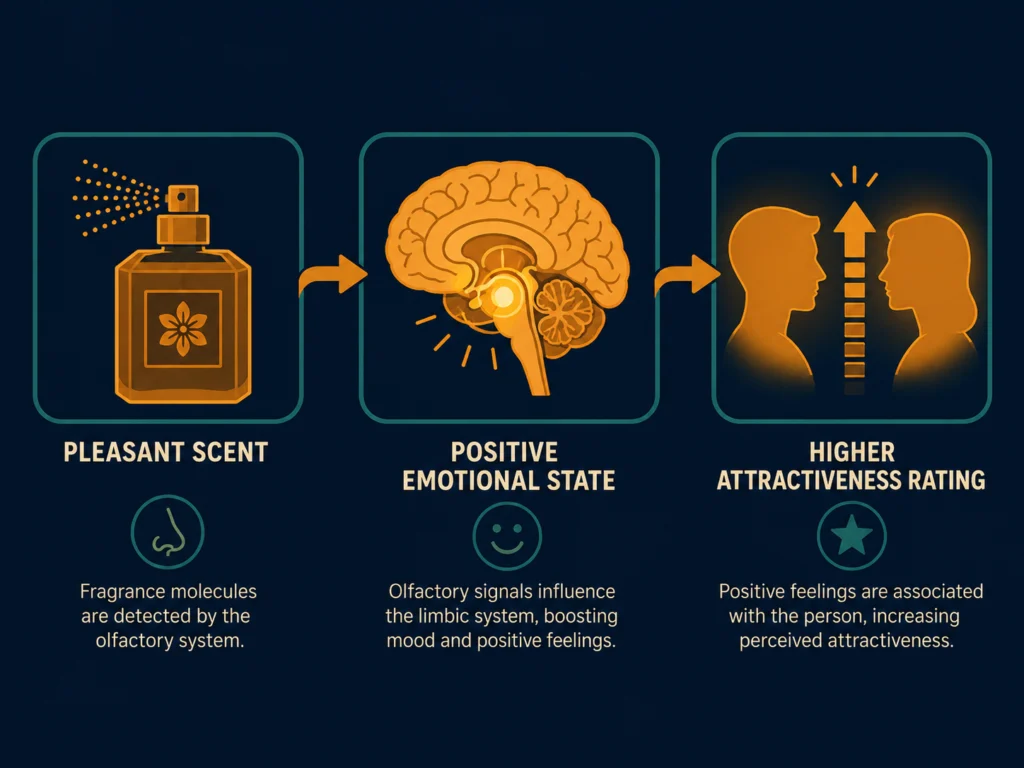
This matters because it means the attraction effect of fragrance is not about a specific note triggering a biological response.
It’s about the pleasant scent creating a positive perceptual frame. The person wearing the scent benefits from that frame.
It also means that which scent you wear matters less than whether the scent is pleasant, well-applied, and contextually appropriate.
The note profiles discussed below are associated with specific types of social signals — but the foundation is simply smelling good.
For the broader context on how olfaction influences all aspects of person perception — not just attraction — see [P00: The Psychology of Fragrance: How Scent Shapes the Way Men Think, Feel, and Are Perceived].
On Pheromones: What the Science Actually Says
Androstadienone (AND) is a steroid compound found at higher concentrations in male sweat.
It has been studied extensively as a candidate human pheromone since the late 1990s.
What the research shows:
- A speed-dating study found that women exposed to androstadienone rated men as more attractive in two out of three study arms.2
- Its effects on mood appear context-dependent — studies suggest the social context matters as much as the compound itself.
- Its effects also vary across the menstrual cycle.
What the research does not show:
- That androstadienone is a reliable human sex pheromone in uncontrolled real-world conditions. A review published in ScienceDirect concluded that its classification as a human sex pheromone “remains inconclusive.”
- That adding synthetic androstadienone or androstenone to a cologne bottle produces the same effects observed under controlled lab conditions.
- That any commercially available pheromone cologne has been validated in peer-reviewed, independent, double-blind research to increase attraction.
The practical position: androstadienone has genuine documented effects on mood and social perception in specific contexts.
The pheromone cologne market has extrapolated aggressively from that research to make claims the evidence doesn’t support.
The compounds in the bottles are real. The marketing around them is not.
What does work — and what you can actually buy — are cologne note profiles that create specific social signals through crossmodal perception. Those are covered below.
Musk: The Proximity Note
Synthetic musk — the kind used in virtually all modern fragrances — produces what perfumers describe as a skin-scent quality: warm, close, slightly animalic, intimate.
It doesn’t project aggressively. It registers most clearly to people who are physically close to you.
This is the mechanism behind its association with attraction. Musk doesn’t announce itself from across a room.
It reveals itself when someone leans in. That architecture — present at close range, invisible from a distance — maps precisely onto the physical context in which attraction actually matters.

There’s no peer-reviewed study that directly links synthetic musk to specific emotional responses in observers. That level of research doesn’t exist yet for individual fragrance notes.
What does exist is decades of perfumery practice and consistent cross-cultural consensus: musk is used as a base note fixative because it extends top notes while adding a skin-warm quality that reads as ease and approachability rather than aggression.
That consensus is why it appears in the base of virtually every mainstream men’s fragrance built for close-range wear.
The practical implication: fragrances with a pronounced musk base are strongest in the contexts where attraction is most relevant — close physical proximity.
They’re not the right tool for projecting across a room, which is why musk-forward fragrances often disappoint people who test them in a store and find them “too subtle.” On skin, in proximity, they perform entirely differently.
How to find it on a bottle: Look for musk listed prominently in the base notes, often paired with amber, woods, or a clean white musk accord. “Skin scent” in fragrance descriptions is usually shorthand for a prominent musk base.
If you want to test this register before committing: YSL Y EDP — musk-amber base, strong longevity, worth comparing to the EDT version.
[PRODUCT LINK — YSL Y EDP, available on Amazon]
[Affiliate link — full disclosure at /affiliate-disclosure]
Amber: Warmth and Intimate Presence
Amber in fragrance isn’t a single material. It’s a blend of resins, typically labdanum and benzoin, sometimes with vanilla and musk, that produces a warm, sweet, slightly smoky depth.
The scent profile reads as warm, settled, and intimate rather than sharp or aggressive.
From an attraction standpoint, amber works similarly to musk but with more sweetness and resinous depth.
The warmth it creates reads as openness and ease — the olfactory equivalent of relaxed, unhurried body language.
It’s not threatening or dominant. It invites rather than demands.
Amber-dominant base notes are a reliable choice for contexts where physical proximity is expected and warmth of personality matters: dates, social gatherings, any setting where interpersonal connection is the goal.
Where it appears in fragrance families: Look for “amber” or “ambergris” (which in modern fragrance almost always means a synthetic approximation) in base note lists.
Oriental and amber fragrance families are built around this accord. The note typically appears as amber, ambre, or as part of an “oriental/amber” family classification.
The warmth and intimate presence that musk and amber create also shapes first impressions in ways that go beyond attraction specifically. For the research on scent’s role in how people judge you in the first 30 seconds, see How Scent Shapes First Impressions in the First 30 Seconds.
Vetiver: Grounded Confidence
Vetiver is extracted from the roots of Vetiveria zizanioides, a grass native to India. The scent is earthy, smoky, slightly woody, with a characteristic dryness — complex rather than sweet, and distinctly grounded.
In the context of attraction research, vetiver doesn’t work the same way musk and amber do. It doesn’t primarily signal intimacy or warmth. It signals composure, groundedness, and quiet authority.
Why this matters for attraction: research on scent and personality perception consistently shows that the traits perceived through fragrance influence attraction independently of physical appearance.1
A fragrance that reads as composed and authoritative increases perceived competence and social status — both of which are documented attraction signals, particularly in contexts where a person’s character and reliability are being assessed.
Vetiver is one of the base notes most consistently associated with this signal. It’s dry where amber is warm, austere where musk is intimate, complex where aquatics are simple.
It’s not a “romantic” note in the conventional sense. It’s a note that communicates that you know exactly who you are — which is a different and often more powerful signal.
How to find it and test it: Vetiver appears as a base note in a wide range of men’s fragrances, from accessible designer options to niche houses.
It pairs particularly well with cedar, smoke, and woody accords. Pure vetiver soliflores also exist and are worth testing if you want to understand the note in isolation before finding it in a more complex fragrance.
Reference point for this register: Guerlain Vetiver EDT — the textbook vetiver fragrance, dry and grounded, nothing added to sweeten it.
[PRODUCT LINK — Guerlain Vetiver EDT, available on Amazon]
[Affiliate link — full disclosure at /affiliate-disclosure]
Sandalwood: Warm Depth With Broader Appeal
Sandalwood is creamier and softer than vetiver — warmer, slightly milky, with a gentle sweetness that makes it more immediately accessible. Like vetiver, it sits primarily in the base and has excellent longevity on skin.
Sandalwood’s association with attraction works through a combination of warmth (shared with amber) and sophistication (shared with vetiver).
It bridges the two registers without fully inhabiting either. The result is a note that reads as approachable but substantive — friendly without being trivial.
In men’s fragrances, sandalwood frequently appears alongside musk and amber in oriental and woody-oriental compositions.
It extends and softens harder base notes and adds the kind of rounded depth that reads as well-considered rather than abrupt.
A note on synthetic vs. natural: Sandalwood appears widely in mid-tier and niche fragrances.
“Sandalwood” in mass-market fragrances is often a synthetic approximation (primarily Javanol or Ebanol) rather than natural Mysore sandalwood, which is significantly more expensive.
Both versions carry the relevant olfactory profile.
For this register in a complete composition: Bleu de Chanel EDP — cedar, labdanum, sandalwood, white musk; accessible enough for daily use.
[PRODUCT LINK — Bleu de Chanel EDP, available on Amazon]
[Affiliate link — full disclosure at /affiliate-disclosure]
What to Avoid in Attraction Contexts
Not every fragrance note fails in attraction contexts — but some create signals that work against the goal.

Heavy synthetic aquatics as the primary profile
Aquatic fragrances (think: Davidoff Cool Water, many Acqua di Giò flankers) are extremely common in men’s fragrance and have their place — they’re clean, fresh, and broadly inoffensive.
The issue is that they’ve become so common they’ve lost distinctiveness. A fragrance that reads as generic projects nothing about the wearer except that they use cologne.
Aquatics also tend to be top-note heavy, meaning they project strongly in the first 30 minutes and fade significantly. For attraction contexts, where close-range longevity matters most, this is a structural problem.
Overloaded gourmand sweetness
Fragrances built primarily around heavy vanilla, caramel, or dessert-type sweetness can read as juvenile or overwhelming in adult social contexts.
These notes aren’t wrong in isolation — many well-constructed orientals use vanilla as part of a balanced composition. The issue is when sweetness dominates to the point where the fragrance reads as candy rather than skin.
Heavy projection in enclosed spaces
This applies to any note family: excessive sillage in a small, enclosed space (a dinner table, a car, a small office) overwhelms rather than attracts.
The research on crossmodal perception suggests pleasant scents increase attractiveness ratings — but “pleasant” is context-dependent.
A fragrance that’s pleasant at arm’s length can become unpleasant at 30 cm in a closed room. Projection control is an application issue as much as a formulation one.
The confidence mechanism discussed in How Cologne Affects Your Confidence is equally relevant here — the behavioral changes triggered by wearing a scent you feel confident in are part of the attraction equation, not separate from it.
FAQ
The compound most studied in pheromone research — androstadienone — does show context-dependent effects on women’s mood and attractiveness ratings in controlled lab conditions. But its classification as a human pheromone remains scientifically contested, and no commercially available pheromone cologne has been validated in independent, peer-reviewed research to produce reliable attraction effects.
Based on the available research, musk and amber are most associated with warmth and intimate presence (relevant at close range). Vetiver and sandalwood are associated with groundedness and quiet authority (which functions as an attraction signal through perceived competence and composure). The foundation for all of them is Spence’s (2021) crossmodal research showing that pleasant fragrance increases attractiveness judgments through a generalized positive perceptual frame.
No single formulation. The research points toward note profiles (musk/amber for warmth, vetiver/sandalwood for authority) and application principles (appropriate projection for the context, longevity in the base notes). Within those parameters, the specific fragrance matters less than how it develops on your skin chemistry.
Price is not a variable in the attraction research. The crossmodal effect documented by Spence (2021) is triggered by pleasant scent, not by fragrance cost. Affordable fragrances with the relevant note profiles produce the same perceptual effects.
Fewer than you think. The attraction research is built on close-range scent detection, not room-filling projection. Two to three sprays on pulse points (chest, wrists, neck) is sufficient for most fragrances. In enclosed social settings — a restaurant, a small gathering — err toward two sprays of a concentrated EDP rather than four sprays of an EDT.
Conclusion
The research on scent and attraction is real, specific, and more nuanced than most cologne marketing acknowledges.
Pleasant fragrance measurably increases how attractive a person is perceived to be, through crossmodal affective priming, not through any magical or biological mechanism.
Musk and amber create warmth and intimate presence at close range. Vetiver and sandalwood signal composure and quiet authority.
Together, these note profiles cover the two primary registers through which scent influences attraction: approachability and substance.
Pheromone colognes sit in a separate category. Some of the underlying chemistry is real.
The marketing built around it is not, and no product in that category has been validated in independent research.
The practical starting point: find a fragrance built around the note profiles above, test it on skin (not paper), and apply it with restraint. The research does the rest.
For the full breakdown on androstadienone, pheromone marketing, and what the research actually supports, see [A19: Pheromone Colognes — What the Science Actually Says].

We research the psychology behind fragrance and grooming. Every article on this site is built on peer-reviewed research, tested on real skin, and written to explain the why behind what works.
Learn more on our About page.
Footnotes
- Spence, C. (2021). The scent of attraction and the smell of success: crossmodal influences on person perception. Cognitive Research: Principles and Implications, 6(1), 46. https://doi.org/10.1186/s41235-021-00311-3 ↩ ↩2 ↩3
- Saxton, T.K., Lyndon, A., Little, A.C., & Roberts, S.C. (2008). Evidence that androstadienone, a putative human chemosignal, modulates women’s attributions of men’s attractiveness. Hormones and Behavior, 54(5), 597–601. https://doi.org/10.1016/j.yhbeh.2008.06.001 ↩ ↩2
- Wyart, C., Webster, W.W., Chen, J.H., Wilson, S.R., McClary, A., Khan, R.M., & Sobel, N. (2007). Smelling a single component of male sweat alters levels of cortisol in women. Journal of Neuroscience, 27(6), 1261–1265. https://doi.org/10.1523/JNEUROSCI.4430-06.2007 ↩