


- Cologne affects your confidence through a behavioral feedback loop, not just by making you smell good to others.
- A peer-reviewed University of Stirling study found men wearing a fragranced spray reported measurably higher self-confidence within 15 minutes of application, rising further over 48 hours.
- An independent panel of women rated the fragrance group as more attractive in muted video clips — meaning they detected real behavioral changes, not the scent itself.
- The mechanism: olfactory signals hit the brain’s limbic system (amygdala and hippocampus) before conscious thought, shifting your internal state before you’ve made a deliberate decision.
- Woody base notes (vetiver, cedarwood, sandalwood) and amber are most associated with the grounded, composed qualities that read as confident in social contexts.
- Wear a scent you genuinely like, wear it consistently, and apply it 30 minutes before you need it. Those three habits maximize the effect.
Most men assume cologne is about other people. You put it on so someone else notices. That framing misses what’s actually happening.
At Mascudo, we’ve spent a lot of time testing fragrances and talking to men about why they wear them. The answer is almost always “for others.”
But the research points somewhere different: the most significant effect runs from the scent to your own brain, before anyone else gets close enough to smell you.
What the Research Actually Measures
In 2009, researchers at the University of Stirling ran a double-blind experiment: male participants were given either an aerosol spray containing fragrance and antimicrobial ingredients, or an otherwise identical spray with no active components.
Neither group knew which they had received.1
Over several days of testing, the fragrance group reported higher self-confidence and higher self-perceived attractiveness than the placebo group.
The confidence lift appeared within 15 minutes of first application and continued to climb across 48 hours of use.
Then came the key test. An independent panel of women watched muted video clips of both groups. They couldn’t smell anything. They were rating body language only.
The fragrance group was judged significantly more attractive in those videos.
The photographs — still images with no behavioral information — showed no difference between the two groups. It was the movement, the posture, the way these men carried themselves, that changed.
Fragrance altered their behavior in ways a camera could capture but a nose couldn’t access.
A 2024 EEG study published in Behavioural Brain Research confirmed this pattern holds across multiple studies: self-perceived physical attractiveness and self-confidence are enhanced when men apply a pleasantly fragranced product, and those internal changes translate into perceptible shifts in non-verbal behavior that independent observers can detect.2
Why This Isn’t a Placebo Effect — It’s a Feedback Loop
A placebo effect implies that believing something works is all that’s driving the result. What the fragrance confidence research describes is something more structural: a behavioral feedback loop with multiple reinforcing stages.
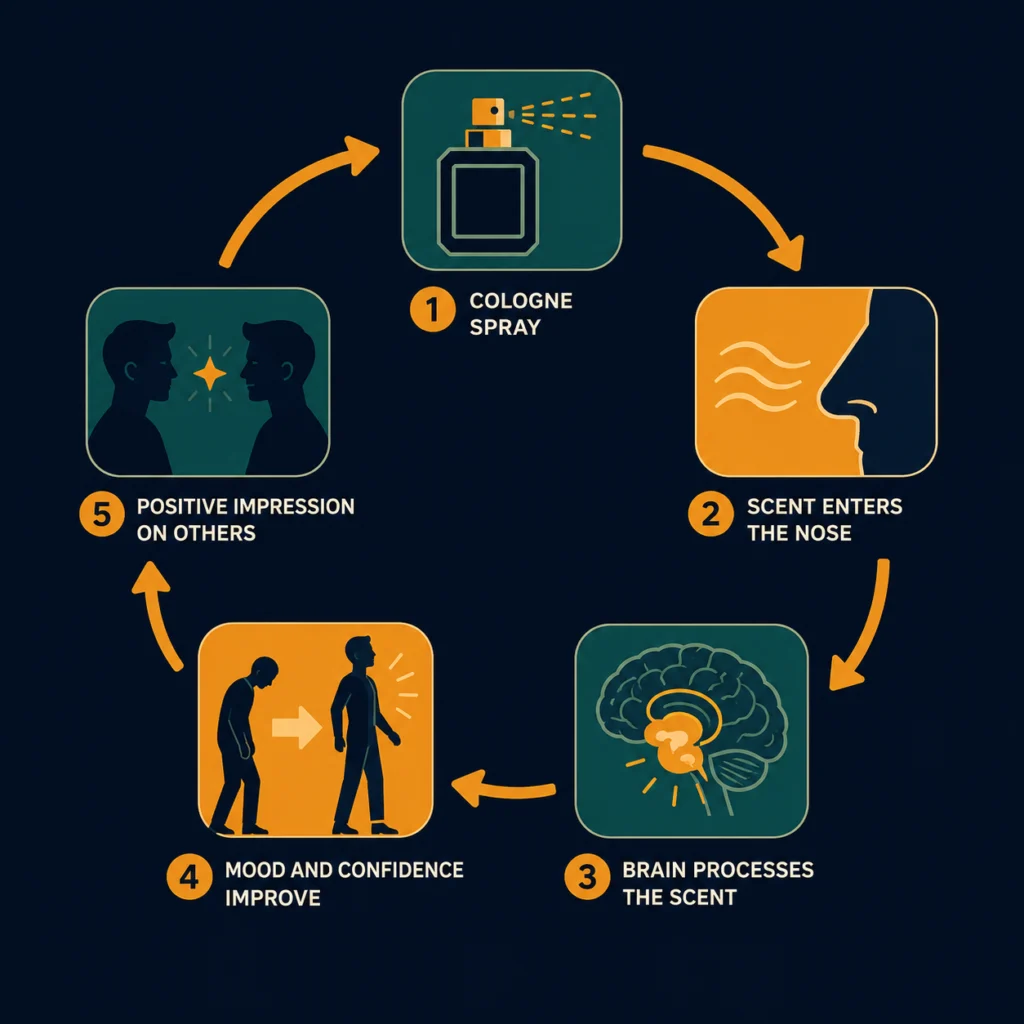
The chain goes like this:
- You apply cologne. You smell it on yourself.
- Your olfactory system sends signals directly to the limbic system — the part of the brain responsible for emotion and memory — bypassing the thalamic relay that every other sense goes through first.3
- This produces an immediate, pre-conscious emotional response. Before you’ve thought anything, your brain has processed the scent as a positive stimulus.
- That emotional state shifts your posture, your eye contact, your vocal tone, your pacing. None of this is deliberate.
- Other people read those behavioral changes and form judgments based on what they see.
The Roberts et al. study captured exactly this chain. The women rating the muted videos weren’t imagining things — they were correctly detecting real behavioral differences between the two groups.
Scent changed the men’s behavior, and behavior changed how they were perceived.
This is also why the effect compounds over days of use, as the study showed. Each time you apply a scent you’ve come to associate with feeling confident, the neural pathway reinforces. The scent becomes a reliable trigger.
“This process also explains why the same cologne can produce different confidence effects on different people — your existing associations with a scent shape the response you get from it. More on how body chemistry and personal history affect fragrance in Why Cologne Smells Different on You Than on Anyone Else.”
The Limbic System Connection
Smell is anatomically unusual. Every other sense — sight, hearing, touch, taste — routes signals through the thalamus before they reach the cortex for conscious processing. Olfaction doesn’t.
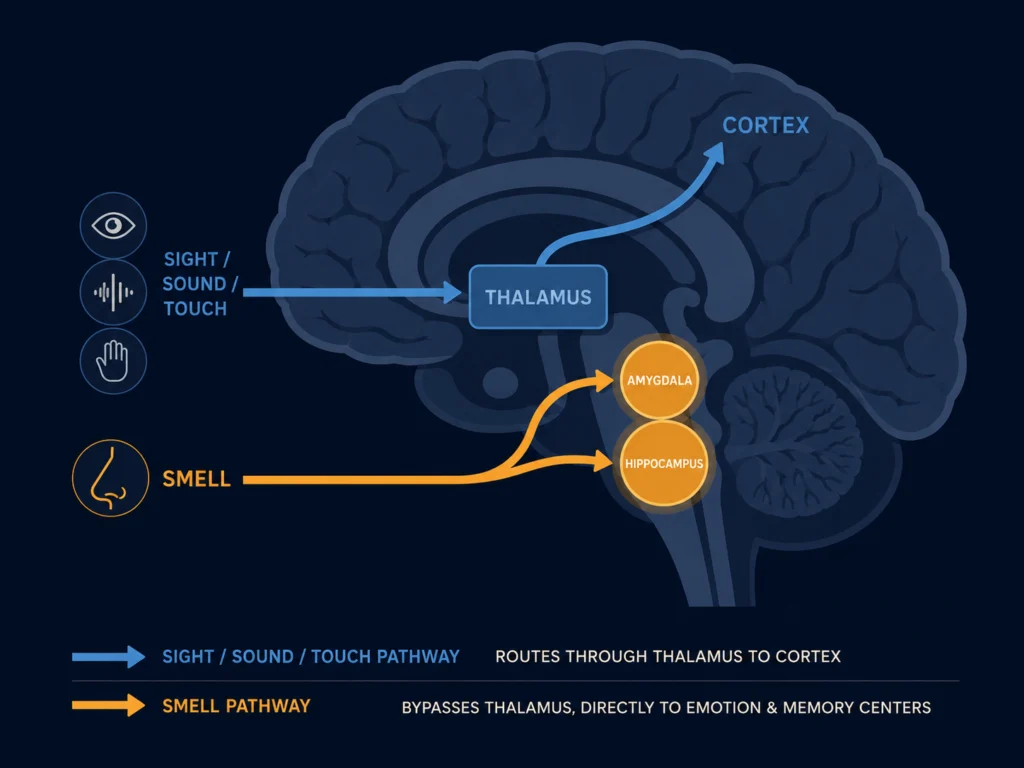
Odor information travels from the olfactory bulb directly to the amygdala and hippocampus: the brain structures most involved in emotional response and memory formation.
What this means practically: your brain has emotionally processed a smell before you’ve consciously identified it. The judgment arrives before the analysis.
This is why a scent can shift your internal state faster than almost any other input. Not metaphorically. It’s the literal wiring of the olfactory pathway.
Researchers at the NCBI describe this arrangement as providing olfaction with “a unique and potent power to influence mood, acquisition of new information, and use of information in many different contexts including social interactions.”
For confidence, this matters because the emotional state produced by smelling your own cologne is immediate and automatic.
You don’t decide to feel more composed. The scent initiates the state before deliberate thought enters the picture.
“For a broader look at how this neurological pathway connects to every aspect of how you’re perceived — from attraction to first impressions — see [P00: The Psychology of Fragrance: How Scent Shapes the Way Men Think, Feel, and Are Perceived].”
Note Profiles That Are Most Associated with Confidence
The research above tells us that fragrance produces a confidence effect, but doesn’t specify which fragrance.
For that, the evidence shifts from peer-reviewed studies to something less controlled but still worth knowing: decades of professional consensus in perfumery, and the well-documented pattern of how base notes develop on skin over time.
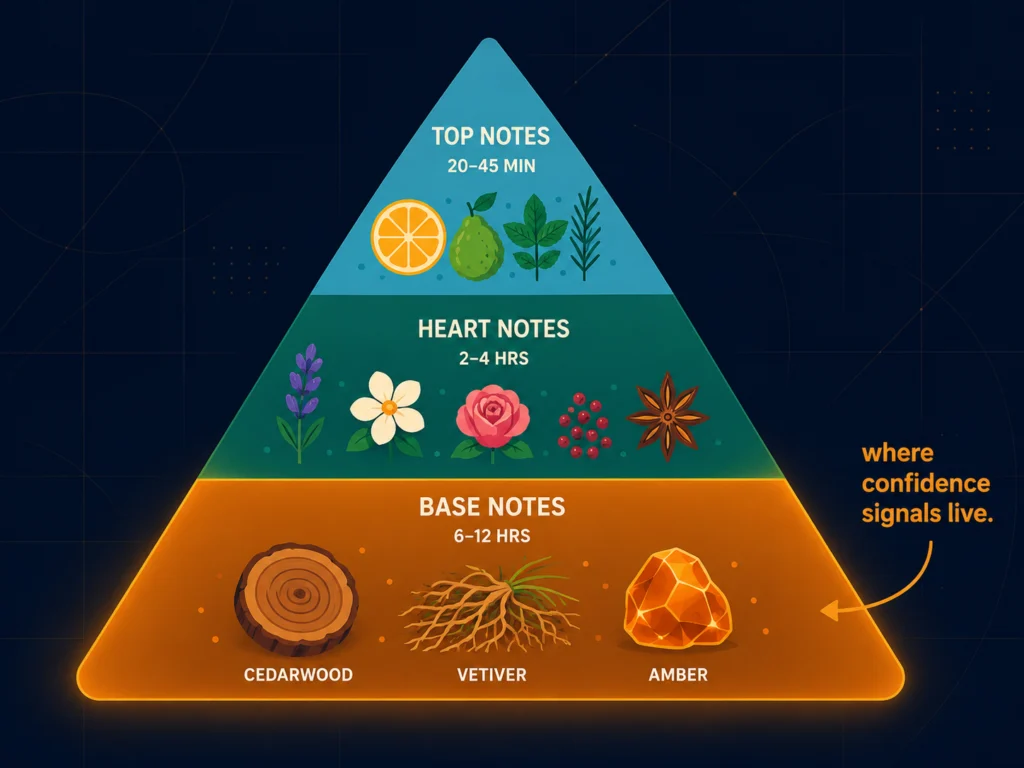
Woody base notes — cedar, vetiver, sandalwood
These notes sit in the base of a fragrance, meaning they appear after the top notes evaporate (usually 30 minutes to an hour after application) and persist for hours.
They read as grounded, stable, and authoritative. Vetiver in particular has a dry, earthy depth that fragrance professionals consistently associate with composure rather than agitation.
Sandalwood is softer — creamy and warm — but shares the quality of reading as settled rather than anxious.
If the confidence effect works partly through how your fragrance reads to other people, base notes that communicate groundedness support the signal you’re trying to send.
Amber
Amber isn’t a single ingredient. It’s a blend of resins and musks that produces a warm, slightly sweet, slightly smoky character.
It creates what perfumers describe as a “skin scent” quality: close, warm, intimate. This warmth reads as ease rather than effort, which maps onto confident rather than striving.
What to limit in contexts where confidence matters
Overly sharp green or aquatic top notes can dominate a fragrance before the warmer base notes emerge.
In an enclosed space — a meeting room, an elevator, a first handshake — top-heavy fragrances project more aggressively than their wearers often realize.
Keeping the opening clean and allowing the base to develop is a more controlled presentation.
Heavy, sweet gourmand notes (vanilla dessert-type fragrances) are enjoyable on their own terms but don’t tend to read as authoritative in professional contexts. They’re not wrong — they’re contextually mismatched.
Looking for a cologne built around those note profiles? One that consistently performs at a price point that doesn’t require a special occasion:
[PRODUCT LINK — recommend: a cedar/vetiver/amber-based EDT, e.g., Terre d’Hermès EDT or a similar woody-amber profile available on Amazon]
[Full disclosure: this is an affiliate link. We earn a small commission if you purchase — at no cost to you.]
How to Use This When Choosing Your Next Cologne
The research points toward a few practical principles:
Wear a scent you actually like. The Roberts et al. study noted that men who expressed a preference for their allocated deodorant showed the strongest behavioral improvements.
Scent you find unpleasant doesn’t trigger the same positive self-perception loop. This isn’t obvious — men often choose cologne based on what they think others will like.
The data suggests your own response to the scent matters as much or more than anyone else’s.
Wear it consistently. The confidence lift grew over 48 hours of repeated use in the study. Consistency builds the neural association between the scent and the positive internal state.
A cologne you wear once a month doesn’t become a reliable confidence trigger. One you wear most days does.
Test on skin, not paper. Your body chemistry changes how a fragrance develops, particularly in the base notes — the ones most associated with confidence and groundedness.
A cologne that smells flat on a paper strip at a counter might open into something entirely different on your skin after 30 minutes.
“If you’re still working out which scent to wear consistently, the most systematic approach is to work through fragrance families before committing to specific bottles. We walk through the full process in [A08: How to Find Your Signature Scent as a Man].”
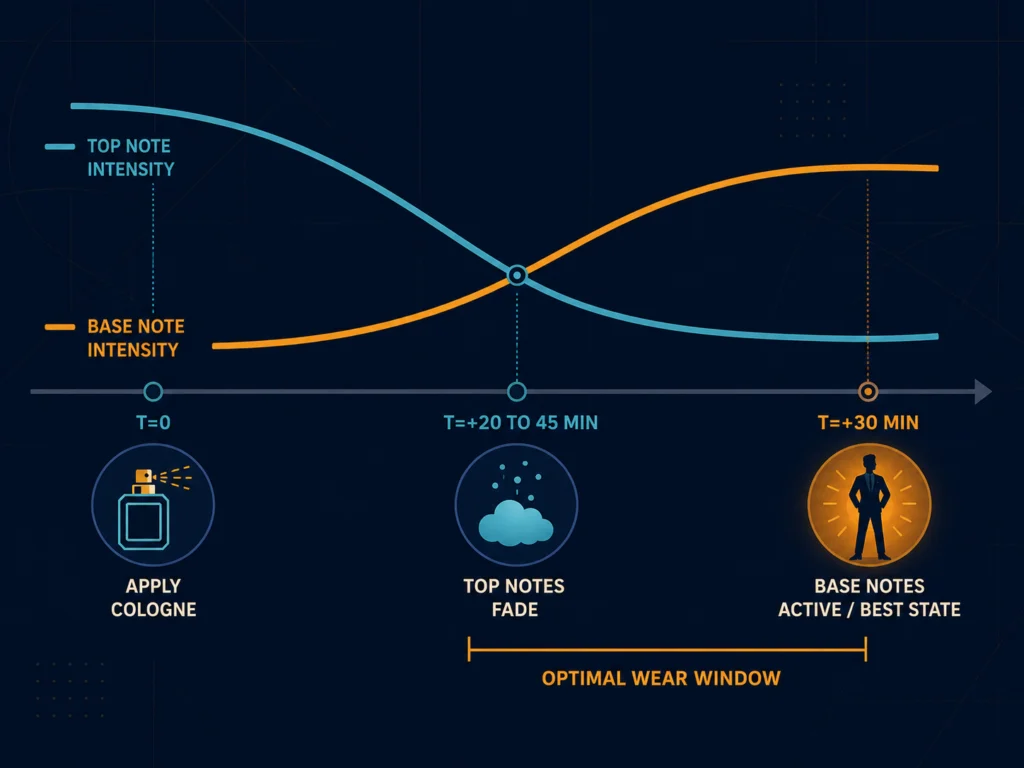
Apply before you need to feel confident, not as you’re walking out the door. Top notes are the first thing you and everyone else smells, but they evaporate within 20–45 minutes.
The base notes — the ones that last and carry most of the psychological weight — need time to develop. Applying 30 minutes before a meeting or event means the fragrance is in its most composed, grounded phase when it matters.
The Note-to-Confidence Connection Is Real, But Limited
One clarification worth making: fragrance doesn’t manufacture confidence that isn’t there. What the research shows is that it amplifies the expression of a state that already exists.
Men in the Roberts et al. study who already felt reasonably confident showed more pronounced behavioral changes. The fragrance didn’t replace other foundations — it extended them into behavior.
This also means the effect is more reliable when the rest of your presentation is consistent. A cologne that makes you carry yourself better sits alongside — not instead of — sleep, preparation, and actual competence in whatever you’re doing.
“Once you understand the confidence mechanism, the logical next question is what note profiles are most linked to how other people judge you in social contexts. The research on that is specific and worth knowing. See The Fragrance Notes Most Linked to Attraction — What Research Shows.”
FAQ
Research published in the International Journal of Cosmetic Science found that men who used a fragranced spray reported measurably higher self-confidence within 15 minutes, an effect that increased over 48 hours. Independent observers watching muted videos of those men rated their body language as more attractive — without being able to smell them. The mechanism is a behavioral feedback loop: scent affects self-perception, and self-perception changes behavior.
Woody base notes — particularly vetiver, cedarwood, and sandalwood — and warm amber accords are most consistently associated with the grounded, composed quality that reads as confident in social contexts. They also have the advantage of longevity: they’re still present hours after application, when first impressions matter most.
In the Roberts et al. (2009) study, self-confidence scores increased within 15 minutes of first application and continued rising over 48 hours of continued use. The effect is both immediate and cumulative.
Both matter, but the research suggests your own response to the scent is at least as important. Men who preferred their allocated fragrance showed the strongest behavioral improvements in the Roberts et al. study. A cologne you genuinely enjoy wearing creates a more reliable confidence effect than one you chose based on what you thought others would like.
There’s no research indicating that price determines the confidence effect. The mechanism depends on how you respond to the scent and how consistently you wear it — not on the brand or retail cost.
Conclusion
The confidence effect of cologne isn’t wishful thinking or marketing copy.
It’s a documented behavioral feedback loop: fragrance reaches the limbic system before conscious thought, shifts your internal state, changes your posture and non-verbal behavior, and those changes are detectable by people who can’t even smell you.
The practical implication is straightforward. What you wear matters less than wearing it consistently, choosing something you genuinely like, and giving the fragrance enough time to develop before you need it.
The science makes a clear case for cologne as something that changes how you function, not just how you smell.
If you’re starting from scratch and want a structured way to find a scent worth wearing every day:
[PRODUCT LINK — recommend: a men’s fragrance discovery/sampler set available on Amazon, e.g., a multi-brand or single-house sample kit]
Starting with a discovery set lets you test on skin — the only way to know how a fragrance actually develops on your chemistry. [Full disclosure: affiliate link.]

We research the psychology behind fragrance and grooming. Every article on this site is built on peer-reviewed research, tested on real skin, and written to explain the why behind what works.
Learn more on our About page.
Sources
- Roberts, S.C., Little, A.C., Lyndon, A., Roberts, J., Havlicek, J., & Wright, R.L. (2009). Manipulation of body odour alters men’s self-confidence and judgements of their visual attractiveness by women. International Journal of Cosmetic Science, 31(1), 47–54. https://doi.org/10.1111/j.1468-2494.2008.00477.x ↩
- Davies-Owen, J., Roberts, H., Scott, M., Thomas, A., Sen, S., Sethna, S., Roberts, C., Giesbrecht, T., & Fallon, N.B. (2024). Beauty is in the nose of the beholder: Fragrance modulates attractiveness, confidence and femininity ratings and neural responses to faces of self and others. Behavioural Brain Research, 465, 114932. https://doi.org/10.1016/j.bbr.2024.114932 ↩
- Aqrabawi, A.J., & Kim, J.C. (2018). Olfactory memory representations are stored in the anterior olfactory nucleus. Nature Communications. / Cleveland Clinic: Limbic System anatomy overview (2026). https://my.clevelandclinic.org/health/body/limbic-system ↩ ↩2