

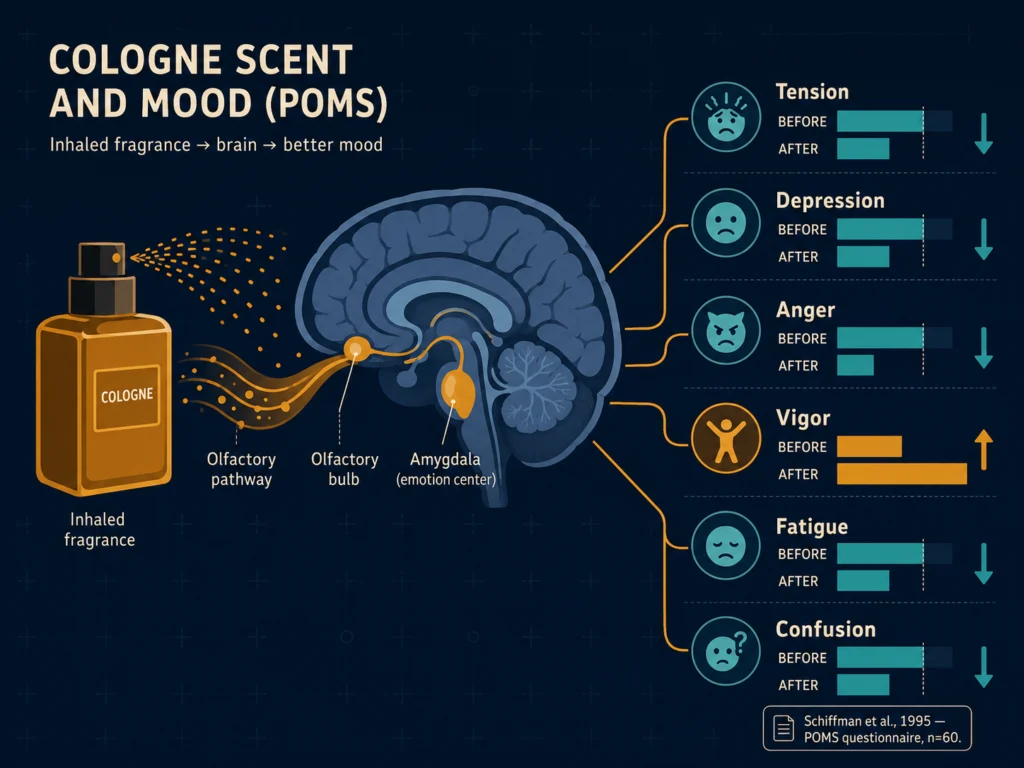
- Yes. A peer-reviewed study measured mood in 60 men aged 40 to 55 using the Profile of Mood States (POMS) questionnaire across baseline, fragrance, and placebo conditions. Cologne use produced significantly better scores on all six POMS dimensions: tension, depression, anger, vigor, fatigue, and confusion. The fragrance condition outperformed both baseline and placebo.
- A separate 2023 study published in Brain and Behavior found that lemon essential oil inhalation improved working memory task performance and activated prefrontal cortex regions associated with attention and concentration. Citrus notes in cologne contain the same active aromatic compounds, primarily linalool and limonene.
- A 2023 systematic review in Healthcare covering 11 trials found that lavender inhalation significantly reduced anxiety in 10 of those 11 studies. Lavender appears in the base and heart of many men’s fragrances.
- The mood effect depends on two things: you need to find the scent pleasant, and you need to wear it consistently. A cologne you dislike won’t produce the same result.
- This is not aromatherapy. The concentrations in cologne are lower than clinical essential oil studies. The mechanisms are real; the magnitude is proportionally smaller.
Most men wear cologne because of how it affects other people.
The research suggests the more significant effect runs in the opposite direction: from the scent, to your brain, before anyone else gets close enough to notice.
Three bodies of evidence support this: a controlled study using a validated mood questionnaire, EEG research on specific aromatic compounds and brain activation, and a systematic review of lavender anxiety research.
None of them were conducted to sell cologne. The findings are worth knowing.
The POMS Study
The most direct evidence comes from a 1995 study by Schiffman et al., published in Brain Research Bulletin.1 Sixty men aged 40 to 55 participated, split equally between European-American and African-American participants.
Researchers used the Profile of Mood States (POMS), a validated psychological instrument measuring six mood dimensions: tension, depression, anger, vigor, fatigue, and confusion.
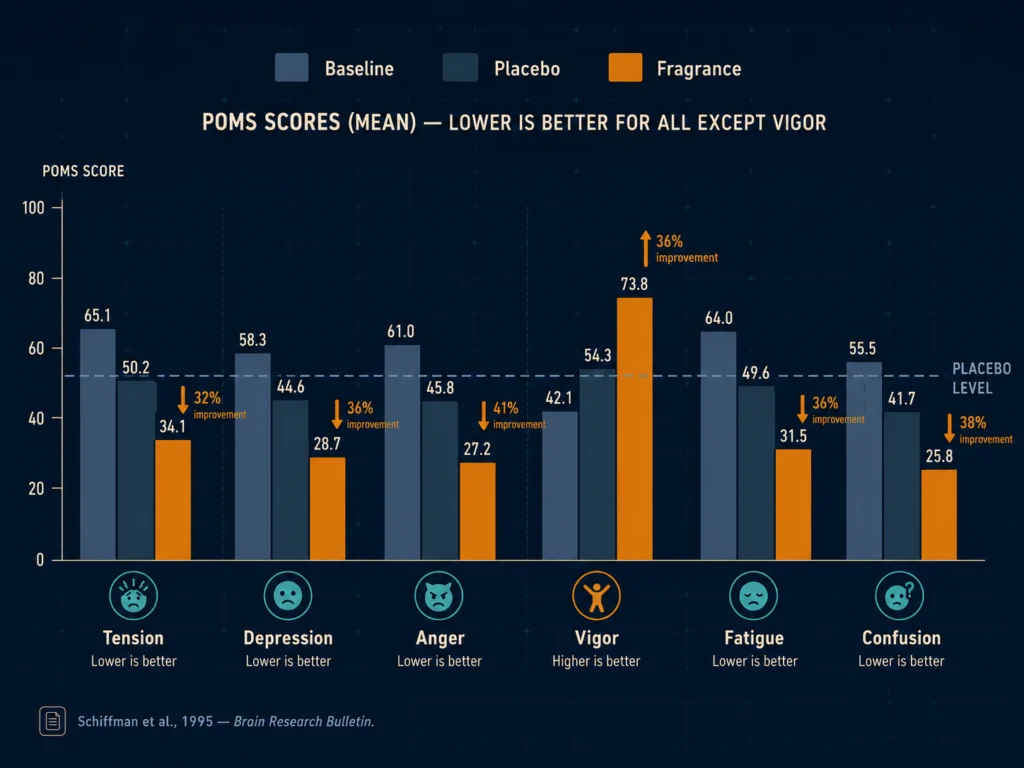
The study ran in three phases: a baseline period with no fragrance, a fragrance period, and a placebo period using an identical-looking product without active fragrance components.
Fragrance won on every measure. POMS scores for the fragrance condition were significantly better than baseline for tension, depression, anger, fatigue, and confusion, and better than placebo on all six factors including vigor.
The Total Mood Disturbance score, a composite across all six dimensions, was significantly lower during cologne use than in either the baseline or placebo conditions.
The placebo comparison is the important part. It separates the effect of doing a grooming ritual from the effect of the fragrance itself.
Participants doing a grooming ritual with a non-scented product did not show the same mood improvement. The scent was driving the difference.
What this tells you: Daily cologne use produces a measurable positive effect on multiple mood dimensions in middle-aged men. This is documented, controlled, and replicated across two independent samples in the same study.
What this doesn’t tell you: Whether the effect applies equally across all age groups, all fragrance types, or all individuals. The 60 participants were adult men in a specific age range. And as noted below, the effect is not independent of preference.
The mood improvement connects directly to the confidence mechanism covered in How Cologne Affects Your Confidence — The Science Behind It. The behavioral changes that make you more confident are partly driven by the same mood-state shift the POMS study captured.
A Note on What This Research Does and Doesn’t Establish
This article covers real, peer-reviewed research on fragrance and mood. A few limits are worth stating clearly.
The POMS study (Schiffman et al., 1995) is from the mid-1990s. It hasn’t been replicated at larger scale with modern methodology.
The sample was 60 men in two specific ethnic groups. It is directionally credible, consistent with broader olfactory mood research, but not a definitive, universally applicable finding.
The EEG studies on citrus and lavender were conducted using concentrated essential oils, not cologne.
The aromatic compounds overlap, but cologne concentrations are lower than clinical aromatherapy doses. The mechanisms are real; the magnitude in real-world cologne use is proportionally smaller.
This article is not making a case for fragrance as a mood treatment or a substitute for anything clinical.
It’s making a case that the mood effect is real, documented, and worth understanding, so you can use it with accurate expectations.
The Citrus and Alertness Connection
Lemon and citrus scents are consistently associated with alertness, energy, and cognitive performance in the research, more so than any other fragrance category.
A 2023 study published in Brain and Behavior (Ueda et al.) measured EEG brain activity before and after lemon essential oil inhalation while participants performed a working memory task.2
Lemon inhalation produced delta and theta band activation in the prefrontal cortex, including the anterior cingulate gyrus, regions associated with attention and cognitive control. Task performance improved after inhalation.
A separate EEG study involving 42 participants compared lemon and lavender scents during a virtual reality task. Lemon produced activation; lavender produced relaxation.3 The differentiation was measurable across participants, not just self-reported.
The active compounds in lemon and citrus essential oils, primarily limonene and linalool, are present in cologne formulations that feature citrus top notes.
Bergamot, grapefruit, neroli, and lemon are among the most common citrus notes in men’s fragrance. They’re particularly dominant in the top note phase, the first 20 to 45 minutes after application.
Practical use: A citrus-forward fragrance applied in the morning, before focused work or an important meeting, puts those alertness-associated compounds in your olfactory environment when cognitive performance matters most. The effect is real, though proportionally lower than clinical essential oil doses.
What to look for: Bergamot, grapefruit, neroli, lemon, and petitgrain in the top note list. These are common enough that most fresh and aromatic men’s fragrances contain at least one.
The Lavender and Calm Connection
Citrus maps to alertness. Lavender maps to calm. The evidence base is substantially larger.
A 2023 systematic review by Yoo and Park, published in Healthcare, examined 11 controlled trials of lavender inhalation for anxiety reduction.4
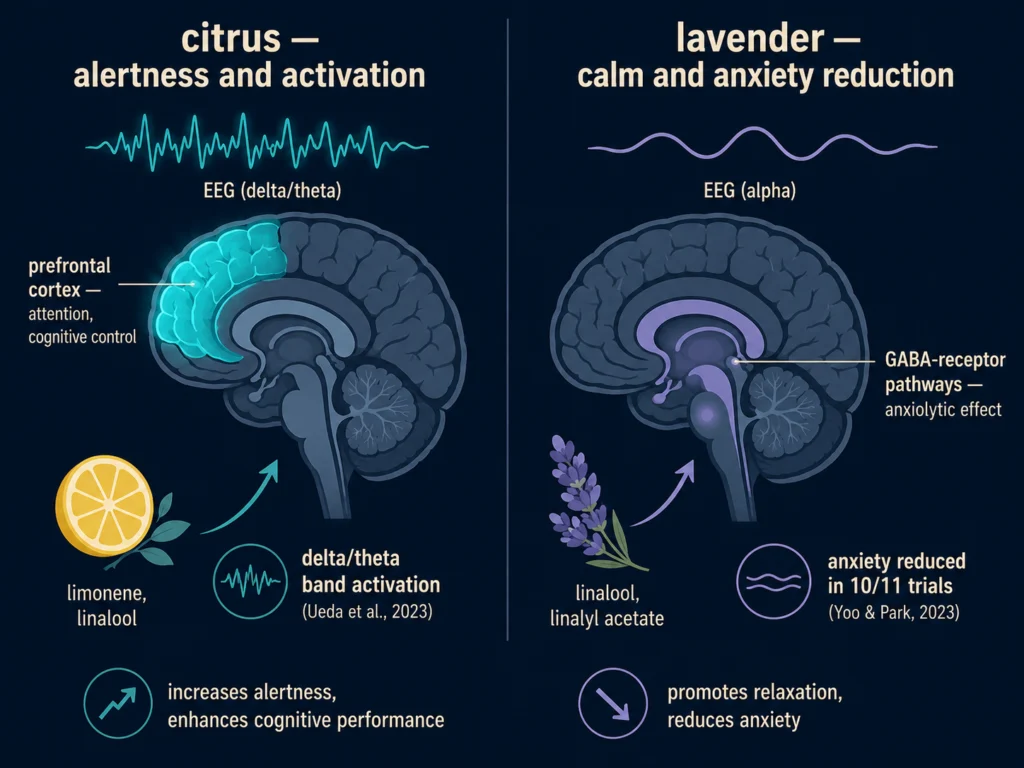
Ten of the 11 trials reported significantly decreased anxiety after lavender inhalation. Three trials included physiological measures, blood pressure, heart rate, and respiratory rate, all showing effects consistent with reduced anxiety.
The active compounds are linalool and linalyl acetate, which appear to work through GABA-receptor pathways.
They influence the same neurological systems that anti-anxiety medications target, though at far lower concentrations and with correspondingly smaller effects.
A 2016 pilot study in Vienna found that lavender and sandalwood inhalation together reduced both blood pressure and salivary cortisol in 32 participants.
Cortisol is the body’s primary stress hormone. Measurable reductions from olfactory input suggest a real physiological mechanism, not just a subjective feeling.
Lavender appears in the heart and base of many men’s fragrances, often paired with coumarin, woods, and musks in the fougère family.
If the warm, aromatic base of your cologne includes lavender, you’re getting some of those calming compounds in the hours after the citrus top notes have cleared.
Practical use: Woody-aromatic compositions with lavender in the heart are appropriate for high-stress contexts where you want to feel settled rather than stimulated: a long workday, travel, a difficult meeting.
Two fragrances that put these note profiles to practical use, one citrus-forward for mornings, one lavender-grounded for calm:
[PRODUCT LINKS — recommend: Terre d’Hermès EDT (citrus-vetiver, alertness-adjacent morning profile) and Yves Saint Laurent Kouros EDT or similar lavender-fougère for calm — both available on Amazon]
The Preference Variable
The mood effect depends on whether you like the scent. The research makes this explicit, and most cologne advice glosses over it.
The Roberts et al. (2009) study found that men who preferred their allocated fragrance showed stronger behavioral and self-perception improvements than men who were neutral about it.
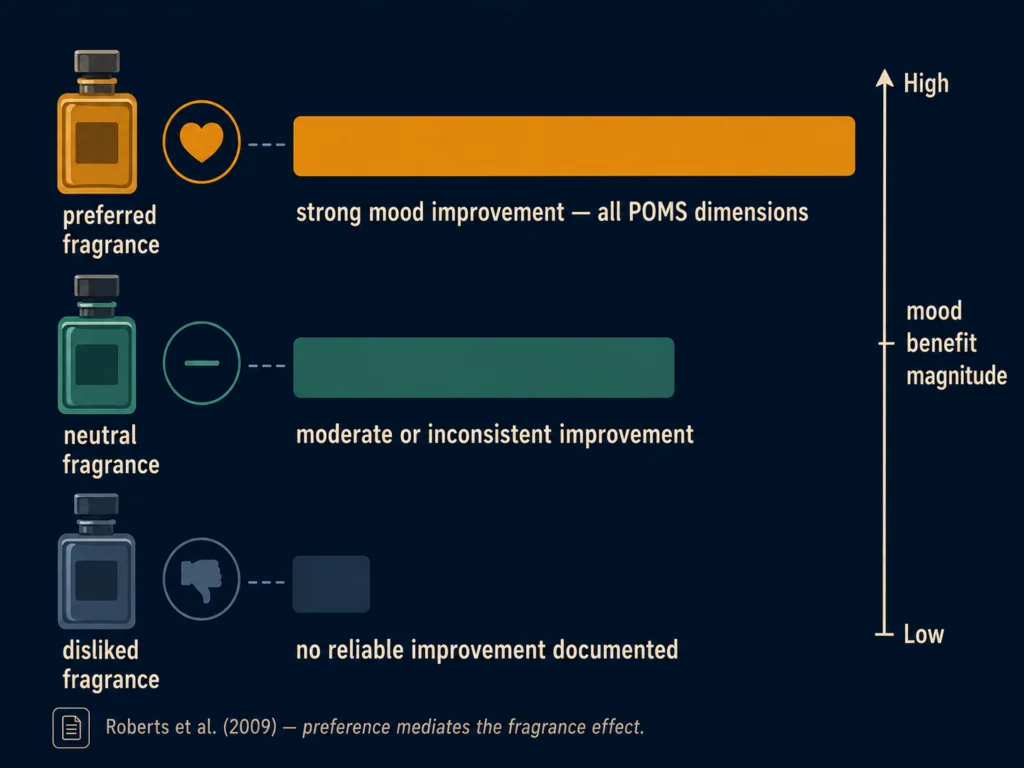
The POMS study used fragrances described as pleasant to participants. There’s no evidence that wearing a cologne you find unpleasant produces the same mood benefit.
“Wear a pleasant fragrance” is not generic advice. It means a fragrance you find pleasant, not one you chose because it was expensive, well-reviewed, or smells good on someone else. Your personal response to the scent is a variable in the outcome.
If you’re wearing a cologne you’re indifferent to, or one you’ve grown tired of, the mood mechanism is not reliably active.
Finding a fragrance you genuinely prefer is about more than smelling good. It’s about finding the one that will actually produce the mood and confidence effects the research describes.
The systematic process for finding a fragrance you genuinely prefer, including skin testing across fragrance families and the 30-minute and 3-hour evaluation checkpoints, is in How to Find Your Signature Scent as a Man.
Using This Intentionally
The research supports a specific and simple practice: apply a fragrance you genuinely like, consistently, as part of your morning routine.
The POMS improvements came from daily use, not occasional wear, not rotating through a collection.
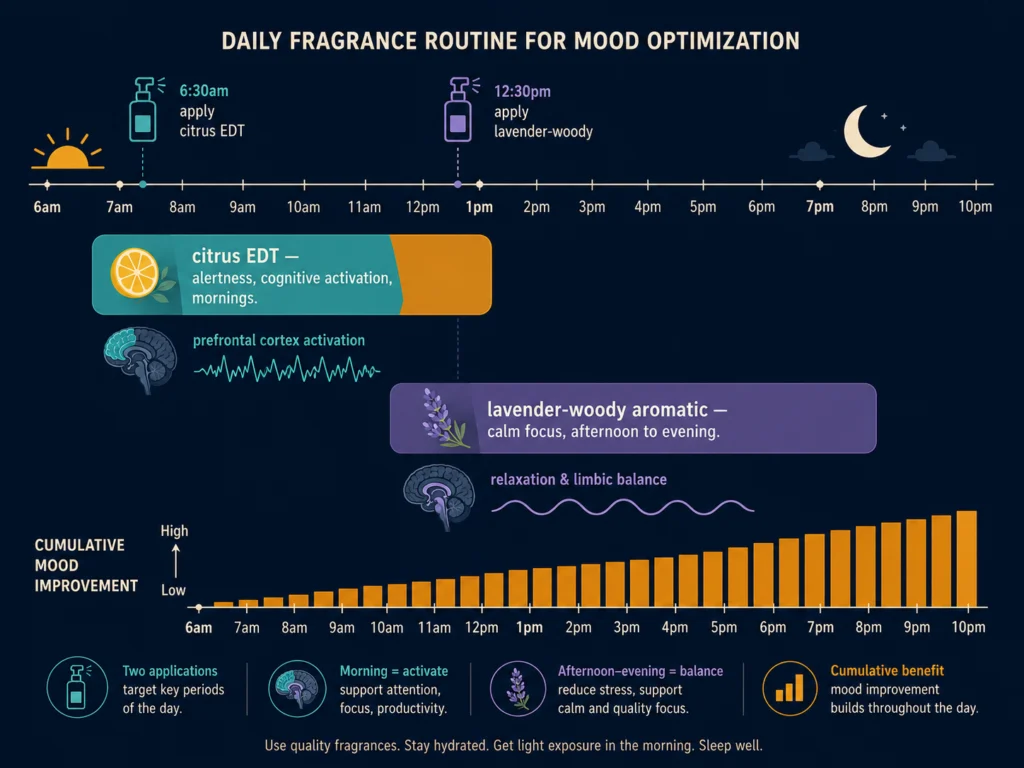
The scent you apply every morning builds a reliable neural association between the fragrance and your positive baseline state. Over time, that association strengthens. The scent becomes a cue that triggers the state.
The note profile matters for direction. Citrus and fresh-aromatic fragrances front-load their impact in the morning hours when alertness matters most.
Lavender-grounded fougères and woody-aromatics carry their calming properties into the afternoon and evening. Building a two-bottle rotation around these two registers, one for energy, one for calm, gives you something calibrated to your daily rhythm.
Timing: Apply 20 to 30 minutes before you need the effect to be in its settled phase. Top notes are the most volatile part of any fragrance.
By the time you arrive at your desk or your meeting, you want the heart notes actively present, not the sharp opening blast. That’s where the relevant aromatic compounds are most concentrated.
For how to match your fragrance to the specific demands of different contexts throughout your day, including professional, social, and evening situations, see How to Match Your Cologne to the Occasion — A Psychology-Based Guide.
What Cologne Can and Can’t Do for Your Mood
This section exists because the research is real but the claims around it often aren’t.
What the evidence supports:
Daily cologne use with a preferred fragrance measurably improved mood in the POMS study across six dimensions in middle-aged men.
Citrus aromatic compounds produce EEG changes consistent with alertness and cognitive activation.
Lavender compounds reduce anxiety in controlled trials. Sandalwood and lavender together reduced cortisol in a small pilot study.
What the evidence does not support:
Cologne as a treatment for depression, anxiety disorders, or clinical mood conditions.
The POMS improvements were meaningful within the normal mood variation of healthy adults, not therapeutic-scale changes for people experiencing clinical symptoms. Any source claiming otherwise is misrepresenting the research.
The honest position: Daily cologne use is one input in a set of behaviors that affect how you feel and perform.
It’s a genuine, low-effort one. You’re doing a grooming routine anyway. The evidence supports doing it with a fragrance you actually like rather than one you’re indifferent to.
If you don’t currently have a fragrance you reach for without thinking, a discovery set lets you test across families before committing. The mood effect only works if you genuinely prefer what you’re wearing:
[PRODUCT LINK — recommend: men’s multi-family fragrance discovery/sampler set, available on Amazon]
FAQ
Yes, with precision. A controlled study using the POMS questionnaire found that daily cologne use significantly improved scores across six mood dimensions, tension, depression, anger, vigor, fatigue, and confusion, compared to both baseline and placebo conditions in 60 men. The effect was attributed to the fragrance, not the grooming ritual.
The evidence points in two directions. Citrus notes (bergamot, lemon, grapefruit, neroli) are associated with alertness and cognitive activation in EEG research. Lavender-containing compositions are associated with anxiety reduction in 10 of 11 controlled trials. Sandalwood and lavender together reduced cortisol in a small pilot study. The direction of the effect, energizing vs. calming, depends on the note profile.
Yes. The mood effect requires that you find the fragrance pleasant. Men who preferred their fragrance in the Roberts et al. confidence study showed stronger improvements than men who were neutral. Wearing a cologne you dislike or are indifferent to does not reliably produce the same outcome.
The POMS study included a placebo condition: an identical-looking product with no active fragrance. The placebo group did not show the same mood improvements as the fragrance group. The effect was specific to the scented product, not to the act of applying something.
The POMS study measured improvements over days of use. The effect appears to accumulate rather than peak immediately. Participants showed better mood after multiple days of fragrance use than after the first application. This is consistent with the neural association-building mechanism: repeated pairing of scent and positive state strengthens the response over time.
Partially and proportionally. Lavender and sandalwood compounds have documented effects on anxiety and cortisol in controlled conditions. The concentrations in cologne are lower than clinical essential oil doses, so the effect is real but smaller in magnitude. It’s not a stress management intervention. It’s one variable in your environment that’s worth calibrating correctly.
Conclusion
The answer to the question in the title is yes, with appropriate precision.
Daily cologne use improved mood across all six POMS dimensions in a controlled study, outperforming both baseline and placebo.
Citrus aromatic compounds produce measurable EEG changes consistent with alertness. Lavender reduces anxiety in 10 of 11 controlled trials. These are documented effects in peer-reviewed research.
The effect requires two things: a fragrance you genuinely prefer, worn consistently. It does not work as a mood treatment for clinical conditions, and it does not produce the same magnitude as clinical essential oil concentrations.
The honest framing is that it’s a real, low-effort lever, worth calibrating correctly as part of a daily routine, not something to inflate beyond what the evidence supports.
The practical starting point: find a citrus-forward EDT for mornings and a lavender-grounded or woody-aromatic composition for the rest of the day. Apply both consistently. The research supports exactly that approach.
Daily cologne use builds more than just a mood effect. It builds a scent identity in the memories of people around you. For the neuroscience of that process, see The Science of Scent Memory: Why Your Cologne Can Define You in Someone’s Mind.
For the broader psychology of making cologne a daily habit, including how consistency compounds the effects documented in this article, see [The Psychology of Wearing Cologne Every Day].

We research the psychology behind fragrance and grooming. Every article on this site is built on peer-reviewed research, tested on real skin, and written to explain the why behind what works.
Learn more on our About page.
Footnotes
- Schiffman, S.S., Suggs, M.S., & Sattely-Miller, E.A. (1995). Effect of pleasant odors on mood of males at midlife: Comparison of African-American and European-American men. Brain Research Bulletin, 36(1), 31-37. https://doi.org/10.1016/0361-9230(94)00134-m PMID: 7882047. ↩ ↩2
- Ueda, K., Horita, T., & Suzuki, T. (2023). Effects of inhaling essential oils of Citrus limonum L., Santalum album, and Cinnamomum camphora on human brain activity. Brain and Behavior, 13(2), e2889. https://doi.org/10.1002/brb3.2889 Note: two of the three authors (Horita and Suzuki) are affiliated with Nippon Kodo Co., Ltd., a fragrance manufacturer that funded the study. Findings are consistent with independent research but this conflict of interest is worth noting. ↩ ↩2
- Marin, M.M., et al. (2021). Forefront Users’ Experience Evaluation by Employing Together Virtual Reality and EEG: A Case Study on Cognitive Effects of Scents. EEG comparison of lemon (activation) vs. lavender (relaxation) in 42 participants. https://pmc.ncbi.nlm.nih.gov/articles/PMC7922691/ ↩ ↩2
- Yoo, O., & Park, S.A. (2023). Anxiety-Reducing Effects of Lavender Essential Oil Inhalation: A Systematic Review. Healthcare, 11(22), 2978. 11 trials, 972 participants; 10/11 reported significant anxiety reduction. https://pmc.ncbi.nlm.nih.gov/articles/PMC10671255/ ↩ ↩2